
Hand Tool Headlines
The Woodworking Blogs Aggregator
“Glory to God in the highest heaven, and on earth peace to those on whom his favor rests.” - Luke 2:14
Norse Woodsmith Blog Feeds
How to Nail Furniture without Splitting the Wood!
5/8" tenon cutter and a new project.........
 |
| needs to be shiny |
The after on top and the before on the bottom. Chucked it in my drill and ran it on 220 grit sandpaper. The action not only shined it, it also removed the burr on the slot sides.
 |
| hmm...... |
Not quite done with the screws. Got the heads and slots cleaned and shiny. I cleaned up the threads on my grinder with a brass wire wheel. I had a steel wire wheel but I found it to be too aggressive and it left scratches that made shining up harder.
 |
| first coat |
I might be able to get away with one black coat but it ain't happening with the red. 4-6 hours before recoating but I'm going to let all of it cook until the AM.
 |
| 2" thick oak |
This is the start of a new project. I am going to make a night stand for the grandsons. It will be painted gray to match their respective dressers and bookcases. I hate to paint the oak because two faces have quarter sawn faces. But I don't have any other stock thick enough for the legs. And I don't like gluing up thinner stock to make thicker stock.
The two boards underneath them will be the top and bottom shelf. I went back and forth about a drawer and for now it is toast. That may change as I get into sawing out the aprons and the wind blows me in a different direction.
 |
| wasn't easy |
The tablesaw had trouble sawing this oak. It was bogging and stalling when I tried to saw it out in one pass. Instead I had to saw it half way, flip it, and finish sawing it out. Planing the sawing marks wasn't an issue. Pushing the plane kicked my ass. I would do 3-4 strokes and have to stop to catch my breath. By the time I got to the 4th leg I was able breeze through with the planing without getting short of breath. I had to take shallow cuts too.
 |
| ouch |
Instead sawing the legs off to the right of the blade, I sawed the legs off to the left of it. I didn't want to chance the blade kicking a leg back at me sawing on the right. Because of that the legs each came out a wee bit different in thickness.
 |
| hmm..... |
Got the legs within a frog hair or two in thickness. Now I had to address the humps in the legs. Three of the legs had humps and 2 of the had their ends high (bowed). Got a little winded but nothing that made stop what had to be done.
 |
| hmm....... |
I guess I wasn't done because I was doing one last check when the bottom (or top) leg was doing its helicopter routine. I did one last plane/check with each of the faces that were opposite each other.
 |
| slat layout |
I am going with 5 slats on each side with none at the back. Did a layout on some scrap to get a visual and for how many slats to use.
 |
| I have 11 and need ten |
There are off cuts from the slats I made for the project I just finished making for my wife. They are a frog hair under 3/8" thick and one inch wide. I would have liked the thickness to have been a bit more then 3/8" but I'll use and deal with what I have.
accidental woodworker
Fundamentals = Foundational

Thinning things down these last few months, probably a year since we decided to build the workshop studio at the end of the garden, didn't yet take care of everything. Currently, much of our equipment, furniture and hand tool gatherings are in a 40-foot container or in my house kitchen where for three months we have been keeping our work a living entity as we continue videoing and making in a slightly more confined space. Outside, Mario is currently laying the paving blocks and it's a big job. The blocks allow any rainfall to reach the ground below so that it does not enter the water systems as run-off. It still gets there if it's an excessive rain day but it does so more naturally.
My recent post covered some of what I saw in the four men building my workplace. These skilled men work with what's to hand and then reach for lasers to pinpoint levels digitally and measure square-footage and distances that need accurate calculation. Even so, they still reach for spirit levels, which historically go back to the late 1600s when the French scientist gave us the liquid in a slightly bent glass tube that allowed a bubble to rise into the high point in the tube to check on site for level. Imagine that, 400 years of spirit levels, and we still use them because, well, they are often far more convenient and accurate is many working areas of our lives. But then so it is with hand tools. To be honest, the reason my work comes together so quickly and efficiently is because I have nothing with a digital readout connection to steer me and my dovetails need no jigs or guides because at my age my hands don't falter or tremble, and my eyes still gauge distances within fractions of a millimetre. Frankly, too, a machine would only speed up wood stock prep but equally frankly, my body needs exercise all day long and not muscle from gym work that would be absolutely useless, useless to me. More than that, I need the brain power too. My hand work is high-demand mentally and physically. Those of you going into the illusion of retirement might best be taking on a new career working wood. It's never too late. Oh, and by that, I don't mean machining wood.

Rising to different challenges can come acceptably in later life. I was in my late fifties when I started serious writing and drawing. I hadn't touched a computer before then. It didn't mean I left my handwriting out, it came alongside it in tandem. I still write a paper page of text every day with a fountain pen I fill once a week from a bottle of ink and then write on my computer into the future of woodworking so that nothing dies with me. Remember it was around the start of the last decade when we filmed making a damned good workbench in the garden of my house. This one act of videoing worked as a bridge between training and developing the confidence to make by hand rather than always machining the stuff of wood. Our amateur video efforts changed the lives for a million woodworkers who thought they needed half a dozen machines at least to simply become a woodworker. When they saw this very radical move on our part, it was Joseph and I and two inexpensive camcorders, they suddenly went, "Wow, I can do that!" The black and Decker workmates came out unembarrassingly to plane wood on, bumped up against a laurel tree. Some of you have been with us through thick and thin since then. Some of you planned your future into woodworking as an engineered intent, bought a handful of hand tools and built a workbench from construction-grade wood with knots and twists and cups in it.

Since that time, I have designed a few hundred pieces of machine-free furniture and woodwork and progressively, progressively, moved towards 98% elimination of the machines I once relied on. Of course, no longer holding classes for hands-on students meant I no longer needed 500 to 1000 pieces of wood for the classes. The half a dozen boxes I made in the last few weeks came from my handsaws, planes, square, chisels and a chisel hammer. Making a tray to slide inside took me half a day and whilst I was doing that, Mario was outside laying almost three square metres of paving by hand too.

I noticed how Agnis and Mario worked in the ground to get the foundations and drainage of my new building and the paving that's currently going in. The foundations were meticulously detailed, and no corners were cut. If I know anything about building, the foundation is perhaps not the prettiest work and is often very tedious, but you must get it right. Everything that goes from there on relies on detailed accuracy that takes place in the foundation. So it is with woodworking and all other skilled crafts. The fundamentals of all things craft are critical in the beginning work. That's why we taught saw sharpening and plane initiation right off. We talked about chisel bevels and bevel-edged or mortise versions. You've never seen me use mortise chisels in any of my videos even though they are boxed in a chisel tray somewhere. No one's asked me why and that's because they see what I use works. And none of my planes are retrofitted with thick irons or special steels. My fundamentals take good care of all that artificiality. And what about low-angle bevel up planes anyway?

So here is another word we rarely consider too deeply: foundational. This word needs a little explaining to gain the full value of it. In Latin, the word foundational comes from fundamentum, meaning, guess what, foundation. The root of it is bottom or base and from this we get basic too. In our recent English we might refer to it as primary and original so foundation and fundamental come together. I just created a box (above) I call my Dovetail Sampler Box. This is now a fundamental course in foundational dovetailing and the first episode in training on dovetails will be out as I type. It is not my first online training, there are dozens and dozens of projects with dovetails that I have put together. My goal in this was to get the foundation right and record it for posterity.

Though still running my own business, still making and delivering on target to provide for my family, It was in and around the early 1990s that started to invest in the lives of others. Oddly enough, mixing in Christian situations, it was the ones I worked closest with that ultimately stole from me in one way or another. This really took me by surprise and the reason I am aware of it now is that I recently finished my autobiography to recount my work-life since my young days of woodworking. Most of my apprentices and trainees ultimately stole and deceived my in one quite serious way or another. My writing has always sustained me as much as my woodworking. My hands-on classes, writing for US and UK woodworking magazines, such like that came ever more naturally to me hence my two books on foundational woodworking and hand tools. This earlier work would undergird my future as an artisan maker teacher. Today, building what will be my last workshop studio, comes from my foundation work in both creating to sell and then advising others to take on their vocational calling no matter their age. Becoming anything is not hinged to age or retirement, but it is hinged to altitude and self belief. Thankfully, because \i have taught so many in hands-on classes and workshops, apprentices and so on, I believe in you. Just plan on some investment in real-time woodworking to train yourself and discipline yourself into your future.
See you soon.
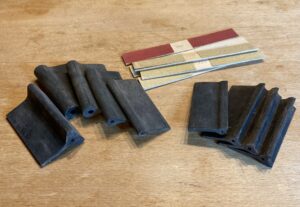
A little sanding help
5/8" tenon cutter........
 |
| pic from the past |
This shaker step stool had been on my A list to do for a bazillion years. I finally made this one (my first) about 11years (?) ago. I gave it daughter #2 and she uses it as a plant stand. That aside what interested me about this pic was the back wall. Not only doesn't it not look like this anymore, the workbench has changed too.
At the back right is where I first kept my drill press. The left side of the workbench has the remnants of a back tool well. I didn't like it and I took out the bottom of it. Kept the rest because it extended the front/back depth for projects.
 |
| what it looks like today |
The wall has exploded over the years as I accumulated toys. It blows my mind when I think of what I had back then and what I have now. I may not use all of them every day, but I do use a good percentage of them daily.
 |
| hmm........ |
When I first took this out of the Simple Green I thought it hadn't worked at all. The body was black but 90% of the japanning was history. There were the obligatory spots in the nooks and crannies that held some stubborn bits still. Overall I was happy with how well the Simple Green worked. I had missed checking it on monday.
 |
| wire brush |
The wire brush work got 99.9% of the remaining japanning. After that I spent seemingly a bazillion years with a file cleaning up the casting boo boos. The only spots I couldn't do were the inside of the vertical flutes.
 |
| done |
Spent the entire AM session getting the cutter to this point. I thought I would have started on the painting but it didn't happen boys and girls. Before I paint this and the adjustable tenon cutter, I will scrub the both of them with acetone first.
There wasn't a PM session. I started getting a wicked headache before lunch and it was full blown before I finished filling my pie hole. I wasn't sure if I could take Tylenol so I didn't. I spent the next 4 hours sitting at my desk with my head in my hands. By 1630 it was gone and hopefully tomorrow I can get started on painting these two cutters.
accidental woodworker
Doing With Intention
 Konrad Sauer and his 911
Recently I was asked to critique a photographer's portfolio, and at some point I learned that all the work was shot on film. I asked the photographer why he shot on film and he said that it was because each shot was a commitment. You have to photograph with intent. The cost of film made each push of a button important and required thought. He didn't get that with digital photography, for which the marginal cost of another picture is zero. This technique helped him focus and make intentional decisions.
I write with a fountain pen. It helps me think. Or maybe more accurately it trains me to think. Ink doesn't erase so I have to approach the page with the intention of getting it right. I need to visualize the words and the spelling and the shape of the letters beforehand. It helps me focus and it trains me to think about my intentions whatever I am doing, including designing tools and making things. I also find the entire process as complicated as it is very satisfying.
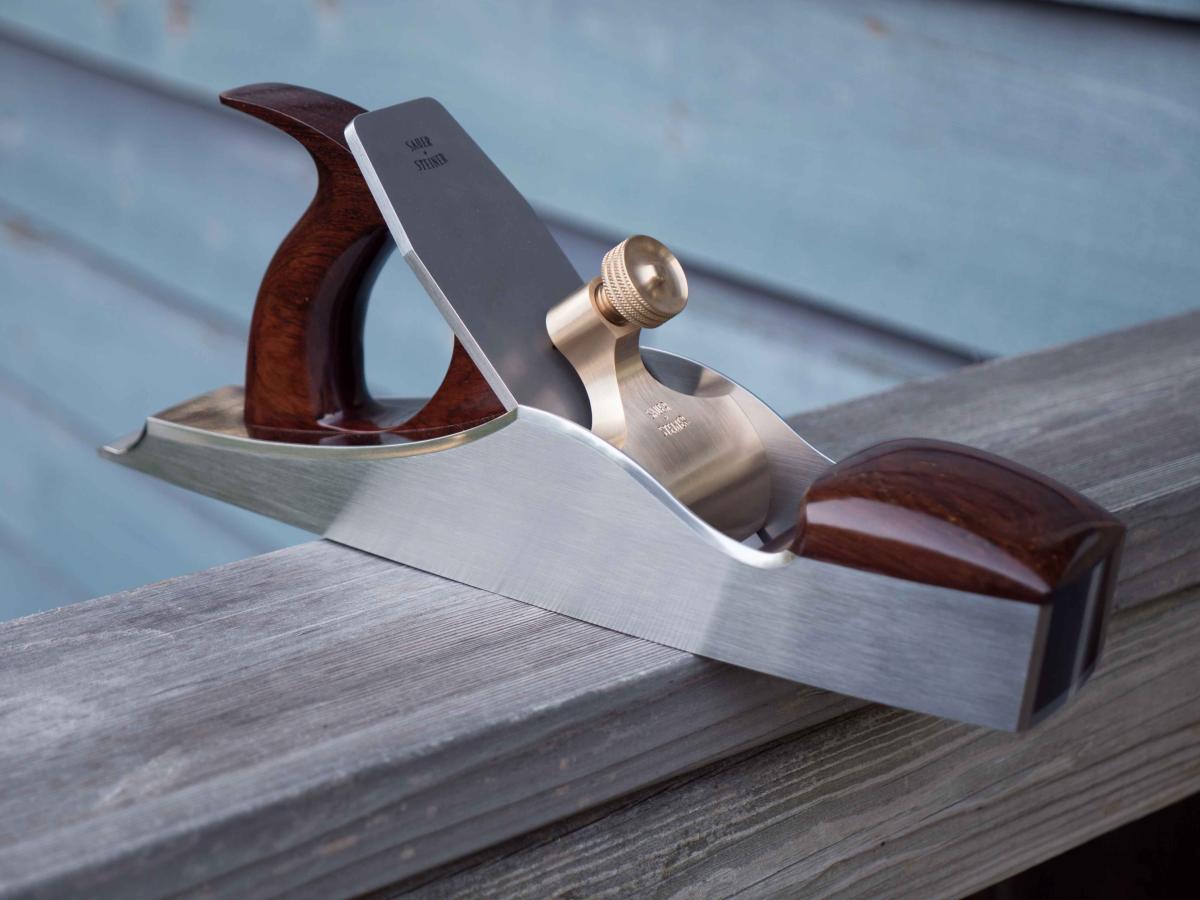
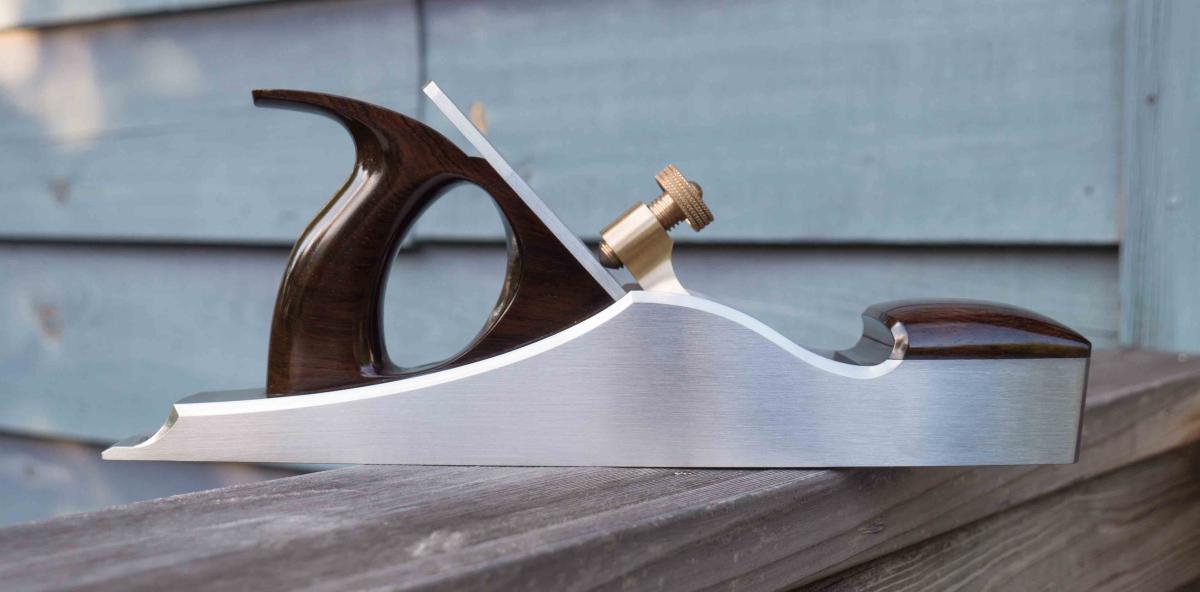
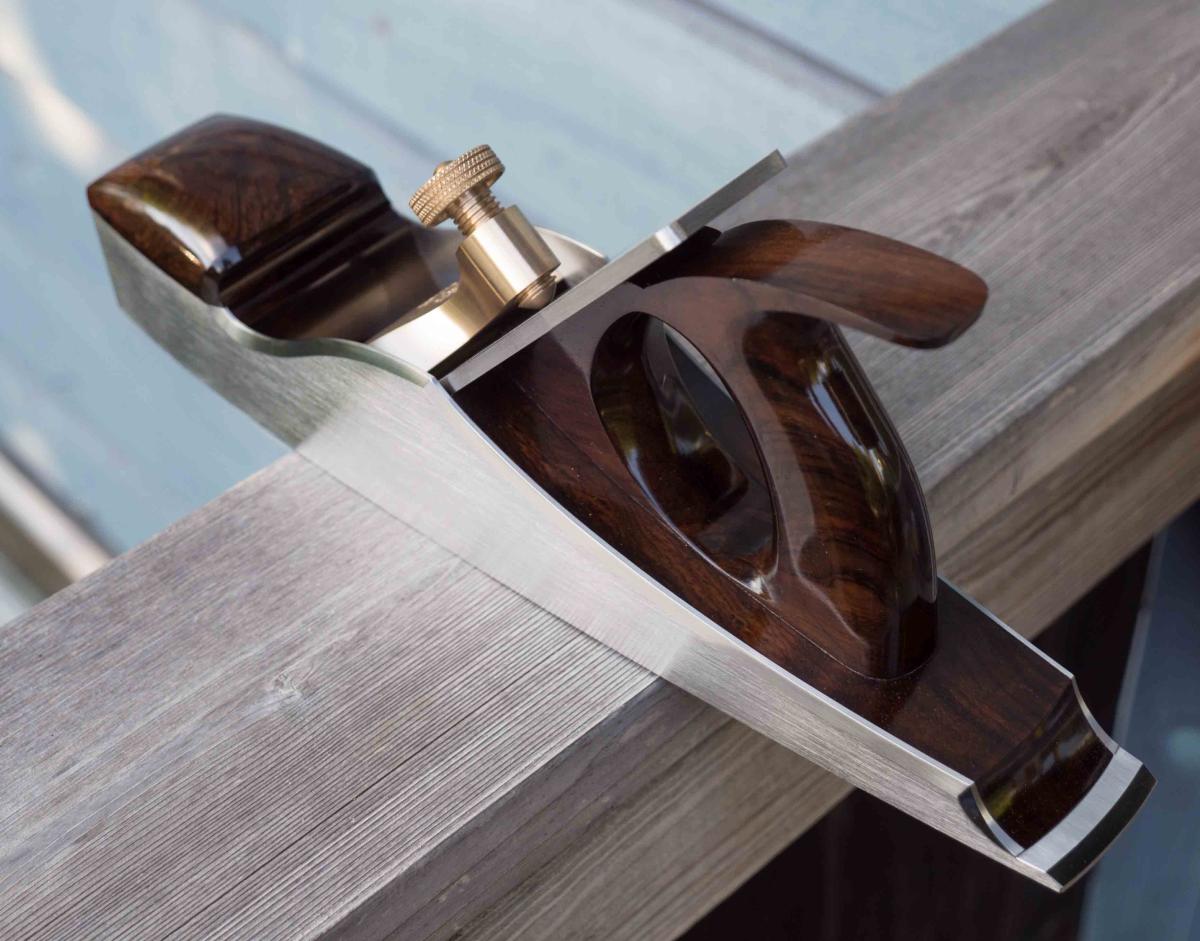
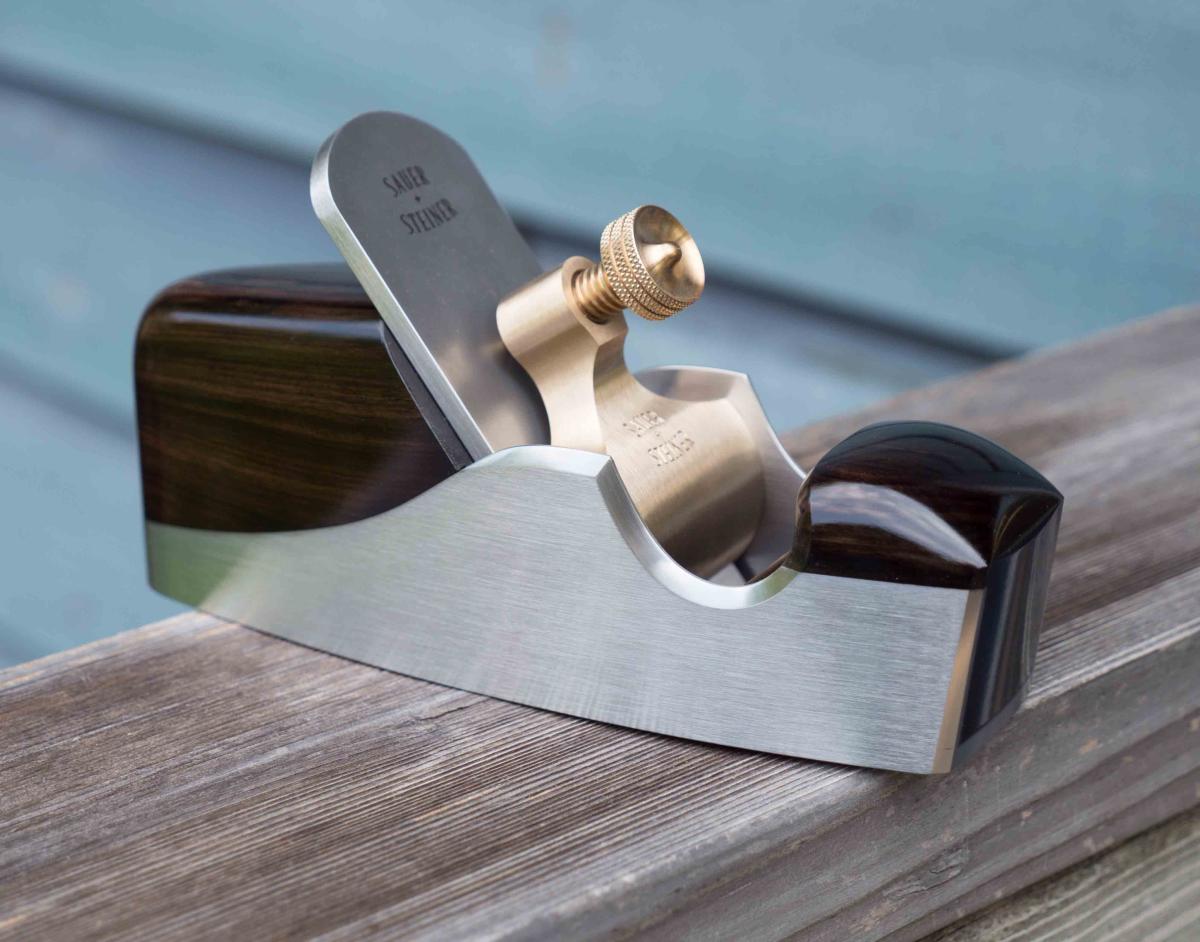
Konrad Sauer, the plane maker, drove to the Handworks show in Amana this year in a 1981 Porsche 911 SC Coupe. This is a choice. It's not a trivial car to drive. Konrad can't put the car in cruise control and sit back. He has to actively listen, feel, and pay attention to the engine, shift gears as appropriate, and generally be a participant in the actual act of going to from place A to place B. This is intentional. The reason Konrad makes this choice is because participating in the physicality of driving this car is fun. But there's more to it. Makers and designers are deeply involved in the work they do. We have to make decisions all the time, about color, shape, function, materials. And the thinking is coupled with hand operations. Thousands of small decisions and movements go into making a single one of Konrad's planes. Practicing working with intention helps make other decisions in all areas easier. And by the same token, designing (in Konrad's own case) a plane with all its decisions is the type of work he likes to do. Driving a manual car is an extension of that fun, just in a different realm.
I think that the process of making decisions coupled with physical action is extremely satisfying to humans and that's the reason Porche 911's, manual cameras, and fountain pens are still popular with a lot of people, especially makers. For me, the constant, instantaneous decisions I have to make when writing in ink (especially as a lefty) help train me and make all the choices and effort I need to exert when typing easier. The process is as important as the result.
This blog post came out of discussion I had with Konrad at Handworks and so I shared a draft with him. He wrote,
"Using manual things, cameras, manual transmission cars, fountain pens, hand tools, they force us to take a deep breath and slow down. The stakes are higher - something could go wrong and something could be ruined - there is more weight behind the activity. It requires careful thought and deliberate action on our part. We are engaged on a different level - it requires that we pay closer attention. There is an element of the workmanship of risk behind it. Developing the skill of being deliberate crosses multiple platforms and areas of interest - they all inform one another and are cumulative. Driving an old manual car helps me use a manual camera which helps me make (and use) handplanes." - Konrad Sauer
Here are some examples of Konrad's work:
Leo's bookcase done........
 |
| hmm....... |
I wasn't expecting this gap to fill in as much as it did with just paint. Made a command decision to see if I could close it up with paint alone. It will be a while before these will make the trip to North Carolina so I can check on it.
 |
| final check |
Used flashlight to cast raking light to highlight any boo boos. Found two on this shelf.
 |
| hmm........ |
The light highlighted them and I could see them without it too. Paint, especially a shiny one, defects pop out like blinking neon lights.
 |
| think I got all of them |
I applied wood putty to 8 spots. I wasn't expecting this because I thought I had steamed all the boo boos out already on this side. I guess the moving around I did with the bookcase wasn't as damage free as I thought.
 |
| done |
A couple of hours later I sanded the spots and slapped another coat of paint on them. Did one final eyeball and flashlight check and I was satisfied that I had not missed any. This was ready to get the back on.
 |
| nails first |
Used 1" brads to nail off the perimeter. If I make another one these I will make the rabbet bigger. The depth was good but the width was a wee bit shy of 5/16". I had to nail the brads angled on the sides due to gaps. If the width was 3/8" I could have nailed them straight.
 |
| screws second |
I put five #6x3/4" FH screws through the back into the back of the three shelves. This really stiffened the bookcase up a lot. I doubt a small block Chevy would make any of the shelves sag.
 |
| only one glamour pic |
Happy with how this came out. It was easier making a 2nd one. If I wasn't feeling so washed out this probably wouldn't have taken me as long as it did -12 days.
 |
| Leo's on the left, Miles's on the right |
They aren't exactly the same and I didn't try to make a clone. At a glance they look to be the same but there are subtle differences. The base cutouts aren't the same and there are small dimensions that you can't see with the eye. Most of them are less then a 1/4".
Another blah day. I had to set the bookcase down 3 times taking it from the shop to the boneyard. The shortness of breath is getting worse. I can longer go up the stairs from the shop without having to stop to catch my breath. It doesn't seem to pop out as I work in the shop. Don't know if I am subconsciously making allowances for that or not. For me the important thing is I can still work in the shop and make things.
accidental woodworker
Tabernacle Frame #291
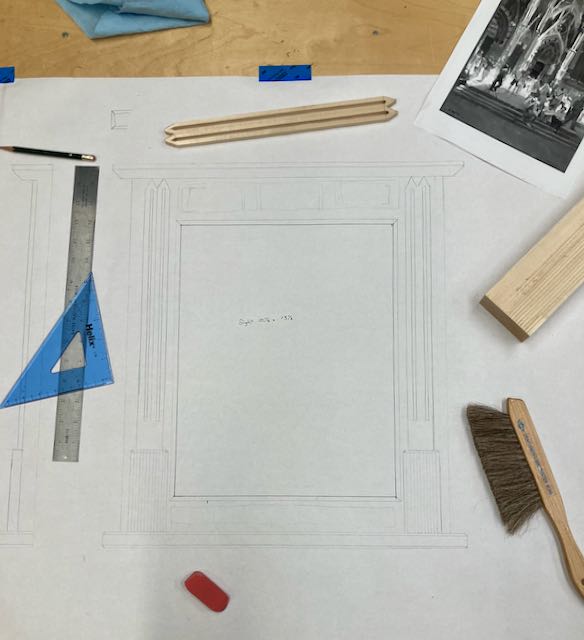
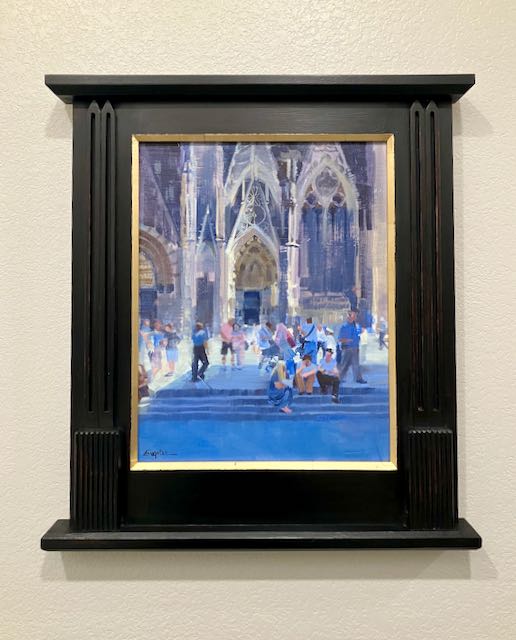
I always enjoy it when I’m commissioned to make a Tabernacle frame, it’s a different twist on frame making and allows a lot of creativity. To really get a sense of how the piece will turn out I like making a full size drawing first, to me that’s much easier than having to scale something like a column that’s 1 1/4″ wide down to fit on a smaller scale. I’m sure that many of you may use computer aided drafting but that’s not in my wheelhouse and honestly I enjoy this process. When I taught drafting as part of middle school woodshop starting in the late 70’s my goal was to have my students be able to conceive something in their mind, transfer it to paper, and then build it with their own hands — that’s an achievement!
This frame is for an 11″ x 14″ panel, the first step was making the main section of the frame using haunched mortise and tenon joinery. Once dry the rabbet and 45° chamfer for the sight edge were cut using router bits. These cuts need to be squared off with chisels in the corners. Next are the top and bottom pieces that are both the same size and are chamfered, first with the router bits and then block planed to remove those inevitable chatter marks routers tend to leave. They are attached to the top and bottom of the frame with glue, screws, and plugged holes.
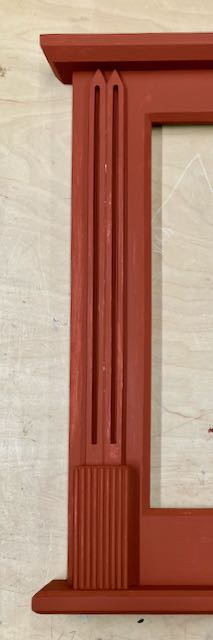
Now comes the creative part, I took inspiration for the columns from the gothic like appearance of the cathedral itself. The columns are 3/16″ thick and about 1 1/4″ wide. After scribing a line down the center a v-chisel was used to create the illusion of 2 columns. The pointed tops were first cut with a coping saw and then pared with a chisel to their final shape. Creating the space between columns was done with a 3/16″ router bit. That was accomplished by setting up stop blocks against the fence to locate the start and stop points of that area. What I’m calling the pillar blocks at the bottom of the columns were made with Lie-Nielsen’s #66 beading tool. They are about 1/2″ in thickness and 4″ tall. The width was determined by the spacing of the beads determined by the cutter. I also cut a bead on the edges. After these blocks were sized and squared I decided they needed a chamfer on the top. This was quick work with a small block plane. These parts are attached to the frame with glue and 23 gauge pins. They leave a slight depression which is concealed with Durham Rock Hard Water putty. This is a product I’ve used for years and always recommend. Unlike other putties this is a powder you mix with water and the advantage is it never dries out in the can. In this small area I used a palette knife to apply the putty. After a light sanding the frame was ready for finishing. I’ve added some pictures below showing the process of making those blocks.
 Creating Pillar Block
 Sizing and Squaring to Fit
 Chamfer on Top Edge
For the finish I begin with Zinsser sealer on all surfaces. After taping off the back of the frame a coat of Dux red burnisher/sealer is applied. This is followed with Ronan Japan paint in Drop Black. These are all brushed on. After the Japan is dry the chamfer on the sight edge is oil gilded and after 24 hours or so lightly burnished (4/0 steel wool) and sealed with wax free shellac. The technique I use to expose the red base coat is to use Liberon wax with a combination of 4/0 steel wool and/or cheesecloth. It’s important to have a few test pieces which I always make; they are finished the exact same way the frame is. Since my shop isn’t climate controlled it’s good to have them to experiment on. Generally I’ll use the steelwool (Liberon oil free) in a circular motion on wider areas and the cheesecloth on smaller ones. It’s a judgement call of where and how much of the base coat I expose. I imagine where the frame may have been handled the most and remove what I think is right. The trickiest areas are sharp edges but if worse comes to worse, a black sharpie is your friend!
Not Mussorgski
It was not the Pictures From An Exhibition but rather pictures from an exhibition of traditional wood finishing as last month I taught another iteration of my class at Joshua Farnsworth’s Wood and Shop classroom. Oddly, three days is barely enough time to scratch the surface of the topic while still changing the students’ mindsets pretty profoundly.
So I present, Pictures From An Exhibition of Historic Wood Finishing, featuring performers (students) from all over North America.


Leo's bookcase pt XII............
 |
| sigh |
I should not have played with this yesterday. I didn't notice this and I thought that the base had twisted. I was wrong and this is way out in left field all by itself.
 |
| opposite end |
This end is seated properly on the side and the front. This is the one I had probably looked at and then wandered out into La La Land.
 |
| not twisted |
This end isn't seated because it isn't fully seated in the rabbet front to back. Fixing this boo boo was way easier then fixing a twisted base.
 |
| almost |
I got two screws from the base into the bottom of the bookcase - the 2nd screw came out all the way through at the front. The front edge of the base was away from the bookcase almost 3/8". I had to use a mallet to drive the front edge up tight to the bookcase. Used clamps to hold the base in the correct position while I drove the screws home.
 |
| hmm...... |
Initially the back didn't fit. The lower right corner was over the edge. I was able to whack the back into the rabbet with my fist. I laid out for the screws going through the back into the back edges of the 3 shelves. I'll screw/nail it off after the base molding is secured.
 |
| doing the base moldings |
I got the two ends secured. Decided to use yellow and super glue to secure them. This way I don't have to fill in any nail heads. I gave the ends a few to set and then started fitting the front molding between the ends.
 |
| small molding shooting board |
This have proven to be a handy thing to have. I sized it specifically for my large LN block planes. Took lot of fit and check dance steps before I got it to fit.
 |
| oops |
I forgot to sand the right miter before painting it. I hadn't trimmed the blow by from planing the miter before gluing it. I'll sand it off before I put on the 2nd coat of paint.
 |
| done |
An hour later I sanded the miter flush and smooth. Happy with how tight both miters (R/L) came out. No gaps but I do have a gap at the top front of the molding between it and the bottom shelf of the bookcase. To me that looks like crap so I'll be filling it it. Instead of wood putty I think I'll use paintable caulk.
Feeling a bit better today. Not as blah and tired but still not more then 85%. Don't know what is next on Ralphie's shop hit parade but I'm sure something will grab my limited attention span.
accidental woodworker
Leo 's bookcase ptXI........
I did not have good day today. The oncology nurse had told me this would happen and today it shook hands with me. It wasn't so much that I felt wrung out hard tired, it was the zero lack of anything. No ambition, no desire other than to exist in space, suck in oxygen and expel carbon dioxide. It is/was a crappy way to feel IMO. I kind of felt this way yesterday but it ramped up today. Needless to say not a lot of shop time. I went down four times and it was mostly because I was doing the laundry.
 |
| 2nd trip to the shop |
Sanded down the dings and holes I filled with putty yesterday. It took way longer to do then it should have. Eventually I got it done and then vacuumed it, the back and the base. Gave up after that and headed upstairs back to my desk chair.
 |
| 4th trip |
On the 3rd trip I rolled on the 2nd topcoat. I was really surprised by how many holidays that were on the bookcase from the first top coat. The back panel and base had much better coverage. I screwed the base on and it is a wee bit rocky. Something I'll have to address later on.
The plan is attach the moldings and paint them. They won't be getting a primer coat. At that time I'll eyeball everything else and do any touch ups as necessary.
 |
| nope |
I lost all interest in getting the moldings done. I will say that I was happy with the fit off the saw. With paint on them they would look flawless but it didn't happen today boys and girls. All I wanted to do here at 1455 was to mold my butt cheeks to my chair. Maybe tomorrow I'll be motivated to finish this bookcase.
accidental woodworker
The Composition of Working

Tools get placed in practical ways that make for easy pickup, instant alignment to task and minimal waste in time. They do everything I ever ask of them and never balk in action. I never abuse them or require anything of them that I don't know they can do. Tools I place wait ready for action. That's the reason I rarely ever put tools away until I'm really done with each of them and that is for the day, half day or two hours. It irritates me when someone says, "So glad to see you work in a mess like us." because that's not the case at all. I don't work like them or every copy the working of others. I'm orderly and disciplined; otherwise I don't work efficiently at all.
 It's two hundred feet long and I doubt without 4mm difference in height or straightness along the whole length.
Though I may well have apprenticed, and I am grateful for all the men taught me in the days when an apprentice served ten men as part of the teaching and learning experience, 98% of my adopted work ethic, methodology and working techniques came from both my parents and especially my mother who was an artisan herself. She too was structured and organised, and I spent many hours at the sewing table working alongside her.
Most of my tricks, jigs, guides and so on originated with me and though some might have been around elsewhere, I worked all the further to improve the methods and invent new ways of working. |This is the way of the craftsman and the crafting artisan. It wasn't about shunning what was there, it was about improvement so that my version matched my expectations. I stopped using shooting boards when I came up with my vertical clamp-in-a-vise version that vastly improves on what was there with ordinary shooting boards for my type of woodworking. It's both a method and a technique.
 My dovetail saw is a third of a millimetre in thickness which is unusual on a push stroke saw and it has 34 teeth to the inch and I can still sharpen it by eye as needed.
No matter which book you read or where you learn of it, my introducing using the router plane for fielding the surfaces of tenons began with my quest to make sure others could get perfect tenons to fit perfect mortise holes. To match that came the vertical mortise guides. Other gurus now use these but give no credit for where they got it. It doesn't altogether matter, but they should give credit, really. There are hundreds of others that go along with my vertical clamp-in-a-vise trimming strategy for end-grain squaring that beats regular shooting boards hands down. What they see as mess is careful placement by choice of kept-out tools I need at the ready for further work. Their mess is often procrastinated tidy up, days and weeks of neglect and not me at all. But they like to think that I give the nod of approval to their lazy neglect. My economy of movement is not their economy of cleanliness and tidiness. That's usually the fruit of an undisciplined work ethic.
This is my bench and it is orderly and functional. Each tool in use is placed for quick pick up and ease of placement every time. That's how a box made from four different woods and with four different dovetails come straight off the saw with chopped chisel work at the bottoms of the recesses. No fiddling or prissy work, just dead in cuts that fit.Everything out on this benchtop at this point in the development of my project is intentional. I do not put tools and equipment away if they are all current to my use and needed within an hour or less for the next point in my work. If I had done all of my plane work, I would put it in its stowing spot at the righthand end of my workbench. It's not clutter, its practical placement and economy of motion.
 It's not just at the end of the day or the end 0f the week that these craftsmen clean up and neaten the worksite. Throughout the day they work cleanly, disallow build up, and they work pleasantly as a team to the same end--a quality product, no question!
The nature of construction work often results in mess and clutter. Four men keep their site clear, as clean as possible and safe and at various points in the day, like my bench, tools get put away, waste is picked up, and the site looks pristine. Today is Friday, though they might or might not work tomorrow, by evening time today the site will express disciplined craftsmen. All four have a remarkable work ethic and high standards of workmanship. I see them every day working away no matter what. When they are finished, I will miss our daily interactions.
 This area will be paved with a permeable block layer that retains rainwater where it falls and does not go into the water network any more.
I watched on and off from the temporary office window today as Mario laid this concrete and steel driveway-to-footpath drain guttering twixt the four new parking spaces and the road. The level, the string line, the digital readout for precise levelling and the concrete mixer were exchanged in his work for four hours. It was truly structured work at the measured pace only a craftsman used to handwork has and I respected the how of how he worked as much as his well-maintained order and self-discipline throughout. When the super tight string line was taken away the site and sight was perfect.
 The four corners to my pencil tray came out about equal. I'll glue up soon, only the bottom to go in. Cherry is a delightful wood to work with and the absolute easiest of all temperate hardwoods to make from bar none. I have no excuse if I make a bad corner joint.
My tools are now stowed. They are sharp and set ready for four more dovetails that must look equal to this one. I saw Sergi closing down for the evening around 5 PM this Friday evening. I commented on how precious it was to see him close up his day the way they always do. He commented back, "We like to make sure everything is in order so that when we start again, we are ready to go and are not looking round for things before we start work again." An orderly work ethic is everything.
 The three-dimensional jigsaw of a new building awaits the final pieces. Doors and windows, and such. Oh, I still have the brick wall to go in on the inside yet.
The last few sheets of plasterboard give me a double skinned sound absorbing feature reducing the transfer of noise in both direction whilst in the garage workshop you see here. We then added a third layer of plasterboard with sound insulating soft foam. It's a luxury, I know, but the air training airport two crow miles away make it necessary, but then I do not want my next-door neighbours to hear the tap-tapping of a chisel hammer when they sit out in the garden. No plasterboard on the ceiling above and the insulation is on top of this beneath the sedum roof covering. Nearly there now.
Smoothing Planes, Which is Better? The Stanley No.3 or the Stanley No.4, Revisited
In 2012, a follower of my blog sent me a question, which size smoothing plane do I like best, the No. 3 or No.4? My answer was the No.3, and if you want to read what else I had to say about those planes, click here to read the post, which has had a good number of hits over this past month.
If I were to get asked that question today, I would answer with one word, “Neither!”
I really enjoyed using those old planes, but as I worked with more visually stunning tonewood, I discovered that I couldn’t really get those planes to step up and create a smoother surface. No matter how I sharpened and tweaked the irons, or flattened the bottoms of those planes, I was always a little disappointed with the results. By the beginning of 2020, I decided to make a change. I purchased a Lie-Nielsen (L-N) No. 62 low angle plane.

Once I sharpened up the iron on that plane and used it on some righteous East Indian rosewood, I knew my time using bevel down hand planes was done. I sold every bevel down plane I owned, I mean every plane, including a Stanley No.5 type 6 that was once owned by my maternal grandfather. The only two bevel down planes I kept were a vintage No.40 scrub plane and an Ibex violin plane.
I ended up buying a toothed iron and several extra irons for the L-N to experiment with cutting angles, all of which I still use for different planing situations, and I bought a Lee Valley Veritas Small Bevel-Up smooth plane. That small bevel up plane is a workhorse for me, with a toothed iron in it I use it for thinning down guitar backs and sides, and with a 55 degree angle on an extra iron its a great smoothing plane for Sitka spruce tops.
A L-N no.9 1/2 and a Violin maker’s plane round out my working planes.
If I were to go back to making furniture and other bits that are based upon squares and rectangles, I would willing spend the time and money to purchase a L-N No.7 1/2 jointer for jointing long boards.
Bevel down planes work well for me.
You should use what works best for you.
Now get out to the shop and make something!
Leo's bookcase pt X........
 |
| oops |
I forgot to tape this off before I put on the primer. Today I sanded and scraped it to bare wood. I need bare wood so I can glue the bottom edge of the molding to it because that and a couple of pin nails is what will secure it.
 |
| slow going |
The chisel is for blobs and drips. Two sanding grits - 120 for problem spots and 320 to sand the primer smooth. It took a while to get this done. I have had to slow down doing things a lot so I don't get short of breath. This is virgin territory for me because I've always gone at things balls to wall until done. Maybe slower is a good thing now?
 |
| hmm...... |
I don't need to buy a container from Wally World after all. This milk carton is big enough for this to soak in. Hopefully I'll remember to do that before I kill the lights.
 |
| how? |
I put on two coats of paint and didn't see this. It is a Miller Dowel that got set a few frog hairs below the surface. As you can see it as visible as a flashing neon sign at night. I'll fill it in with wood putty. That will negate me getting the 2nd top coat on today, maybe. Depends if I trot back down to the shop after dinner and do it.
 |
| mini card scraper |
I was not expecting rolled up paint on the edges because I had used a roller. They are there at every single 90°. Not as bad as brush leaves but still annoying to me. Scraped them all flattening the 90° on both sides. All three pieces - carcass, back, and base - are fully prepped and ready for the 2nd (and last?) topcoat.
 |
| didn't forget |
All of the japanning is covered with Simple Green. This will soak until monday and I'll check it then.
accidental woodworker
Authors from whom I learned the most

blogger is working again..................
I didn't get much done today. I felt blah and spent the day vegging out at my desk. In the AM I finally dragged myself to the shop and got the primer on the bookcase. That is all I got done today and I knew nothing else is happening after dinner.
Feeling like this sucks pond scum. Not really sick but not even close to tip top neither. I also had wave after wave of coughing fits. Most of them I felt like heaving up everything I'd eaten for past 7 months. Hopefully it is one of the side effects from the chemo. I only have one more to endure.
 |
| from yesterday |
Got my 1/8" flat above the top of the molding. I'm using my laptop to write up this blog. So far it is uploading my pics. I think the problem is/was with the interaction between blogger and my Firefox browser.
 |
| #2 from yesterday |
There was only one screw from the back of the back rail into the side bearer holding it in place. I added 2 Miller dowels into the back rail from the sides of the base. This should keep it in place - it won't be subjected to any stress once it is placed.
 |
| #3 from yesterday |
I got this after reading a post about them from Lost Art Press. This is the best glue brush I have used ever. I've had this one for over a year and it is still viable. I bought 12 of them for just in case and I have only shit canned one of them. That was because I didn't clean it after using it. I tried soaking it for several days and nada, had to toss it. (Torrington Brush Works)
 | |
|
Final prep before primer. I ran out of gas and decided to stop here. Primer went on in the AM.
 |
| #5 from yesterday |
5/8" tenon cutter. I thought I had a container big enough to soak this in a Simple Green bath. I don't so I'll make a run to Wally World and find something cheap. I'll paint this at the same time as I do the adjustable tenon cutter. I haven't forgotten about it, it has just been out of sight and out of mind.
 |
| #6 from yesterday - depth stop thing |
I thought I would try it and it kind of works. The depth stop on the 5/8" tenon cutter was MIA when I got it. I set the depth stop from the adjustable tenon cutter for 2" and when I measured from the sole of the cutter it was about 2".
 |
| #7 from yesterday |
It is just a wee bit shy of 2". Not bad for something that was not made for this cutter.
 |
| only pic from today |
I used a roller to put the primer on and a brush to get into the corners. Primer on the carcass, the back panel, and the base will be ready for topcoat in the AM. I'll do the moldings after I get the base secured to the carcass.
I uploaded the the last 3 pics from my desktop tower computer. I wasn't sure if it would work but it did. I had to sign into my google account when I signed into the laptop and I had to accept cookies. It appears that is/was the problem. If the browser doesn't accept cookies from google, google won't upload anything. This SNAFU must of happened on the last Firefox update from a few days ago. Fingers crossed this headache is solved.
accidental woodworker
Clothespin Nirvana
For many years I’ve been a fan of Herrick Kimball and his Planet Whizbang site. He is one of the most inventive guys on the interwebz.
I’ve posted occasionally about my fixation with the utility of clothespins in the shop, employing them for a whole host of uses. I’m always on the lookout for good clothespins and currently have a shoebox full of them on the clamp rack. Since even better ones are cheap, I use and dispose them frequently.

Even Mrs. Barn appreciates a good clothespin as most of our laundry is hung on the line. A while ago I bought her some of Herrick’s clothespins from his Classic American Clothespin website.
Holy cow! They are so different in quality that they are different in kind. I mean, who makes clothespins from kiln-dried ash, and oversized to boot (compare it to a pretty good quality clothespin from Ace hardware.)
Maybe my search for the perfect clothespin is over.
CRAZY EASY way to use a Vintage Dado Plane
Leo's bookcase pt VIII...... & pic frame is done......
 |
| tedious |
This word comes from the Latin word meaning this pisses me off. Setting the depth for the rabbet was annoying and a Royal Pain in the arse. I seemingly seesawed on either side of the correct depth forever. I finally had to quit because I had to go to the VA for my CT scan.
 |
| done |
Got three coats on it - the last one after dinner last night. I was going to bring to the Frame it Shop tomorrow but I did it today. My wife is going to NC sometime after the 22nd. Fingers crossed that Maria will have it done before then so she can bring it with her. I really don't want to pay to ship it.
 |
| still fussing |
I finally said NO MAS and ran the rabbet. It was within a frog hair of the back edge of the shelves.
 |
| support for the router |
Doing the rabbet was easier than I anticipated it being. It was a bit awkward because I had to keep shifting the support. Routing into and away from the shelves was a no brainer. I expected the router to protest and gouge and dig into the back of the shelves but none of the nightmare scenarios I imagined happened.
 |
| last one |
Squared up the corners and the slight rounded bits around the shelf dadoes.
 |
| hmm...... |
This end of the shelf ran high and it was a little over a 16th higher than the rabbet. There was a hump that I had to knock down and the spoke shave was the best choice because it got closest to side.
 |
| hmm...... |
The diagonals were off less than a 16th. Encouraging but remember this tidbit.
 |
| Houston, something is amiss..... |
The top to bottom measurement on the R/L agreed at 41 1/4" but the side to side decided to have a hissy fit. The top was 30 5/8" and the bottom was 30 13/16". Based on the diagonals I expected the rabbets to be the same.
 |
| fixed |
I had let the putty set up for 24hrs before I sanded it. I didn't go nutso on this and I'm leaving it as is. It isn't a perfect match with the molding profile but it doesn't have the big gouge neither. After I sanded it I immediately moved it into the boneyard.
 |
| back fitted |
I only had to make two saw cuts to get the back fitted unlike Miles's where I had to plane it to fit. The fit is gappy, top/bottom and side to side but it covers the rabbet. I will screw the back into the three shelves and nail it along the perimeter.
Well boys and girls blogger has determined for me that this is it for pics. I can not get any pic to upload. Period. Nada. Not even a giggle or an accusatory finger pointed at me. Tried all the tricks I could think of and six hours later I threw the towel.
This is not the first time blogger has thrown a monkey wrench into the gears of posting a blog. Not 100% sure that it is blogger (but 99.9999999999999% sure) or the SD card I'm trying to upload from. It loaded the first 6 and then I fought to get the next four uploads. #11 wasn't happening.
I'll save the pics and see if tomorrow is better and the blogger is behaving. I don't think I've posted a pic free post for 10-11 years?
accidental woodworker
Leo's bookcase pt VII and a pic frame pt IV.........
 |
| hmm...... |
Both sides of the bookcase had some dings and bangs that would pop after the top coat was applied. Happy that the iron steamed out every one of them. I'm slowly getting closer to getting the primer coat on.
 |
| base glued and cooking |
This corner may give me headaches later. I clamped the tails to close gaps and that pulled the corner way out of square. Unclamped it but the squaring jig had some problems. I couldn't square the corner with hand pressure completely but the jig squared it but I had to use four clamps to get it there.
Sawed the cove moldings over length. I'll set them after the base is attached to the bookcase.
 |
| three hours later |
Cleaned up and flushed the tails. The corner I had double clamped wasn't square. I was off about 3-4 degrees. Not a problem as the cove molding is wide enough to cover any gaps.
 |
| last bearer |
Glued and screwed bearers to the front and sides. I set the bearers down from the top of the base 1/8". That should leave about 1/8" flat above the top of the molding against the bottom shelf of the bookcase.
 |
| the back apron of the base |
Went back and forth on whether or not to cut out the back. In the end I did it to help the bookcase setting flat and straight. Easier to sit/level on four small bearing points rather then one 32" long.
 |
| tapered gap |
This is the corner that is off square. If it had been square each side would have had a gap of about a 16th.
 |
| prepping for the rabbet |
I had planned to do the rabbet today but it ain't happening boys and girls. I spent a couple of hours playing in the boneyard making room for Miles's and Leo's bookcases. The rabbet is on the A list for the first thing in the AM. Maybe, I have a MRI at 1030 at the VA that will cut into AM event list.
 |
| sigh |
I measured the back of Leo's bookcase and it will be about 31"x 41". This left over plywood from Miles's bookcase is 32"x 48". I thought this was smaller than that at least on the shortest length. I bought the 4'x8' plywood panel for nothing but it won't go to waste in my shop.
accidental woodworker
Pages
