
Hand Tool Headlines
The Woodworking Blogs Aggregator
“Glory to God in the highest heaven, and on earth peace to those on whom his favor rests.” - Luke 2:14
Norse Woodsmith Blog Feeds
honey can you pt I...........
 |
| almost done |
There were two white holidays on the inside I painted and two dings showing some primer on the outside. It will be a while before I can move this into the boneyard. I haven't gotten around to arranging it.
 |
| leg stock |
Made a me-steak with the 6/4 leg stock. I thought this was long enough to get 8 legs out of it. I also thought that I had bought another 6/4 board but that ain't so boys and girls.
 |
| a wee bit of twist |
The board wasn't rocking on the tablesaw and the eyeball didn't see any twist. I took a couple of the shavings off the high ends and called it done.
 |
| hmm...... |
I got 5 legs out of the 6/4 board. The two outside ones will be the front legs. The two back legs have straight vertical grain on two faces and two faces with cathedral grain. Not that pronounced and they will be the back legs.
 |
| cleaning up |
The tablesaw didn't like ripping this poplar. It stalled and grabbed a couple times when I ripped out each leg. I cleaned up those faces and then did a skim cut on the tablesaw getting all four legs to the same dimension.
 |
| close |
My Olsen miter gauge wouldn't extend the 45" I needed for the legs. I knifed each leg at 45 and cut them on the tablesaw. I will reference everything off of the top of the legs. After it is together I'll even up the legs at the bottom.
 |
| rails |
Got all the rails saw to length and width. I still need one more rail - the top drawer rail. Holding off on that for now. I still need 3 shelves, slats, and a top. When I do them I'll get the drawer rail from those scraps.
 |
| Miller Dowel jig |
 |
| the final look |
In the end after playing with it for a while adding and removing shims, I finally got it. The back is within a frog hair of being flush with the inside of the leg and the opposite face is inset about 3/16".
 |
| hmm...... |
This jig is for setting the depth of the drill bit and I think I finally figured it out. I thought the measurements on the jig were for the dowel length. It ain't so, it is for the drill depth on one side of the dowel joint. It is very easy to confuse me and I could have avoided it if I had read the instructions. Now that I sorted that out I'm trying to decide whether to use 1 1/2" or 2" dowels.
 |
| ready for drilling |
I was going to drill the holes but nixed it. I wasn't feeling 100% so I'll come back to this in the AM.
Day three from my 2nd chemo cocktail and I felt like total crap this morning. I slept throughout the night. I had hit the rack at 2100 and I got up 4 times for the toilet trot races but I was able to fell back asleep right away. It doesn't look like this round of chemo is going to be as nice as round one.
Feeling nauseous sucks pond scum so I finally broke down and took a pill for it. I felt better about an hour later with the nauseous feeling knocked back 98%. I had my friday fish 'n chips and so far I've kept it down without the urge to make an offering to the white porcelain throne. Blah feeling slowly dissipated over the day and by the time I killed the lights I was feeling a wee bit better. Fingers crossed tomorrow will be better.
accidental woodworker
Highland Hardwoods.......
I got on the road a little after 0600, heading north to Highland Hardwoods in New Hampshire. It was a nightmare driving up there. 95 and 495 had several log jams I had to deal with and I don't do good in traffic. Especially so when nothing is moving. The closer I got to New Hampshire it started to thin out but a surprise was waiting for me in NH. They were doing massive construction for several miles on the road to Highland Hardwood. Coming home was much better - no log jams and I sailed through the bazillion mile long construction zone.
 |
| $262 worth of poplar |
I know I have enough for one and I'm going to try and squeeze out two if I can.
 |
| the honey do project |
This is what my wife asked me to make for her. Surprised me to no end that she liked this style. It is definitely something that I like and I like a lot.
 |
| painting done |
On the front no holidays but there are a few spots to do on the back. The front looks good after two coats. It is smooth to the look and touch with no brush marks.
 |
| flipped it |
Back went on next. I screwed it into the backs of shelves and nailed it off around the perimeter. No glue because of the paint.
 |
| last screw |
The back wasn't glued and nailed/screwed. The screws (#6x1") stiffened the bookcase much more than I thought they would. The edges and the top and bottom on the back needed a top coat. I am only putting on one to cover the white primer.
 |
| done |
I have a couple of spots to touch up. Wrestling it off the workbench and getting it upright didn't go smoothly. One down and one more to go. This one is for Leo I think based on the color of the paint. Both of the grandsons have gray dressers but different colors.
 |
| 15" |
I got 3 boards this wide and one 16" wide. All four of them are 5 feet long.
I'll get started on this in the AM. I made some doodles on paper that will guide me. I'll settle on the height, depth, and width as I start cutting the stock to rough dimensions.
Day two from my 2nd chemo cocktail and no side effects so far. I didn't sleep well last night, I had woke up at 0215 and couldn't fall back asleep. I finally nodded out sometime after 0430 and woke up again at 0515. I hope that I sleep like the dead tonight.
Had trouble getting the wood into the truck at Highland Hardwoods. I had to go old man slow because if I tried going at my normal balls to wall speed I got winded. Getting the lumber out of the truck at home and into the cellar took a long time. I get winded and short of breath now more and more when I exert myself even slightly. I had to rest and catch my breath several times. I don't know if that is due to the lung cancer or the ILD. From what I read about ILD that is most likely the culprit.
accidental woodworker
New Class, New Translation

I’ve been having a field day. Last weekend I started researching a long-promised post about pole-late treadles. In the process, I discovered that the internet can translate just about any book. That set me off translating Latin, German, and French books on pole-lathes from the 16th- to 18th-centuries. It takes some effort, but it’s much easier than learning another language. I’m sure an expert human would be better, but it’s pretty good: I compared a human-translated section to my internet version and the gist was mostly the same. You’ll be hearing more about these translations – and pole-lathe treadles – soon.
In the meantime, I’ve decided to book one more class this year from November 16th to 21st, on Curtis Buchanan’s loop back. I’ll be booking more classes for early 2027, including some 18th Century Chairmaking classes. But I’m also overseeing the construction of an addition on my mother’s house to help her age in place; I’m not sure how much time that’s going to take, so I’m posting just this one class for now (I may even need to leave this November class for an hour or two to meet contractors, but if so, I’ll have someone cover for me). More info and registration here.

first bookcase pt X.......
 |
| ready |
I eyeballed the bookcase checking for any holidays and found none. Last night after dinner I had put primer on the molding. This AM I sanded it down with 320 grit, wiped down it down and rolled on the first top coat.
 |
| nope |
Used a roller to apply the top coat and I like the look. No brush marks and the coverage looks smooth. I had to brush some parts - corners and the molded edges of the shelves.
 |
| the left one |
Both frames have the same molded outside edge. The left one I got today and it is just a wee bit larger then the right one. That is the one I made first and ran a bead on the inside of edge. I still don't remember how I made that frame. Pretty sure that I ran the bead before sawing the miters but it is still fuzzy.
 |
| fuzzy looking but done |
Finally got all the of the black scraped off. There are a few scattered spots of black in dings that I can't get out.
 |
| ready for paint |
I got all the screws and loose parts wire brushed. The frame came out better then I thought it would - cast iron doesn't shine up as nicely as brass does. I'll wipe everything down with acetone before I paint it.
 |
| hmm....... |
The plan as of now is to roll on the 2nd coat after dinner. That will have given the bookcase over 8 hours to dry after the first coat.
I got a 'honey can you......' project. I'm going to Highlands Hardwoods in New Hampshire in the AM. I called Koszela lumber and they didn't have all the sizes I needed. My wife likes bland looking wood so I'm making it out of poplar. I need 3/4, 5/4, and 6/4 and only Highland has all three in stock.
accidental woodworker
A Few More New-To-Me Tools
Last post I wrote about buying several tools from the widow of a woodworker who, after several months of grieving, was ready to let go of her husband's tools. On a separate occasion, I got a few more things from her and this post shows them.
 |
| A few more new-to-me items |
I already have a pair of mag goggles (though I can't seem to find them right now), but these had an extra lens that pivots in front of the right eye for extra magnification. This pair does not have a light like my other pair, but it'll be nice to have the extra lens for looking at finer things. It's already helped me get a better view of cutting edges.
I also already have a set of brad point bits, though my set only has 7 bits - 1/8" to 1/2" by 16ths. This new set goes from 1/8" to 1/2" in 64ths, and already it has come in handy when I had to drill a 15/32" hole. The set looks to be in great shape. They had been used, but probably not too much.
 |
| A nice complete set of brad point bits |
I had been looking for a circular (or "compass"? - not sure of the correct term) plane for the last year or two. When I saw this one in the man's collection, I really hoped I could get it.
 |
| Stanley #20 |
 |
| View from above the front portion |
It's a bit grungy and has some issues, but I'll clean it up and get it working. Can't wait to try it out.
Finally, I picked up a book that looked interesting. It's "Shoji and Kumiko Design, Book 1: The Basics", by Desmond King. I had experimented with Kumiko a few years ago and enjoyed it. And I recall seeing King's name when I was researching Kumiko at that time. This book will give me some more information to continue with the techniques.
 |
| Desmond King's Book 1 on Shoji and Kumiko |
That's all for now. I've got some tools to clean up, materials to read, and some woodworking to get to.
In The Showroom and Other News
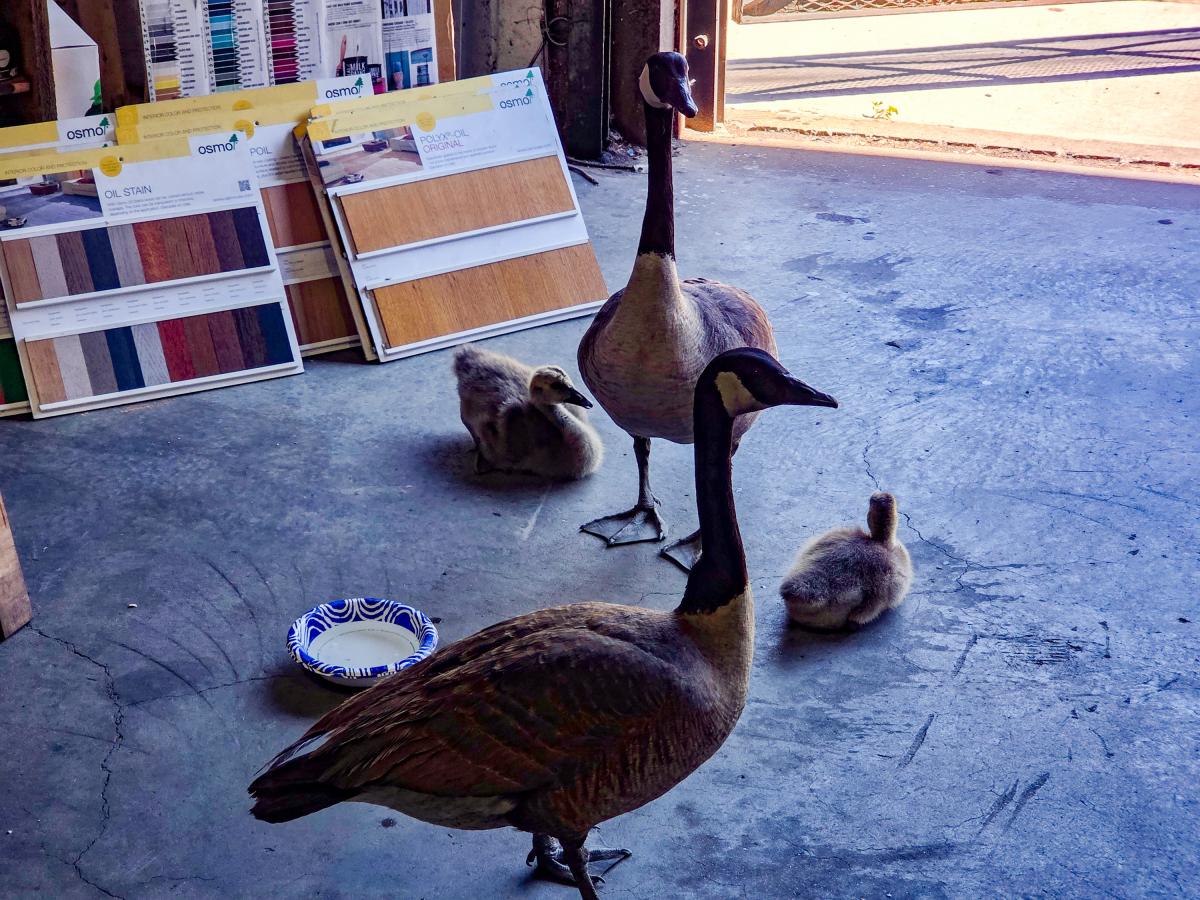
Our showroom barely earns the name - it's just the front part of our warehouse/manufacturing where we have some products on display. But we nevertheless manage to host customers from all over the world, and we're very happy to see them.
Often one of the visitors is driving the visit, with some bored loved ones in tow. We try to suggest local delights that will offset the boring-to-them tool talk. Recently we had visitors from Brazil, Germany, the Dominican Republic and the UK, in addition to states far away from Brooklyn.
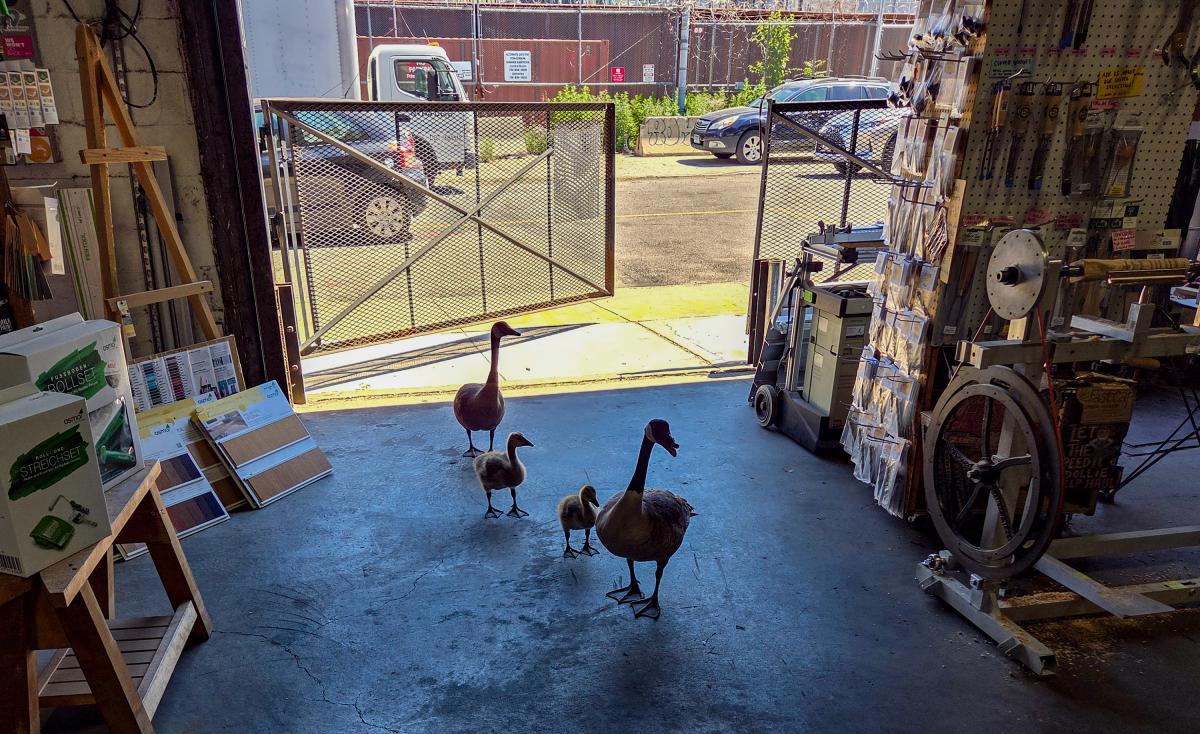
We recently also hosted some local browsers - probably extremely local, as in the river one block away. A family of geese stopped by to check out the shop.
The geese didn't talk much so I don't know their names. It was a family of four, and they really came by to get out of the heat. The father wandered around looking at the tools on the lower shelves. The mom and the two goslings sat down on the cool concrete and rested. They didn't actually buy anything, which isn't a surprise since they didn't seem to have cash, a card or a phone. I suppose having webbed flippers not fingers is a handicap for woodworking. But you didn't hear it from me - I like to be encouraging. Basically they visited to get out of the heat, have some water, and use the bathroom (let's just say their habits here left room for improvement). Just to be safe, we called animal protection to find out if we should do anything special to protect them - we're down the block from an expressway extension with a lot of traffic. Animal Protection said that if the geese didn't seem to be in distress, which they weren't, they would probably wander up and down the block and go back to the river.
Apparently this is what they did, we've seen them several times subsequently. They're I guess staycationing in the city for the summer or at least until the goslings are old enough to fly. Our FedEx driver said he has seen them in other spots in the neighborhood near the river, so there's probably a way for them to get to water. But I don't exactly know where. We have been delighted to see that the goslings have definitely been growing and look pretty healthy. So that's very nice. I know this is a story about retail not woodworking, but one of the best parts about buying things in person whether you're doing it by coming to the store or calling up, is the personal connection we get when we actually meet our customers. Even if they're just plain quackers.
In other news, we are almost finished delivering all the pre-ordered treadle lathes. Delivery has definitely been slower than we would like, because we are having trouble with some of our suppliers. Manufacturing is hard! We will be taking a few lathes to Hand Works in Amana. How many we will bring depends on if we get another shipment of bases from our welder. And we just won't know for at least another week. Either way, we should be able to reopen ordering either just before Amana or just after. (We hope.)
That leaves me right into saying I'm looking forward to seeing a lot of you at Handworks on the first weekend of September. It's the only woodworking show we do, and it's well worth the effort for both us and you. Pretty much the entire hand tool world is there and the admission is free. It's a great, fun, exhausting time for all. The big problem is for me is that I've been to every single Handworks, and because I'm working a booth I have yet to really see the show. But stop on by, say hello, play with the lathe. You will have a great time.
first bookcase pt IX...........
 |
| it fits |
I had my 2nd chemo cocktail this AM but before I left I checked the base and how/if the molding fitted. The base fits well along the front gap free not that it matters much.
 |
| left side |
This gap is tapered going wide at the front to almost nothing at the back. The gap is because of me planing the tails/pins flush. I didn't check or pay any attention to keeping the corner square.
 |
| right side is a little better |
 |
| hmm...... |
Got lucky and planing the top of the base was correct. There is a strong 16th between the top of the molding and the top of the bottom shelf. I would have liked it to have been an 1/8" but this is acceptable.
 |
| I like it |
This is the look of the miter off the saw. I am going with this because it is a paint grade miter and it will look tight and gap free when the paint is on it.
It was 1334 before I made it back to the shop today. The chemo infusion took forever. I got there at 0815 for blood work. I got my premed infusion at 0930 and I left finally at 1220. After filling the pie hole I ambled down to the shop.
 |
| sanded |
I am gluing the molding to the base only. I will nail (pin nails) it to the base and the bottom shelf. That should be more than adequate for securing the molding. Sanded the primer off with 80 grit.
 |
| securing the base |
I went back and forth with putting the base on now or waiting until I painted the bookcase and base separately. Nixed that because I have to apply primer to molding after it is secured. Two of the screws poked through and said hello. Replaced those two with 1 1/4" long ones and filled the errant holes with putty.
 |
| sigh |
I checked the molding dry and it look good to go. I glued and nailed off the front and left side moldings and got a surprise when it came time to do the right one. The front molding ran long about an 1/8". I used a chisel to trim it so the heel was on the outside edge of the side. I didn't chisel it at 45 though. I eyeballed the short leg and checked it - it was way off. I tried several times to adjust the angle by sawing and that wasn't working.
I used a 100 grit sanding stick to getting the mating miter to match. It was easier going then I thought it would be. I eventually got the miter 99% gap free with a minor space at the toe. I filled that in with wood putty. The paint will hide that sin.
I set all the pin nails and filled them in with putty. After dinner I'll go back to the shop and sand them smooth and apply the primer to the molding.
 |
| fixed |
Initially I thought having a gap here at the back wasn't a big deal. But I didn't think the gap would be as big as it is. After seeing it I decided to put a shim in around the middle. The shim is about 9-10" long and roughly centered on the back rail.
 |
| done - ish |
There are few stubborn spots on the interior that are resisting my charms trying to scrape. Overall I'm satisfied with the removal which now showcases a bazillion dings and casting imperfections. No rush on this and I'll get the last of the recalcitrant paint removed.
 |
| hmm...... |
I found another can of red paint and two cans of black. The red had a skim coat that I removed and it looks viable. The red sample I did yesterday is toast - it was still tacky and more so than it should have been given the warm temps and the 24hrs. Can states dry to the touch in 4-6 hours. Tossed it into the shitcan without getting a pic of.
 |
| went 1 for two |
The first can of black had thick skim coat with a small puddle of black paint. Tossed that without giving it a second thought. This can was perfect - no skim coat and the paint looked and felt good when I stirred it. I will try it out painting the tenon maker once all the old paint is history.
accidental woodworker
first bookcase pt VIII..........
 |
| prepped |
Got the base sanded (120 grit) and it is was ready for paint. The tear out I filled with putty felt smooth and flush when I checked it with my finger tips. The bearers/cleats are just screwed on and I will screw up through them to secure the bookcase - no glue there neither.
 |
| hmm....... |
I would have bet a lung that this was flush yesterday. Not so today. I had checked that the top of the back was square to face but it wasn't. Squared that up and that increased the light under the square. Same headache on the other side to deal with.
 |
| fixed |
Initially I was going to use veneer but I had to use 5 pieces to get the height needed. Instead I ripped out a thin piece of pine and planed/sanded it until it was flush with the bearer/cleat.
I am going to use the cove molding from yesterday. I took four shavings off the sides and the front which now I think was the wrong way to go. Having trouble trying to visualize if dropping the base will sink the molding down further against the bottom shelf of the bookcase. I'll find out in the AM.
 |
| step one |
Painting the base is a two stepper. Step one is painting the underside and the inside. Step two, to come, is painting the outside faces of the sides.
 |
| flipped a coin |
Heads I left the back natural and tails I painted it. Tails won.
 |
| one more two stepper |
Got the primer on everything except the two outside vertical faces. I'll do them after the paint has dried for a couple of hours.
 |
| the oops |
Mishandled the router removing it after I had routed the rabbet. It on the back top and it should face a wall unseen. I am not painting the backside of the back panel.
 |
| primer coat done |
I will let this go until the AM. Then I will lightly sand it with 320 grit and apply the top coat. I have zero confidence that one will cover. On a brighter note I did like the primer coat - it laid down smoothly with no visible brush marks. Will I get lucky with the top coat?
 |
| it is working |
The paint is coming off effortlessly with the screwdrivers. I got most of the outside done I would say about 90-95%. The inside is scraping off but it is slow going. Hard to hold it conveniently and scrape. Ideally I like scraping having both hands free.
If I remember hardly anyone is selling pint cans of oil based enamel. I need red and black - my black can had skimmed over and is total crappola. I have a can of red but it is iffy. I slapped some on a scrap to see what it looks like when I check it in the AM.
accidental woodworker
I’ll Be Watching With Great Interest
I actually watch a lot of Japanese woodworking videos and welcome this new tutorial approach. As much as I like the videos in Japanese shops, they are usually in Japanese and mostly without translation. Since I neither read nor speak Japanese this English chyron approach is most welcome. Not that I do much better with English…
first bookcase pt VI.......
 |
| base is done |
Went together off the saw and fit the bottom of the bookcase. Because of the size of the bookcase I increased the height of the base. Raising it up (about a 1/2") makes it easier to access the bottom shelf.
 |
| sigh |
Dinged this up taking it off the workbench. I can't leave this as is because it looks too ugly.
 |
| fixed |
I planed the flat on the front edge and routed the chamfer again. Planed it some more and routed it again. I'm leaving this as it is for now.
 |
| no more |
I could have planed some more and routed the remaining ding on the chamfer. If I had done that the flat would have been thinner then the chamfer. The both of them are about the same now.
 |
| oops |
Got the base back on and I wasn't paying attention. The top of the back rail should have been flush with the top of the bearer/cleat. Instead I made it flush with the top of the base. I secured the ends into the sides with Miller Dowels. I already have the fix rattling around in the brain bucket.
 |
| saw kerfs |
I have to remove/flatten/straighten out about 3/16". Made a bazillion saw kerfs staying just above the pencil layout line.
 |
| working down |
This worked better and quicker than I thought. I didn't have to make this dead nuts straight R/L nor maintain a specific height.
 |
| flush |
This is the only spot, here and on the opposite end, that has to be flush with the bearers/cleats. The bookcase will bear down on the back here.
 |
| hmm....... |
The cove molding is barely a frog hair below the top of the bottom shelf. I had gone to Lowes but the small molding section was as bare as Mother Hubbard's cupboard. I didn't feel like driving to Home Depot but I might make that road trip tomorrow. I don't have a warm and fuzzy about using this molding.
As I was doing this I thought of routing a chamfer on the base. The base fits fairly well on the front and the left side - the right side has a teeny gap. I'm not sure my OCD will allow me to ignore it.
 |
| ouch |
Got some tear out on this side that was so ugly the wood actually cried. It was one of the areas on pine that tears out on every compass point.
 |
| still soaking |
I went searching for my tools from rehabbing planes and nada. I had made several scrapers with sheet rock knife blades and it is them I wanted to use on this. I'm in no hurry and I've been using small blade screwdrivers as scrapers.
accidental woodworker
Priority of machines to get for woodworking (part 5)
What's Not Known
And I am talking about what woodworkers new to woodworking don't know starting out.

I'm not really a hand tool enthusiast, but an enthusiastic maker that works primarily with the hand tools he's worked with for over sixty years and has no plans to change a thing. Why? Because Paul Sellers is good at using them and is considered something of an expert. What many do not know is that I'm just as experienced and competent a machinist as I am with hand tools. I once used machines in my day-to-day business ventures and developed production lines I enjoyed too; these businesses were on a one- or two- to five-man scale. Nothing massive or factorial, just common sense. More important though, and so worth noting and comparing: after my sixty-one years of daily hand tool woodworking, I learn something new about the hand tools, the work methods, and techniques every day. Much more than that, the reality of my working with hand tools means that I know the depth and breadth of the woods I work with far more because of the handwork. You simply cannot get this by machining wood. It doesn't happen because it can't. No one gets the kind of information I speak of as long as a machine is processing the wood in your stead. Once you understand that, you understand you will need to start on the learning journey. You simply cannot gain the diverse experiences from machining wood, and neither can you read about it or look at pictures or videos, etc., to gain such experience. Only hand tool woodworking delivers the goods, and this usually gets dismissed by those from all other camps.
He's hand-cutting one of his first-ever dovetails to the apron of a coffee table. He has cut five in the first part of his course, making a box and an exercise piece. At this point, all four of his dovetails came out perfectly. How would it look if he and the twelve others on the course were wearing gladiator gear to power up their machines to run them through the slalom tines of a dovetail jig? Look at the composition, the alignment of the arms and hands, the focus, the muscled shoulder to power into the cut. And you should have seen his face when he pressed the dovetails home to the gap-free corner he never thought he would ever make!I am never trying to be divisive when I say things like this. The issue for me is anyone drawing a comparison, thinking machining is the same thing, only a more advanced way, when they, in 98% of cases, never actually mastered any one of the hand tools or techniques hand tool woodworkers use. It might not take a lifetime to glean the information I speak of, but it does take repeated working of all the different types of tools and woods because within every tool and every species there are remarkable differences where the wood or the tools affect one another very differently. This exchange means that we , the hand tool woodworkers, engage with our work in radically diverse ways. We rely on what we feel when we plane and saw and chisel. Passing your wood into the jaws of a thickness planer takes zero sensing of any kind. The power feed pulls the wood in and pushes it out for the machinist to catch. Nothing sentient about it. For us, the hand tool worker, woods change within any given distance. You can never gain such intimate detail of character and workability by simply feeding the wood into a cutter head of any type. So there you are. That's the reality that is rarely, if ever, really considered by machine-only makers and advocates. Simply put, you never know the wood by simply pushing it into a machine or pushing the handheld machine types into the wood, and it's this distinction that makes the difference between a machinist and a hand tools maker.
 They came from throughout the USA and even as far as Australia, Mexico, and Canada. Data analysts, programmers, and an eye surgeon who told me his loss of earnings that week cost him $150,000 in loss of earnings to attend. You can see the tool chest and the coffee table they've already made. Missing from the picture are their dovetailed candle box and their wall shelf. This is the last week, and they will make their rocking chair. They didn't use a machine, nothing beyond a drill driver. These men are not manual workers in the day-to-day. Most of them never picked up a bench plane until 15 days ago.
But you see, we want and focus on developing this sentience in our work life. We don't want substitutes for skill; nothing that stands in our stead. We even want the unpredictability of it, like the challenge, and then too the risk of it, and the call to mastery. Without this, woodworking is dull and predictably boring. There is almost nothing to consider without the sensing of the wood through the hand tools we use. Additionally, there are still so many things to consider with the cutting edges delivering information as we work with hand tools. Even in the end results, though they might look identical, possibly, are intrinsically incomparable.
 I mean, look at this. Twelve of them, and they all look the same after 12 days, and this is their third project. College work would take them 2 years to get here, if they ever do, and that's using machines for most of it. Just above the cabinet, you can see the hint of their next project on its way, the Craftsman-style rocking chair made from solid oak–another twelve of them!
And on another tack. Using terms like scary-sharp was a more attention grabbing strapline (tagline USA), like a fun piece of trivia; the man coining the term achieved no more than the ancients had done for centuries before, and salesmen selling equipment use it all the time because it grabs the mind. If tools are not essentially surgically sharp, you might as well just go and use machines where the blades are traded out and sent off for resharpening the carbide tips and cutters. What was accepted for the previous few hundred years still proves the same for us today. In an age when almost everyone has no knowledge of how to sharpen anything, developing a sharp edge to a knife can certainly put you on a pedestal; it was nothing more than a substitute distractional term to entertain. It's the same with micro-bevels and such. They're mostly just cute terms and something to say. Any bevel between 25-30 or even 35º cuts well, and you'll scarcely, if ever, tell the difference with one or two bevels up against one another. Also, I vary my cutting edges for different tasks, and I never ever grind my chisels on any kind of mechanical grinding wheel. The no-grind method of old is the fastest and unfussy methods for non-commercial methods, such as we need at the bench in a few seconds, and it delivers exactly the same level of sharpness and cutting ability.
 Typically, my classes were always filled with men like these. Percentage-wise, maybe 1-2% could occasionally include women, but sadly we never managed to increase this percentage, although we really tried over two decades.
Did you know that despite my still learning about my hand tools and such, the half a dozen machines used predominantly in woodworking take no more than an hour per machine to learn just about everything you need to know about machining wood? And that most of your time will then be spent considering how you must use them as safely as possible. After that, you become a jig and guide maker for each project. Is that really the woodworking you wanted when you started out? For some, that will be the case, and then there are the others. Those who want the high demand of woodworking mastery
 He's a dentist. Dentists make great woodworkers, as do plumbers, psychoanalysts, doctors, solicitors, and truck drivers. We bridged the huge chasm between occupations and brought people together in a knot of new woodworkers.
 I was introduced to a man in a cafe recently. The wife, who I knew, introduced her husband as "a woodworker too." It soon became apparent that he was disdainful about anything unmachined and described himself as a "biscuit addict and a domino fan!" There was an immediate cut-off with glazed-over eyes at the mention of hand tools. I try not to waste my energy on such and switch topics as best I can. Their blindness is not my concern. To do what I do the way that I do it, you have to want it wholeheartedly. You must volunteer into it. There is no substitute, and without that, you will never do it and thereby know any of the gain of it. Running a marathon is never done by bus, and whitewater kayaking demands total concentration. There is no distancing yourself from the cutting edges of hand tools to cut the pins to fit the tails and the mortise to the mortise hole.
 48 mortise and tenons hand-cut and machineless woodworking at its best. Every surface was hand planed by total novices to a glass-smooth level and a level they never believed they could ever achieve. I taught this course as a hands-on effort, but now everyone around the world can follow the same projects following my online teaching.
Getting others off the conveyor belt to adapt, adopt, and end up as truly skilled makers is and will be the ultimate measure of my objective and success. If anyone intersperses their day with the use of machines, I am fine with it, I do not mind at all. I think machines are handy pieces of commercial equipment, but 98% of new and even seasoned woodworkers around the world will never own even a single machine. Think high-rise dwelling, inner-city complexes, social housing piled one on top of the other, and then, simply, the poorer majority of the world. My woodworking style embraces the demanding work of hand tools for a dozen good reasons I am always ready to give. What about better physical and mental health, developing patience and fortitude, mastery in skilled workmanship? There is, of course, much more to it than any of that. How about fulfillment and satisfaction, sharing your space with your young children, an apprentice you are helping to shape, and giving others the hand tools you are using to do their own work with...'off the devices, wood in the vises.'
 I ran the same course in the UK later that year. Another twelve students broke ranks from their usual everyday work to challenge themselves by making a series of high-demand projects. It's quite a remarkable thing to see such a diverse group come together to make but make they did.
My being good with hand tools is not in question, and neither are many of the operations I perform any faster using all machine methods. The only way to really test this is to run everything in parallel, which I don't have time to do. Fact is, machine methods might even be slower, more dangerous, more isolating, and then just plain dull and boring. In my view, most people can gain mastery in hand tool woodworking within a year or two. I have found that a 14" bandsaw makes the heavy cuts in hardwoods like oak easier and less tedious. It's there in the background, taking its small footprint. Not compromising; nice!
first bookcase pt VI...........
 |
| done |
Routed the the top and bottom rabbets without any hiccups. Well one hiccup but it is on the back and won't be seen. Squared up the corners and it was ready for the back.
 |
| Lowes run |
I had to buy a full sheet of 1/4" plywood and they sawed it in half. It was a struggle carrying it out to my truck but I managed. I sawed the back out a wee bit wider and longer then needed. I trimmed/planed it until it fit within the rabbets.
 |
| hmm........ |
Seeing the back fitted is making me wish that I wasn't painting this. I like the 'grain' in this plywood a lot.
 |
| base |
I am only doing a 3 sided base. The back 'side' I'll deal with after the base is glued and cooked. Tails laid out and sawn - the chopping will start in the AM.
 |
| half pins |
Last night I slept through the night without getting up once. Closed the peepers around 1030 and woke up at 0530. I had felt bone weary tired before hitting the rack. Today after lunch I felt the same. I haven't this tired/worn out in a very long time.
Of late I've been getting winded quickly. More frequently now I get out of breath coming up the cellar stairs. Carrying the plywood at Lowes was an eye opening. I have never gotten that out breath carrying a light load for such a short distance.
When I'm working in the shop I don't get winded like I do walking up the stairs. I got a wee bit winded planing the dovetails yesterday but I was able to keep going and finish that job.
Maybe this is the 'bone weary tired' that the oncology nurse said I would experience. I cut short the shop time and spent the rest of the day nodding in/out at my desk. If I'm up to I'll finish the base in the AM and start painting the bookcase.
accidental woodworker
Markus Wasmeier Museum, Schliersee, Bayern


A Few New-To-Me Tools
A friend was asked to help a lady sell off her deceased husband's tools. Apparently the man was into woodworking and so much more and had the tools to show for it. He had been a machine woodworker, but he used and collected hand tools as well.
My friend asked if I might want some of the tools, so I went with him one day. Holy mackerel! There was so much stuff. Over 100 chisels, over 100 planes, many saws and hundreds of bits and bobs of every sort. It has taken him weeks to gather and sort all the stuff. This is a bigger job that he imagined.
 |
| A sampling of the chisels (and some other nice things) |
 |
| Planes organized - and he found more planes after this! |
In the picture of the chisels above, if you look closely you can see a Lie-Nielsen shooting plane and at least one other L-N plane. Most of his things weren't old and collectible, but very useable.
I've grabbed a few things, and besides one item, I've paid a fair price for them - there were no bargain basement prices here. The proceeds will go to the widow, so I feel good about that.
Here's the first group of things I got. I'll show a few pics here, and hopefully later I'll post about cleaning/fixing them up and write in much more detail about each item.
 |
| Grinder, 5 planes, and an auger bit box |
Unfortunately the auger bit box did not have a set of bits in it. The box had been altered for some other purpose so only the bottom tier had the fitted semicircular grooves that keep bits safe.
 |
| Russell Jennings auger bit box |
I'm guessing the handle was added at some point - I've not seen a handle on these before. And one screw for the handle went through to the inside of the lid. If there were bits inside, I'd be worried that holding it by the handle would result in disaster if a tier clasp came undone.
Next up was a 3/4" rabbet plane, looking in very good condition. It's a Sandusky and appears to have the number "716" stamped on the toe.
 |
| Sandusky Tool Co. rabbet plane |
Then there was a pair of hollow and round planes by R. W. Hendrickson at 65 1/2 Bowery (presumably a New York City address). Both had the number "10" stamped on the heel.
 |
| H&R pair |
 |
| R. W. Hendrickson 3/4" hollow and round |
The round plane iron is right on 3/4" wide, but the hollow iron is a little more than 1/32" oversized.
The shorter of the two bench planes is a 16" jack by the New York Tool Co. It's got a "12" stamped on the toe. The body is in very good shape. The Auburn Tool Co. iron and cap-iron look good, but I'm sure I'll have to do some work to get them working right.
 |
| 16" long jack plane from New York Tool Co. |
The last plane is this 22" fore plane from an unknown maker. I could not find any identifying marks on the toe. There are several owner marks "AC" stamped on the plane, and "A BYRON COOPER" behind the tote. On the heel is stamped "2 1/2", and that's the iron's width. There is another A BYRON COOPER stamped on the heel, so I'm guessing that's the owner's full name for the "AC" mark.
 |
| 22" fore plane |
 |
| The heel stamps |
I can barely make out a "SORBY" mark on the iron. Can't wait to get this one into working order. The plane is from a dense wood - it seems quite heavy for its size.
Last on the list for this post is a hand crank grinder by The Carborundum Co. of Niagara Falls. Not sure what to make of the different numbers on the decal: NIAGARA NO. 2, and MODEL NO. 70. Is it a #2 or a #70? Regardless, this grinder works so smoothly that I couldn't resist. I paid a lot for this one - hopefully the quality will have been worth it.
 |
| The grinder needs a bit of clean-up, but already works great |
 |
| The logo |
That's is for now. I have a few more tools that I picked up, but I'll post about them separately.
New Model Mandolin: 8
My "New Model" mandolin (as I'm currently calling it) has now been completed. I'm incredibly happy with the final outcome and looking forward to building the next one! Here is the last video in the series and below that a whole batch of photos for you.
Cheers Gary


first bookcase pt V...........
 |
| first blurry pic |
The dial slipped off the auto setting and a few pics came out blurry. Any ways, I behaved and I let the spacer cook overnight. I resisted the urge to play with last night after dinner.
 |
| hmm....... |
The plan was to use this screwed up shelf to give up a couple of dividers. I had doodled placing them on paper last night and gave up on it. The design and placement of the dividers was asymmetrical but I couldn't find something that I liked. I tried one divider, then 2, ending with 6. Didn't like any of them and the shelves will remain open and clear R/L.
 |
| lucked out |
I planed a profile on the edge of the screwed up shelf. I wanted to see how far inboard the profile ran. The outside edge of it was forward of the end of the notch. I didn't want the profile to be at or behind that notch.
 |
| done |
Molded the profile, and then I sanded it, both sides, with 120 grit. These are ready to glue in.
 |
| #4 and #3 |
I flushed the tails/pins on the outside faces with the #4 & #3 planes. The sides there needed to be flush because I will be putting a quarter round molding against it. Before flipping it I hand sanded it with 80 grit (to remove pencil marks) followed with 120 grit in my RO sander.
I will sand the bookcase up to 120 before painting it. I will also be applying a primer coat. I want to see how the wood sanded to 120 helps/hinders the top coats. I have given up on one coat coverage so I know I will be doing a primer coat followed by at least two top coats.
 |
| hmm....... |
Dry fitted the back stop thing. This is the 2nd fitting, the first one was too tall. This one is an 1 1/8" tall and 32" R/L. I can glue this on without it interfering with routing the rabbet.
 |
| choices made |
I rounded the top corners but the first choice was a 22.5° but I nixed that. Instead I routed a 3/8" round over - only on the front edge. I left the back squared off.
 |
| glued and cooking |
I got this glued and cooking around 1030. I let it cook and set until after I got back to barn after filling the pie hole with fish 'n chips.
 |
| Miller Dowels |
These dowels are for 1/2" stock but the larger ones for 3/4" stock don't leave much wiggle room. They have to be dead nuts on the center line. I have used these smaller ones for years now without any hiccups or failures. Used 3 per shelf on both ends.
 |
| done |
Back stop thing is glued, clamped and cooking. It was slightly cupped but I was able to align it easily with the back edge of the bookcase. Routed a chamfer on the front and the two sides.
 |
| the base |
The base will be 4 1/2" high. The two smaller pieces are the cleats that I will screw on the inside of the base and then screw through them to secure the bookcase on them.
 |
| hmm....... |
The whole bookcase (except the base) had been sanded. Used the wood putty to fill in the gaps from the pins, the chip blowouts, and the bazillion dings. I may have to do another application in the AM when I check this.
Almost done with bookcase #1. I'll make the base in the AM and start applying primer to the bookcase. The topcoat will be the same color as the dressers I made for Miles and Leo.
The past few days have turned miserable again. High temps and high humidity. The shop was bearably tolerable and keeping the fan blowing on me helped a lot. Don't know when this will break but it is about normal for this time of the year in New England.
accidental woodworker
How to Flatten a Wooden Hand Plane Sole
Part 5B: Making Your Own Reamers (2)
This video is part 5b of a 6 part course: Gearing Up For Chair Making: Pt 5b DOWNLOAD THE DRAWING TO BUILD YOUR OWN: METRIC | IMPERIAL Follow on YouTube My goal for this course is to equip you with the knowledge and tools to design & build your own chairs from scratch.Once this is […]
The post Part 5B: Making Your Own Reamers (2) appeared first on The English Woodworker.
Cootville
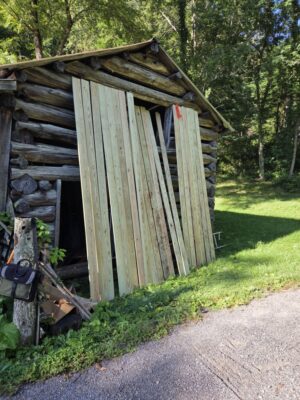
Not only was a substantial portion of the inventory worthless, it was all soaking wet. I had to change my shirt after loading my struck. I wound up standing it outside for five days to get it somewhat dry.
My name is Don, and I’m an old coot.
Last week Mrs. Barn and I took one of our occasional trips to the big city, in part for me to restock some routine building supplies. It had been a very long time since I bought much in the building materials realm as I had really stocked up while constructing the barn almost two decades ago. Slowly over time that inventory had dwindled down and it was time to do a little restocking. Plus, replacing some decking was on the autumn agenda.
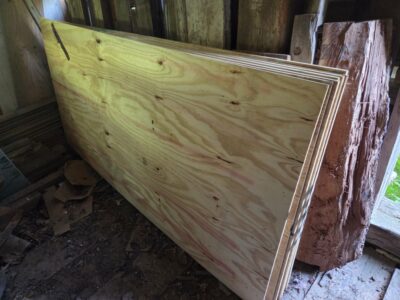
The sticker shock almost put me into a wallet-coma. Some CDX plywood, nothing special to say the very least. Enough decking to refurbish an 8’x12′ deck with some left over (even disregarding the need to sort through the pile since about a third of it was useless). Checkout was well on its way to ONE THOUSAND DOLLARS. To say that I was ranting all the way home like a curmudgeonly old coot vastly underemphasizes the pungence of my rhetoric. Not only do they not call material what it is, they tripled the prices since I last bought stuff. $60 for a 3/4″ sheet of CDX plywood? $14 for a 12-foot piece of PT/SYP decking? Insanity.
It would be easy enough to condemn the lumber stores and the lumber markets, but markets just do what markets do. Their moral duty is to maximize legal profits on behalf of their shareholders.
The real crisis is inflation, a crisis I do not believe we has a culture have the knowledge, wisdom, or courage to address.
It would be easy enough to blame the bankers, especially The Fed. But even though they are integral to the crisis, the central bankers are only doing what the legislative, executive, and judicial politicians are instructing them to do.
Even though they are misanthropes integral to the crisis, the spineless weasel elected politicians are only doing what the electorate is instructing them to do; spend money on us that we do not have. When legislators and executives spend money they do not have, in order to purchase votes they need as they need food, water, and air, there are only two “solutions.” 1) raise tax revenues to cover the expenditures, or 2) create/borrow phony baloney money to do the deed.
The limits to the first are well established as history has revealed an almost iron-clad truth: governments can only extract about 23% of the economy in taxes regardless of the taxation scheme. Hence the drive towards totalitarian collectivism, a/k/a abolition of an economy.
As for the creation of phony baloney money, also known as fiat currency, the only limit is political. The blame for inflation comes down to us, the electorate. In the aggregate we demand the gubmint give us stuff we cannot afford and cannot be paid for. So they do the “rational” thing, they create money out of ones and zeroes and fractional reserves, reducing the worth of the money in existence. Intrinsic prices are not rising, it’s the value of the money that is falling. That has always been and always will be the proximate cause.
Until we in the electorate tell them to stop spending money on us (yeah that’s gonna happen) the inflation locomotive will be picking up steam as it charges down the tracks, the engineers unaware that the bridge up ahead is collapsed (if it has not yet occurred, servicing the debt will soon be the largest component of the Federal budget). And collapse is the only possible end point. Get ready for it. I do not know the current score in the game nor do I know how much time is left on the clock. But I know the end result.
So Don, are you saying you are smarter than all the smart guys in Washington?
Yup.
But then I live in Cootville and the perspective is not in sync with the outside world. As CS Lewis said, “Reality is a ruthless instructor. It does not care whether you agree with it or not.”
Pages
