
Hand Tool Headlines
The Woodworking Blogs Aggregator
“Glory to God in the highest heaven, and on earth peace to those on whom his favor rests.” - Luke 2:14
Be sure to visit the Hand Tool Headlines section - scores of my favorite woodworking blogs in one place.
The Barn on White Run

Boullework Marquetry (!) Class 2027
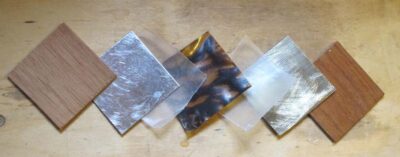
The “stack” we will be sawing into elegant patterns: plywood or mat-board outer sheets, pewter and brass sheet, waxed paper, and “tordonshell.”
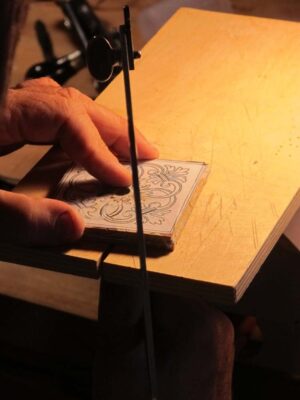
I am very pleased to confirm that Joshua Farnsworth over at Wood and Shop has scheduled my Boullework Marquetry class for this upcoming year. I’ve been working on persuading him for some time, this one is pretty far outside the comfort zone for the school, so I urge you to support us in this listing.
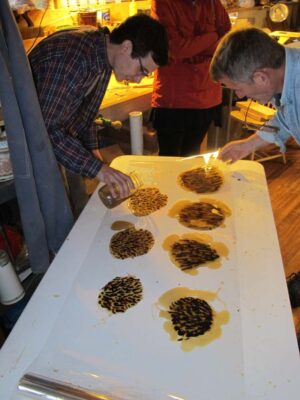
We’ll be making some of my own invention, “tordonshell.” I’ll have pre-made shell for everyone to use in the class; this is for the students to take home.
I look forward to seeing you in Earlysville VA, September 20-22, 2027.
Woodworking Class: Boulle Work Marquetry with Don Williams (3 Days)
Unwanted Harvest
For the past few weeks we’ve been afflicted by the nuisance of being bombarded by thousands of two-inch ball bearings cascading down into the yard. You might call these ball bearings “black walnuts” but we just view them as hazards of the yard and hillside to be navigated around.
Neither of us like eating black walnuts so we see nothing beneficial in their presence. In addition, many of Mrs. Barn’s plants, especially in the vegetable garden, are harmed by the toxic juglone in walnuts, walnut leaves, and walnut sap. She’s had to reconfigure the garden continuously to accommodate the magnificent trees growing just outside the west end of the fenced area.

Bombing season is drawing to a close so I will rake up the trash-can-full of these dangerous nuisances in the coming days. If only we had a better breed of squirrels to haul them all away. We’ve got gigantic squirrels here (seriously, almost as big as the cat) but the bums are too lazy to bother with our needs and clean up the yard.
Harvest

With days getting shorter and nights getting cooler, the forecast for a few days of below-freezing nights had us diligently wrapping up the squash harvest. This is about 2/3 of the haul, I just forgot to take the last “all done” picture. Winter is a time of heavy soup and stew lunches, and one of my absolute favorites is her squash soup made with fresh raw milk and heavy cream. No need for dessert with that on the table.
.
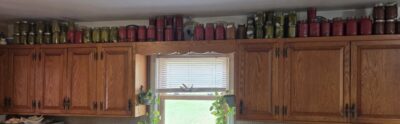
Combined with Mrs. Barn’s relentless earlier harvesting and canning, we are just about wrapped up for the season. There are a few more tomatoes in the greenhouse but we do not know their ultimate disposition.
Boondock Sunrise (?)
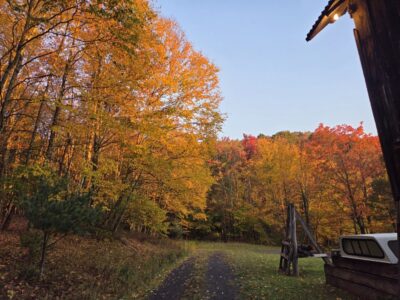
When you live in heavily wooded hills like Shangri-la, the term “sunrise” can have different meanings. In the case of today’s post, it is the time when actual sunshine strikes the surroundings, or somewhere between 9AM and noon.
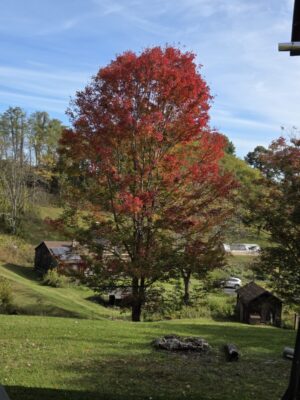
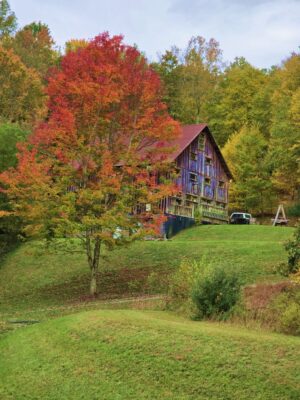
This tree exploded in chromatic brilliance once the sun was on it. Last week’s pic was from a grim, grey day that was followed that night with four inches of rain.
My oldest picture (very distant and blurry) of this tree was from 25 years ago and it was a sapling probably the size of my wrist. Now the trunk is the size of my waist.
Presenting Gragg at Winterthur
Every Spring, Winterthur Museum hosts a Furniture Symposium, and I have been invited (again). I will present a demonstration on the making of Gragg’s Elastic Chairs during this year’s event, April 23&24, 2027. (I say “again” because I was invited to present five years ago but was then disinvited when I declined to comply with their Fauci Flu protocols.)
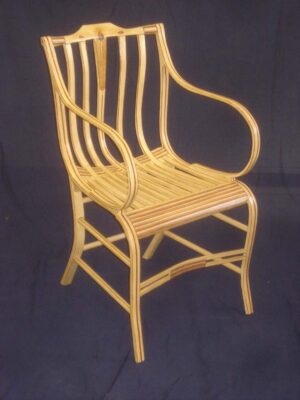
I think my presentation/demonstration will be about 75-90(?) minutes, which should be quite the adventure. You can follow the event developments at winterthur.org. Just go to the “Calendar” page.
I hope to see you there.
Once I get my teaching and presentation schedule finalized for 2027 I will post it here.
A Different Way of Thinking, Doing, Being
This video had been sitting in my “to watch” queue for a while, and once I watched it I was delighted I did. (this channel has more than a little whiff of hypercomputationality about it, a/k/a artificial “intelligence,” but the content is pretty darn interesting)
It brought to mind a couple unrelated items.
The first was the reminder this excerpt from the apostle Paul’s letter to the Philippians:
Finally, brethren, whatsoever things are true, whatsoever things are honest, whatsoever things are just, whatsoever things are pure, whatsoever things are lovely, whatsoever things are of good report; if there be any virtue, and if there be any praise, think on these things.
Then came the memory of me teaching bench skills to an intern. I demonstrated making a dovetail and left her to execute the same exercise from start to finish. After almost an hour-and-a-half, she came into my space and was clearly exasperated. She had cut several dovetail sets, none of them worth anything other than kindling. She asked me to show her the complete process again, and that was when she got really angry.
“I’ve been working on these forever and you just come in and do it in fifteen minutes,” she fumed.
“Not exactly,” I replied. “I did it in thirty years and fifteen minutes.”
After watching this video, I understand why I prefer to start out my day sweeping the floor. It’s what gets me going.
Just don’t ask me to work sitting cross-legged on the floor.
Gerrymandering
One component of my activities organizing and streamlining barn/shop space and function this year has been taking a page from the American political handbook, wherein electoral district has been reconfigured to render a permanent advantage. This process is known as Gerrymandering in honor of it first practitioner, early 19th Century Boston politician Eldrige Gerry. Ostensibly this practice has been attributed to partisan advantage, but in practice it has mostly been used to protect incumbents. (Actually, only one Party has this strategy figured out and the other is just spinning on its thumb.)
In my case the spatial reorganization has been centered on the question, “How often did I use this particular tool or supply?” If the answer was, “Not in several years,” the item(s) got moved from a place of relatively easy access into deep(er) storage.
Given the termination of workshop activities here, thus no longer needing classroom or dormitory space, I have plenty of available space to use for storage and archiving. Lots of stuff has been relocated to reflect more current usage.
One instance of that was removing the leather, mother-of-pearl, and veneer inventories in the giant map case in my main shop workspace. I had already reconfigured the top of the cabinet quite a while ago to serve as the location for processing beeswax and shellac wax, and the occasional batch of Mel’s Wax. The leather inventory consumed four drawers, the MOP four drawers, and the special veneers three drawers.
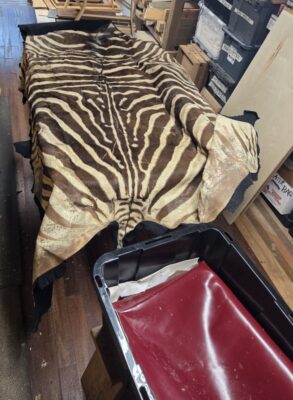
The mother -of-pearl went into two large storage bins now located on the shelves now ringing the former classroom. The specialty veneers went underneath a rolling worktable that is moved to wherever it is needed (I have a giant stash of walnut and cherry veneers up in the former dorm space), and the leather went into two giant storage bins and a large plastic trash can now relocated on top of that veneer stash.
Seriously, what in the work was I doing with a complete buffalo hide and a zebra skin rug? And a big pile of elephant hide?
Who knows.
The map case was about 90% empty, available for a large inventory of different tools that had previously occupied a nearby cabinet.
Gerrymandering, my friends. Gerrymandering.
One Last Rodeo – Handworks 2026
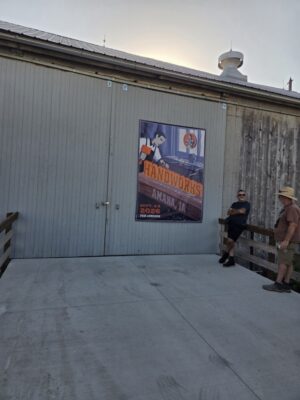
In what will almost certainly be my last long trip unrelated to family matters, Mrs. Barn and I hit the road for a Labor Day weekend toolapalooza in Amana, Iowa, for the fifth (?) convening of Handworks, a mondo gathering of hand woodworking enthusiasts. The trip was very long, two full days of driving each way (I took a full-to-the-brim truckload) and even though the gathering of several thousand friends old and new is a delight, it is just too much for us. Part of the problem is that Mrs. Barn’s CR-V is excruciating for me to ride or drive; it was not made for linebacker-sized folks. My large pickup is a perfect fit but Mrs. Barn hates driving it. Oh well. I still get many invitations to travel to speak and teach but at this point I decline them all. The Wood and Shop school fits my needs just perfectly as it is two hours away from Shangri-la. That I can do easily. Two days each way? Not so much.
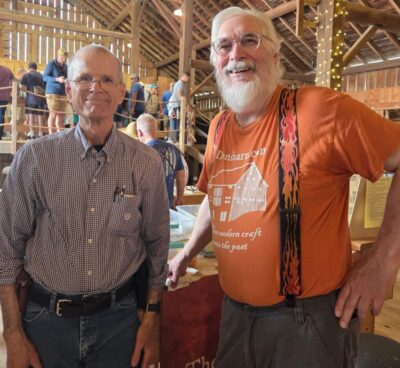
We were joined by dear friends Mr. and Mrs. Ripplin’ John.
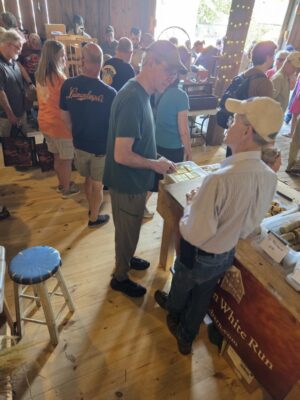
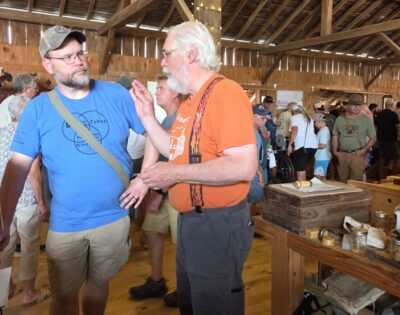
John was with me side by side throughout the event as multitudes of folks wanted to ask about historical wood finishing and we were delighted to explain and demonstrate. While we were doing that the Misseses were out and about doing gal-pal stuff.
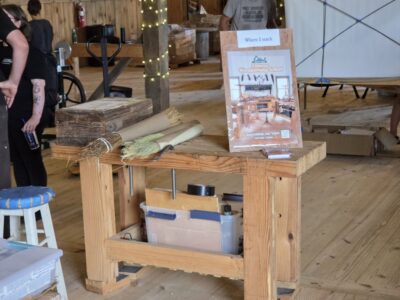
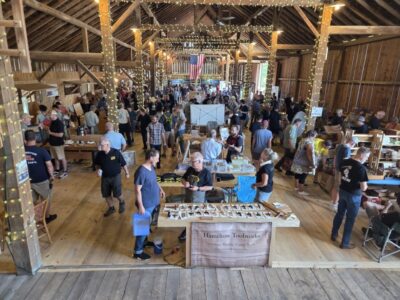
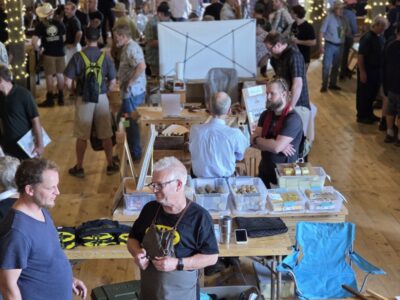
We were among the first to set up, near the center of the giant Festhalle. I brought two of my smaller workbenches to use as display and demonstration space. Soon the place was filled with enthusiasts of every stripe. I was glad to see that the demographics of the attendees was becoming broader and especially younger. It gave me hope for the future of the skill set.
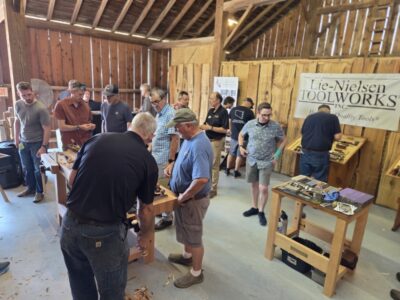
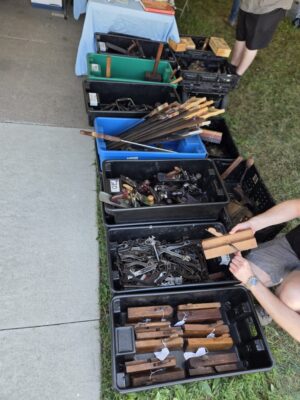
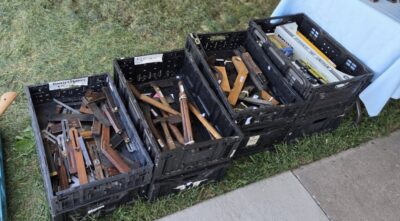
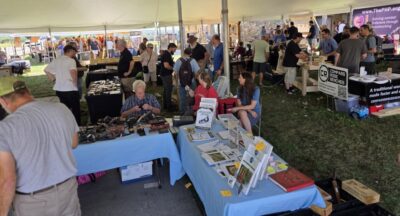
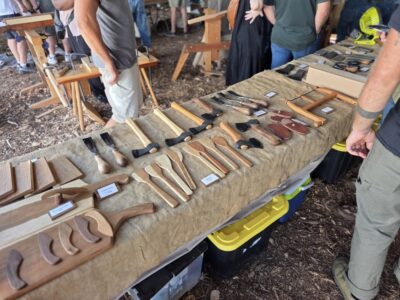
The Festhalle was only one of many venues for the event, I think the total this time was seven. They were all filled with a bajillion tools, old and new. I only managed to get pictures of about 10% of the goings-on.
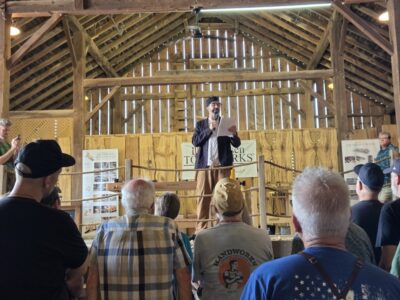
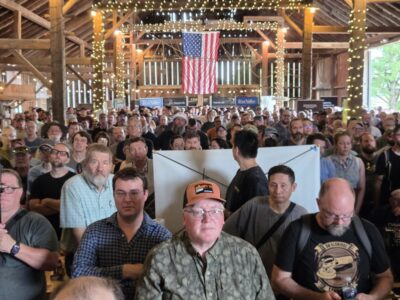
On the second morning the packed house was regaled first with a stirring rendition of The Star Spangled Banner magnificently presented by Mike Siemsen followed by a recitation by Chris Schwarz of some old-codger-ish correspondence between a Welsh Stick Chair maker and an American host regarding some workshops. Very entertaining stuff.
One final note is a comment on the weather, which was a stark counterpoint to the first Handworks. At Handworks 1 the weather was absolutely frigid, a very cold and rainy Memorial Day weekend fifteen years ago. This year the air in central Iowa was stifling, temps in the mid 90s with a choking level of humidity. With every handshake, two hands stuck together. They day after the event was much cooler. Oh well.
Latest Conversation
My most recent conversation with long-time friend, broadcaster Brian Wilson, is now posted on his Substack, Brian Wilson Writes. If pungent conversation about the state of the culture it might not be for you.
Not Mussorgski
It was not the Pictures From An Exhibition but rather pictures from an exhibition of traditional wood finishing as last month I taught another iteration of my class at Joshua Farnsworth’s Wood and Shop classroom. Oddly, three days is barely enough time to scratch the surface of the topic while still changing the students’ mindsets pretty profoundly.
So I present, Pictures From An Exhibition of Historic Wood Finishing, featuring performers (students) from all over North America.


Clothespin Nirvana
For many years I’ve been a fan of Herrick Kimball and his Planet Whizbang site. He is one of the most inventive guys on the interwebz.
I’ve posted occasionally about my fixation with the utility of clothespins in the shop, employing them for a whole host of uses. I’m always on the lookout for good clothespins and currently have a shoebox full of them on the clamp rack. Since even better ones are cheap, I use and dispose them frequently.

Even Mrs. Barn appreciates a good clothespin as most of our laundry is hung on the line. A while ago I bought her some of Herrick’s clothespins from his Classic American Clothespin website.
Holy cow! They are so different in quality that they are different in kind. I mean, who makes clothespins from kiln-dried ash, and oversized to boot (compare it to a pretty good quality clothespin from Ace hardware.)
Maybe my search for the perfect clothespin is over.
Rasslin’ A Super Slinky
Last week my brother and I laid the new 2″ HDPE penstock (pipe) for my microhydroturbine system to power the barn (and the cabin if necessary). Last winter absolutely trashed the existing pipeline of Schedule 40 PVC.

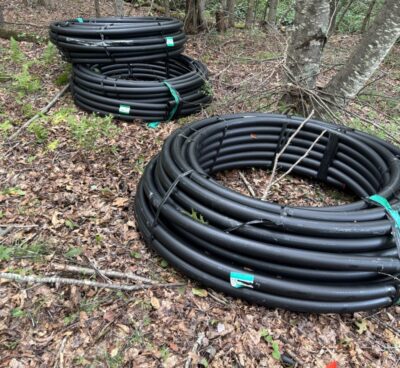
The 2″ HDPE came in giant ~6-foot coils, each of which weighed several hundred pounds. Once these were unraveled we had a rasslin’ match that looked like a monster movie with giant snakes. If you’ve never handled large dimension HDPE it is unbelievably tough and strong, slippery and cantankerous. Not to mention ridiculously expensive compared to Sch40 PVC, but I am expecting it to be worth the added investment. I got 15 years from the Sch40 PVC so this should outlast my time in Shangri-la.


Even two stout redneck brothers were no match for the Super Slinky. We wound up lashing the end to a long rope, feeding the rope along the path we wanted the pipeline to follow, and then pulling it up the ravine with my beloved little 4WD S10. The pipe was more than a match for two ~septuagenarians but was no match for 210 h.p. x 4500 lbs.

Here are the old and new, side by side. This level of damage to the old penstock was present in about 75% of the 1000+-foot length.

We finally connected the new pipeline into the system and had water flowing! I discovered that even at the bottom there was a crack in the PVC joints, so that needs to get replaced as soon as I can find the time. It’s working, now, but who knows for how long?
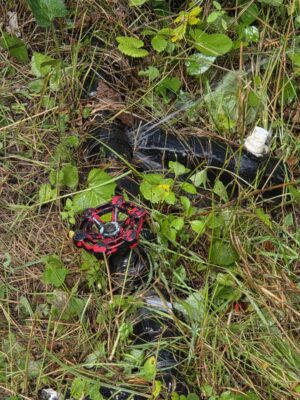
The work is not done by any means. I’ll let the new HDPE pipeline relax and lose its coilification to the greatest degree possible, then work the line from top to bottom leveling and lashing it. Reducing the up and down of the lay is critical to making the flow have as little turbulence as possible. If all goes well I will be able to run the system year round. Here’s hopin’.
This Week
Just as last week was all about loading up and teaching Historic Woodworking (more about that later) this week is all about unspooling, laying and connecting over a thousand feet of 2-inch Heavy Duty Polyethylene water line for my hydropower system. My brother is here for a visit and I am working him like a rented mule.
The water line is heavy but not brutally so, each of the four coils is probably about 350 lbs, but being coiled up for an unknown period of time it is set hard into the coil shape. Basically it is like straightening out a giant Slinky that wants to beat you up at every turn.
Stay tuned.
I’ll Be Watching With Great Interest
I actually watch a lot of Japanese woodworking videos and welcome this new tutorial approach. As much as I like the videos in Japanese shops, they are usually in Japanese and mostly without translation. Since I neither read nor speak Japanese this English chyron approach is most welcome. Not that I do much better with English…
Cootville
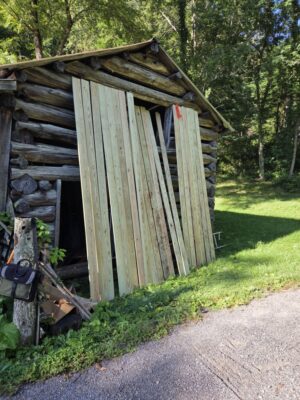
Not only was a substantial portion of the inventory worthless, it was all soaking wet. I had to change my shirt after loading my struck. I wound up standing it outside for five days to get it somewhat dry.
My name is Don, and I’m an old coot.
Last week Mrs. Barn and I took one of our occasional trips to the big city, in part for me to restock some routine building supplies. It had been a very long time since I bought much in the building materials realm as I had really stocked up while constructing the barn almost two decades ago. Slowly over time that inventory had dwindled down and it was time to do a little restocking. Plus, replacing some decking was on the autumn agenda.
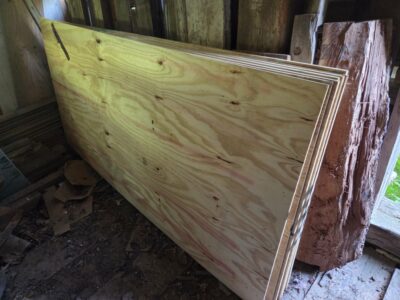
The sticker shock almost put me into a wallet-coma. Some CDX plywood, nothing special to say the very least. Enough decking to refurbish an 8’x12′ deck with some left over (even disregarding the need to sort through the pile since about a third of it was useless). Checkout was well on its way to ONE THOUSAND DOLLARS. To say that I was ranting all the way home like a curmudgeonly old coot vastly underemphasizes the pungence of my rhetoric. Not only do they not call material what it is, they tripled the prices since I last bought stuff. $60 for a 3/4″ sheet of CDX plywood? $14 for a 12-foot piece of PT/SYP decking? Insanity.
It would be easy enough to condemn the lumber stores and the lumber markets, but markets just do what markets do. Their moral duty is to maximize legal profits on behalf of their shareholders.
The real crisis is inflation, a crisis I do not believe we has a culture have the knowledge, wisdom, or courage to address.
It would be easy enough to blame the bankers, especially The Fed. But even though they are integral to the crisis, the central bankers are only doing what the legislative, executive, and judicial politicians are instructing them to do.
Even though they are misanthropes integral to the crisis, the spineless weasel elected politicians are only doing what the electorate is instructing them to do; spend money on us that we do not have. When legislators and executives spend money they do not have, in order to purchase votes they need as they need food, water, and air, there are only two “solutions.” 1) raise tax revenues to cover the expenditures, or 2) create/borrow phony baloney money to do the deed.
The limits to the first are well established as history has revealed an almost iron-clad truth: governments can only extract about 23% of the economy in taxes regardless of the taxation scheme. Hence the drive towards totalitarian collectivism, a/k/a abolition of an economy.
As for the creation of phony baloney money, also known as fiat currency, the only limit is political. The blame for inflation comes down to us, the electorate. In the aggregate we demand the gubmint give us stuff we cannot afford and cannot be paid for. So they do the “rational” thing, they create money out of ones and zeroes and fractional reserves, reducing the worth of the money in existence. Intrinsic prices are not rising, it’s the value of the money that is falling. That has always been and always will be the proximate cause.
Until we in the electorate tell them to stop spending money on us (yeah that’s gonna happen) the inflation locomotive will be picking up steam as it charges down the tracks, the engineers unaware that the bridge up ahead is collapsed (if it has not yet occurred, servicing the debt will soon be the largest component of the Federal budget). And collapse is the only possible end point. Get ready for it. I do not know the current score in the game nor do I know how much time is left on the clock. But I know the end result.
So Don, are you saying you are smarter than all the smart guys in Washington?
Yup.
But then I live in Cootville and the perspective is not in sync with the outside world. As CS Lewis said, “Reality is a ruthless instructor. It does not care whether you agree with it or not.”
A Shovel Ready Project
I’m not spending 100% of my time fighting the Rearrangeritis War. I still try to spend a couple hours a day writing, although not as fast as I would like, and portions of almost every day with chores around the homestead. One such chore is maintaining the driveway.
If you recall, several years ago I had the driveway to the barn rebuilt with hard packed “Limestone dust,” a pea gravel sized aggregate in common use out here in the hinterlands. (Shangri-la is immediately adjacent to a gravel quarry). The material packs to become almost concretious and serves its purpose well.

Then came the monster ice storm of last winter and the torrential rains of last spring. The frost-heave and runoff from these events took its toll not only on my microhydropower waterline, soon to be replaced en toto, but now I must spend moments of many days reconstructing the crown and shoulders of the roadway. The material is so hard it broke my hoe so I must break it down with a derelict adz, the only tool I have with the heft and robustness to accomplish the task. It was one of several old adzes I bought at a tool auction many moons ago. Two of the adzes are kept razor sharp, but this one is just a beefy hoe that I use for all sorts of digging fun. I repaired the original hoe but now use it mostly as a rake. The adz has the additional advantage of being three times wider than my pickaxe, which would have been my other option.
Cue Rod Serling
Good Evening, Ladies and Gentlemen
Consider if you will, a man with the shop of his dreams, dreams that formed at the knee of his father working together at the bench well over a half century ago. This shop is in Shangri-la, a place and a refuge from the maelstrom from the surrounding civilization swirling down the drain.
Unfortunately our subject is not the most orderly fellow in the world, and over the years his shop and all its contents have slowly drifted into disorder. The time has come for him to impose order on the space and all its contents, tools and supplies requisite for almost any sort of project imaginable.
If this fellow were you in a one-car garage workshop, how long would it take you to clean and organize every cubic foot of it? Now imagine that instead of a one-car garage your workshop is equivalent to a 36-car garage and you get the sense of the task before him
Welcome, my friends, to the Rearranger Zone.
So that’s what I have been up to almost 100% of my shop time since last Thanksgiving, with hopes the undertaking will be complete this coming Thanksgiving.

By far my favorite woodworking shop video of all time was James “Stumpy Nubs” Hamilton’s presentation of “Rearrangeritis,” a debilitating disease for most craftsmen.
I will write more about this soon, but the plain and simple facts are that, in addition to being more than a little bit whimsical in my shop arranging and housekeeping, two realities have emerged. First, I use the space and setups differently than I had originally imagined. Second, what I am doing in the space has evolved over the years so even if the original organization was correct, it is so no longer.
Whenever I take too long between posts I’ll get a gentle query or two as to my well-being. All is well, I’m just cleaning and reorganizing and wrestling with this current bout of Rearrangeritis.
Double Barn Portrait Selfie
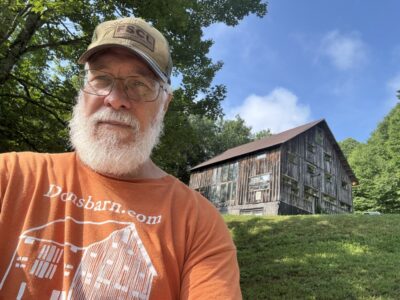
During his recent impromptu visit my brother took a whimsical double-barn-portrait selfie. I was amused. Some folks think we resemble each other (our wives say we even walk exactly the same) but we don’t see it. ;-)
A Walk in the Woods
We’ve been blessed with a couple of days’ semi-impromptu visit from my brother and his wife, who taught school with Mrs. Barn about fifty(!) years ago. Since it was sorta last minute I didn’t have much of an activity agenda. We trimmed up the walnut trees in the yard, toured the garden and greenhouse, confirmed that the late frost had left all the apple trees fruit-less except for one small crabapple, then hiked up the hill to assess the microhydro water line in preparation for replacing it when they return in August. Goodness, the old Schedule 40 PVC line was trashed by the brutal ice storm last winter.
We walked along with me running the traveler along the ground to get a reasonable measurement of how much of the black poly pipe to order. Were two rolls of 2″ x 500′ going to be enough? Well, the rough measurement was 1,007 feet, so I will have to either use a little of the Schedule 40 at one end or the other or order another hundred feet of the black poly.

Meanwhile, just above the weir we could see a large tree had fallen across the original logging road so we walked another 150 yards to it. And what a tree it was! The amount of firewood we can harvest will be impressive.

The tree was struck by lightning and felled very recently (the leaves were withered but still green on the branches) and it was a big ‘un. At four feet off the ground the girth was eleven feet. Another very large tree had fallen right next to it, probably in the same storm.

So come August we will be hard at work. Sugar maple ain’t the best firewood but it’s better than nothing. Especially if you have tons of it.