
Hand Tool Headlines
The Woodworking Blogs Aggregator
“Glory to God in the highest heaven, and on earth peace to those on whom his favor rests.” - Luke 2:14
Be sure to visit the Hand Tool Headlines section - scores of my favorite woodworking blogs in one place.
General Woodworking
almost done.......
First thing this AM after posting the blog I went to the VA to pick up a Rx. I finally got a hold of pulmonary and they gave me a new Rx. It is for managing the cough but when I got to the VA the pharmacy was closed. No weekend pickups. I should have gone on friday but I didn't want to deal with the school bus traffic. I'll have to go back on monday to get it. Which is just as well because the doc told me to make sure that I get my flu and COVID shots up to date. With my current lung issues getting either one of them would suck beyond drinking pond scum.
 |
| cooked |
I came back to the shop last night after dinner and resisted the urge to take this out of the clamps. I let it be to fully cook overnight to impart as much strength as possible to the miters.
 |
| better |
I got the 3rd coat of shellac on the box and the lid. Now I can see a wee bit of shine and a definite difference between the shellac and the raw pine. It would appear that 3 coats are needed for that to pop.
Based on the last outing with this shellac I am wiping down the shellac with steel wool between each coat. So far it appears to be setting up and drying unlike the last time. I haven't feel any stickiness between the coats so far.
 |
| doesn't fit |
The front to back (long sides) fit nicely but the short ends don't. The right side will drop in but the left won't. I penciled the over and it is a strong 32nd. The decision was where to remove to get it to fit. Removing it from the base would be difficult so I opted to plane/sand the box bottom.
 |
| took a while |
I took my time planing/sanding the bottom until it fit. I didn't want to end up with ugly looking gaps. The gaps changed on me with a slight one on the front right. I tried reversing the the box 180 but the gap was still there.
There was also the gap on the back left short side that was there on the dry fit up. With the base glued and cooked, it shrunk a little.
I was careful with the fitting because I didn't want to have any of the miters open up on me. I still don't have good luck with miters staying glued but today they cooperated.
 |
| based glued on |
When I went to the VA the shortness of breath kicked my arse big time. The pharmacy is a hike even though I got a good spot in the parking lot. I had to stop and catch my breath 4 times walking to it. Last week when I had my podiatry appointment I had gone to the pharmacy and I got winded but I didn't have to stop and catch my breath.
This little trip sapped my strength and made me tired. I spent most the morning sitting at my desk resting with my eyes closed. I made a brief appearance in the shop in the PM to finish up what I started in the AM working on the box.
 |
| chamfers |
I planed a chamfer (20 strokes on each side) to finish up the base. I did the chamfer to lighten the base and make it look thinner. I am finding that the less I walk around in the shop the more I can do. Most of what I accomplished in the PM involved me standing at the bench mostly.
 |
| first coat |
I'll try to get back to the shop at least once more to slap on the 2nd coat. I still don't have issues walking down the stairs but coming up them against gravity ain't so good anymore. I have to stop in the back hallway to catch my breath before I navigate the final 3 steps up into the kitchen.
This box would have taken me no more than a couple of days pre lung surgery but that is the way it is. Next month marks one year since the initial lung cancer diagnosis and June will be one year post tumor removal surgery. I'm settling into a rhythm with this now. I'm comfortable with working in the shop whenever I can. I like that a whole better then vegging out sitting on my arse or worse laying in bed staring at the ceiling.
accidental woodworker
shellac time........
 |
| one down, three to go |
The left short side was done first with the front long side next. I worked my way around the bottom until all four miters closed up.
 |
| a lot to remove |
Rabbeted miter corners confuse me a lot. Rather then saw the miter closer to the line I used the plane and shaved it to the line. When I got close I stopped and took one shaving, checked it, and repeated until the miter closed up at the corner.
 |
| um....... |
The back left corner has a small gap with the other three sides pretty much seamless. I am not putting a small molding on top the base. So I had to play and fuss with it a bit to get to this point. This gap is due the corner of the box being slightly out of square.
 |
| happy face on |
Got the base band clamped and the box dropped into it without a problem. I can live with the gap.
 |
| final cutout |
Clamped the sides together and drilled a 7/8" hole 1 1/2" in from each end.
 |
| double line |
Before I drilled the holes I had ran a line to mark where the base cutout would be. I cut the line out on the bandsaw.
 |
| needed some massaging |
When I tightened the band clamp pulling the miters tight, it also twisted the base. After tightening it I saw that the base wasn't laying flat on the tablesaw. I loosened the band clamp until the base laid flat with no rocking. I added the quick grips closing the miters up tight. This will cook until the AM.
 |
| first coat |
I was not expecting to get the shellac on the box today. But once the base was glued and clamped there wasn't anymore woodworking to do.
 |
| hmm....... |
I almost made the me-steak of applying shellac to the whole box. Glad I thought it through because you can't glue over shellac for the long term. Instead I applied shellac to the inside and the top of it. I'll do the rest of the box after I glue the base to the box.
 |
| 2 coats |
The build ain't happening as quickly as I would like. It barely looks any different then raw pine. I had planned to put only three coats on the inside of the box but I'll probably have to be put on more than that.
accidental woodworker
shavings & still not done........
Still slugging my way through the box. It is taking a lot longer than I thought it would even with the health issues factored in. It is a small project but the devil is in the build steps that I changed again today. I'm so close to the slapping on some shellac but no check mark for the done column today. Maybe tomorrow or the.....
 |
| new lid |
Resawing it as much as I can on the tablesaw. Like the first one I'll complete it with the japanese saw.
 |
| hmm..... |
I tried to resaw the web evenly top to bottom but wandered off. I was doing good until I flipped it to complete the cut from the opposite direction.
 |
| new lid |
Got 8mm dowel locators in the holes in the box. These are made for twist bits and not brad point drill bits. Regardless, they locate the drill point in the lid.
 |
| hmm..... |
Soss hinges dry fitted and the back looks good. The joint line is consistent R/L but it isn't dead nuts flush. The lid is off a couple of frog hairs but not along the entire length.
 |
| ta da |
I like the 'no hinge' look of these. They don't act like a stop hinge but that might change once I secure the hinges with #2 screws.
 |
| ???? |
The lid gap is tapered, close on the left and wider on the right. The Soss hinge on the right isn't centered on the box. In spite of that the lid opens and closes smoothly. No binding or hesitation at all.
 |
| hmm..... |
First change with the box build. Decided to put a base on the box to dress it up a wee bit. I sawed the 3/4" stock down to 5/8" because 3/4" looked too thick and clunky looking. The initial plan was to glue up the box, install bearers, and then glue the box to them.
 |
| change two |
I didn't like the thickness of the base at 5/8". I sawed a 3/16" wide rabbet in the base for the box to sit on. That leaves it a wee bit less than a 1/2" - you can see the difference in left and short (thicker) side.
 |
| sneak peek |
I changed to this because when I was dry fitting the base I made the first long one short. With the rabbet I now have a 1/4" plus of wiggle room. I plan to do a cutout on the bottom of the base. I'll do that before I glue the base together.
Last night was peaceful with little coughing and lots of uninterrupted, blissful sleep. I had 3 toilet trot races but no coughing and I dropped off to sleep right away. When I went vertical in the AM, no coughing. Usually that is a given and it varies from a few fits to seemingly endless as in when will I stop trying to hack up a lung. I was looking forward to having a nice relatively cough free day with a AM and PM shop session.
All that got flushed after lunch. I went into a spasm that left me light headed and wanting to lose lunch several times. This fit was the worse one I've had since the lung surgery in June. It wiped me out and 30 minutes after it stopped I was still wiped slick. I went to the shop late in the day just to get my camera. At least one more day before this box gets done.
accidental woodworker
shavings & still not done......
 |
| from yesterday |
This was the last thing I did in the shop before I killed the lights yesterday. 1/8" plywood I have learned is more than sufficient for a box of this size.
 |
| hmm...... |
Put the Soss hinges in and checked the swing and how much clearance there was. It is basically 2 frog hairs and beveling either the lid or the box wouldn't help. The hinges are too close the edge - the bevel would eat into the hinge holes.
I was going to make a new lid with the hinge mortises inset further in away from the edge. That plan went south on the express in a hurry so I stuck with what I got.
 |
| flushing the bottom |
Sawed off most of the bottom overhang before planing and sanding it flush. I paid attention this time to make sure I wasn't throwing it out of square again. The front edge was bit on the wonky side. There was a hump in the middle with the left side corner square but the right one was out to lunch. Some things you just let go because it still looks good.
 |
| signature look |
I went back and forth about beveling the back and in the end I didn't. With the hinge mortises so close to the edge the bevel of the top might have exposed them. I didn't want to chance being wrong or right about that.
 |
| can you see it |
Made a small finger grabbie thing on the underside of the lid. Opening and closing the lid as is without would have worked but this only took a minute a whack out.
 |
| a real big sigh |
I didn't go postal on this and just excepted it. I put the grabbie thing on the wrong edge. I did it there because that is where I had the center of the back edge marked. After looking at it I decided it was for the best because the grabbie thing looked like crap against the bevel. It looked too thin and looked like a big me-steak.
 |
| new lid upcoming |
I had three pieces of pine to choose from and picked the one that had most straightest grain. All of them had swirls and cathedrals that looked too busy.
 |
| ran out of gas |
I'll finish the new lid in the AM or PM. The other box is still waiting for its turn at the workbench.
Had a terrible night last night trying to sleep. I had been coughing continually all day long and it didn't slow down when I hit the rack. I would cough, it would stop, I would fall asleep, and then I would wake up coughing. Wash, rinse, and repeat all night long. This was something new as before this I would wake up and then I would cough a minute or so after. Now I was waking up coughing.
I finally said No Mas and went vertical and instantly felt like crap. All morning long I felt like a carpet that had the snot beaten out of it. Didn't even entertain any thoughts of wandering down to the shop. Feeling like this sucked pond scum where I just wanted to take nap. The nap wasn't happening because the coughing just would not stop. Hoping that this is just a another bad day that it will be better in the AM.
accidental woodworker
101 Hand Planing for Beginners CRASH Course
more shavings........
Been sleeping late and today I woke up just before 0800. Last night was peaceful too. I barely coughed at all and I was only entered in one toilet trot race. I coughed off an on all day but nowhere near the volume and intensity yesterday. I hope this trend continues because it was nice for a change.
 |
| ready for clean up |
The box looked good when I eyeballed it. All the tails/pins appeared to be gap free.
 |
| flushing the corners |
The bottom of a box (or a drawer) is the reference surface. I flushed the corners first and then ran the #3 around it a few times.
 |
| happy face on |
The bottom is twist free. If I wanted to be totally anal I would run a knife line all around the top and then plane down to it. That would make the bottom and top parallel. But that isn't necessary for this box.
 |
| Soss hinges |
These are the smallest Soss hinges I have with a 8mm diameter. The minimum stock thickness for them is 7/16" and the box is between 3/8 and 7/16. I am going to use them regardless.
 |
| flushing the top |
The top is now twist free too.
 |
| cleaning the box |
Instead of planing the box I sanded it. The tails/pins were no more than a frog hair off flush. First one out of the starting blocks was 80 grit followed by 120.
 |
| hmm...... |
I want the lid to overhang the box at the front. The tablesaw wasn't able to make the complete resaw cut. Finished it with my japanese saw.
 |
| it is gone |
Flushed the web first and then planed it until it was a 1/2" thick. I made it that thick to accommodate the 3/8" depth needed for the Soss hinge.
 |
| minimum |
I went with a frog hair more then a 1/2" to allow for the spur on the 8mm brad point drill bit.
 |
| close, oh so close |
The front and back walls on the hinges in the box look ok. The ones in the lid aren't the same. They ended up painfully close to the outside edge. Thinking now that maybe I should have pushed the back of the lid past the back of the box a wee bit.
The instructions say to drill a 8.2mm hole for the hinges. I drilled 8mm holes and the hinges fit in them snug. The lid opened and closed without any hiccups. 8.2mm seems to be oversized and the hinges wouldn't fit even with the screws installed.
 |
| #2 FH screws |
There is a groove on both sides of the hinge, top and bottom. They are for a #2 screw to secure and keep them from twisting and uplifting when the lid is opened/closed.
 |
| hmm...... |
The outside of the box ain't square. The inside is dead nuts square. There is also a slight bow in the back long side. I didn't expect the sanding to go nutso and throw the box out of square. Used the #3 to square the back corners. I left the front one alone. I did this to help with evening the overhang on the ends.
 |
| slight curve |
Didn't get to the smaller box but there is always tomorrow. I got the planer to the tool guy and he said that the way he does the belt change is to loosen the big pulley. When I had first looked at changing the belt I had thought that was the way to replace it. Don't know when he'll get around to it and I'll get it back.
accidental woodworker
How Turning Tools Work
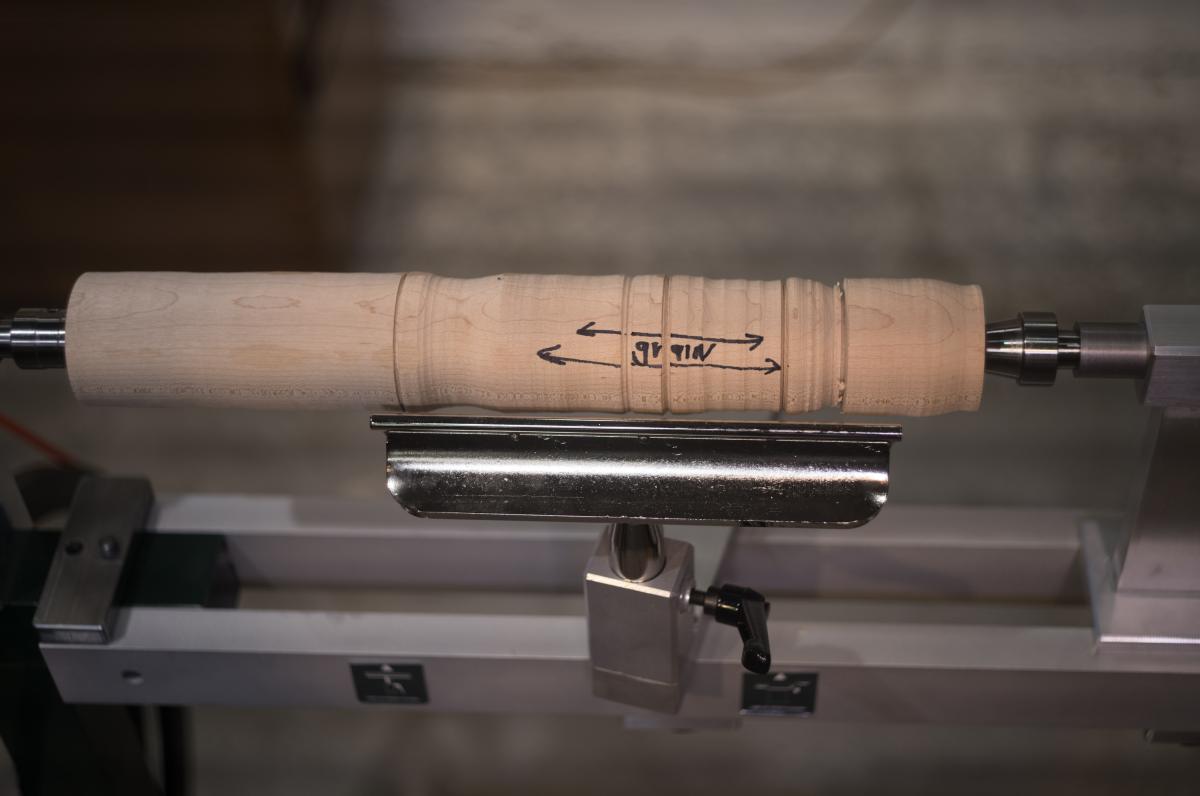 When spindle turning between centers you are always peeling perpendicular to the grain
Do you learn the way I do?
If we're talking about a hands-on skill like turning, I need to understand why a process works. I have a terrible memory for procedure, so unless I understand the procedure steps in context, I won't be able to remember the procedure.
When I begin to learn turning I read a lot and saw a lot of videos. But very little of that information was about the "why." It was mostly about the "how."
This series is about the "why." It won't of itself teach you how to turn, but it may help give some context that can complement other turning instruction.
Before we look at the tools, let's look at what we're trying to accomplish. There are two types of turning: the first is spindle turning (above) - think chair legs, candlesticks and banisters. The wood is mounted end-to-end between centers, with the grain running parallel to the spindle of the lathe. When you turn a spindle, you're always cutting across the grain.
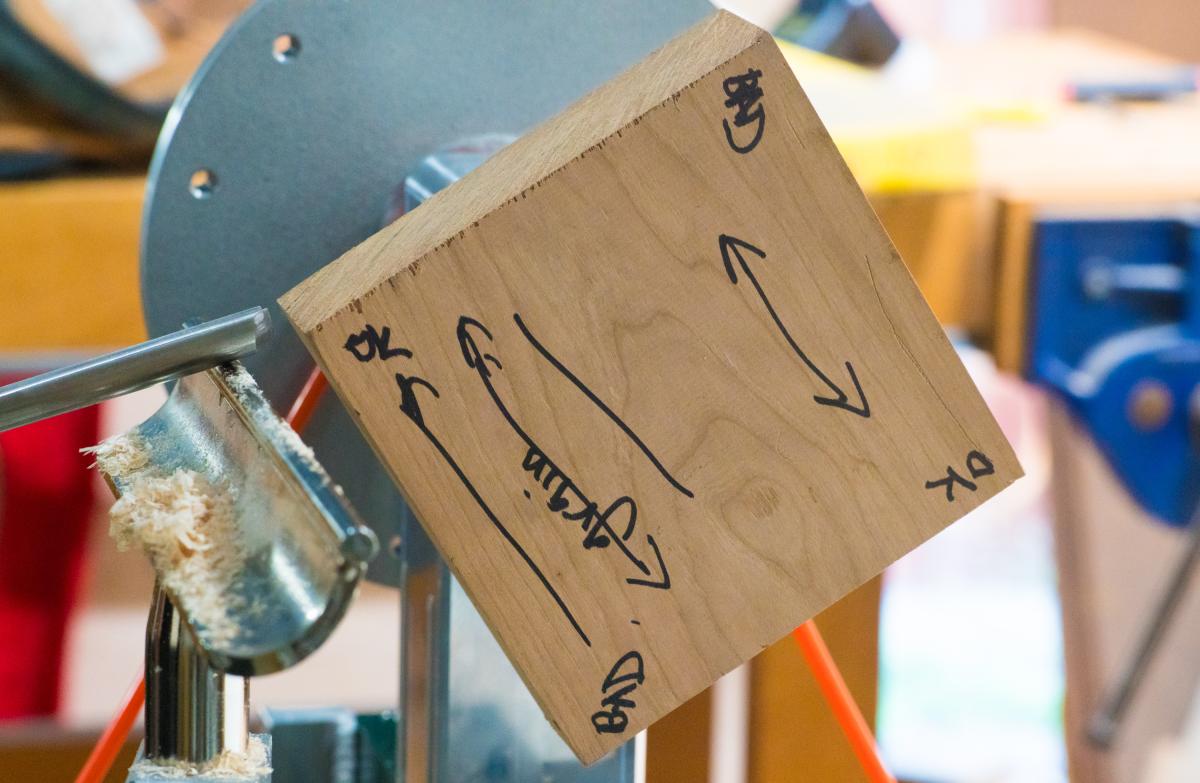 With bowl turning, the grain is always shifting direction
The second type of turning is bowl turning. In this type of turning, the wood is mounted perpendicular to the spindle. As the wood rotates in the lathe, you may be cutting along the grain, with the grain, or half the time directly into the grain, albeit the wrong way. This presents a lots of problems cutting against the grain.
We'll look at bowl turning another time, but for now, let's look at spindle turning in more detail. As I just mentioned, you're cutting across or perpendicular to the grain. Typically when you cut across grain, the wood simply peels away. Different species offer different experiences. If you have a very stringy wood, it will peel away leaving a rough surface. On a fine and dense wood, you'll get a fine surface. There's no real danger of tear-out, except on corners of the cut (where the wood will splinter out if the corners of the cutting tool are buried in the wood).
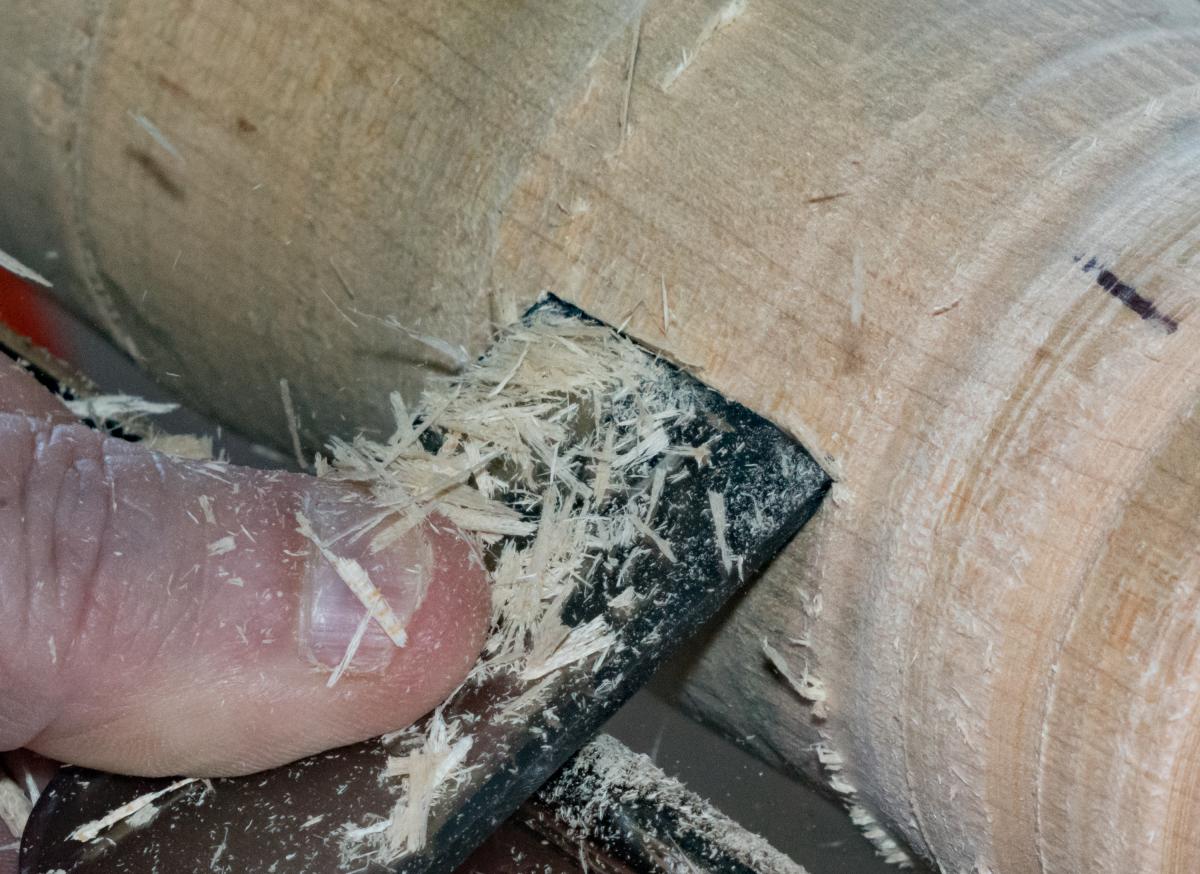 With a straight chisel, the wood just splinters out at the corners of the chisel
The very simple solution to splintering out at the corners of a straight tool is instead of a straight tool is to use a gouge that cuts and peels the wood away in the middle - and then gracefully exits and shears the fibers at the corners of the tool without splintering. This is essentially how all spindle turning tools work. The center of the gouge peels away material, and the curved sides exit cleanly.
A continental gouge, which has a gentle curve to it, can cut cleanly, provided you don't have too heavy a cut, which can engage the corners of the tool. A roughing gouge, with its high sides and U-shaped profile, can take very deep cuts and still cut cleanly. A thumbnail spindle gouge, has a nose (finger) sticking out in the center of the tool so it can cut deeper, but the tool still has the raised sides of a gouge so it can do some shearing at the sides and leave with a clean transition at the edges of the cut.
Skew chisels, and scraping tools, both of which are flat and don't have a curved gouge geometry for a clean cutting on the sides are used differently than gouges and I will look at them analytically another time.
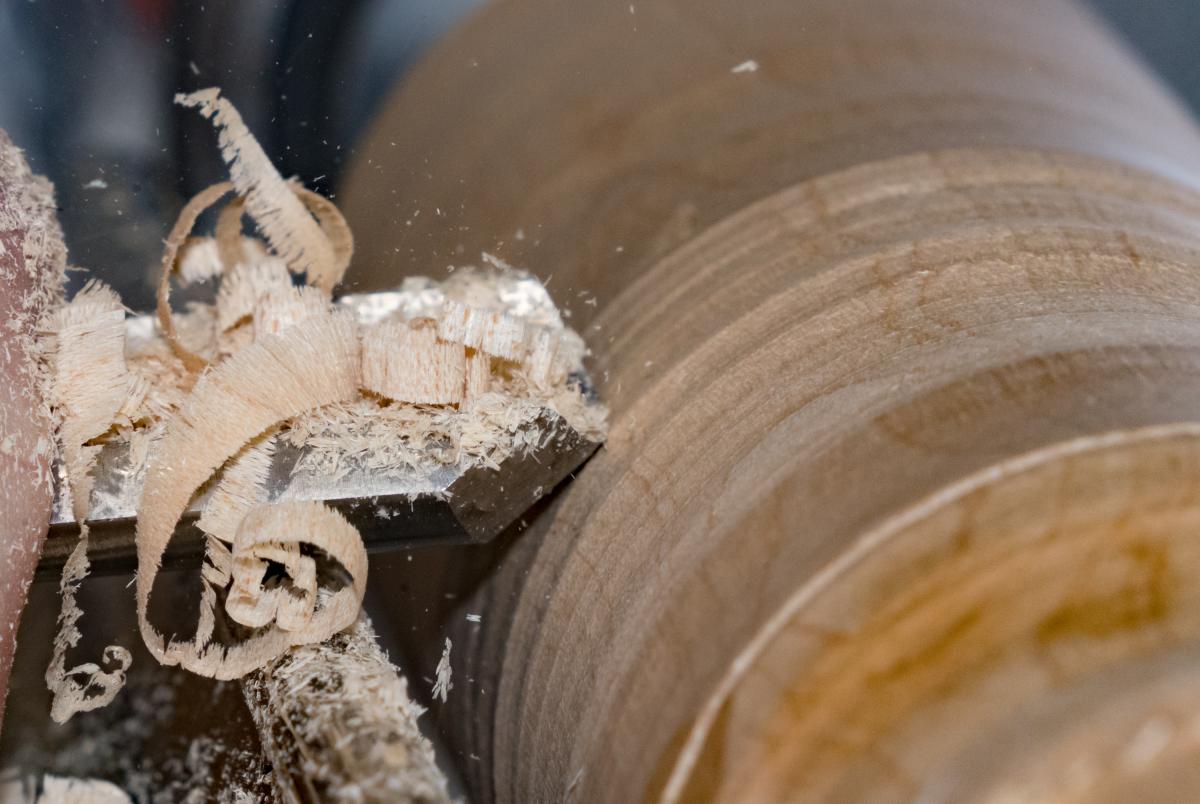 Nice clean shavings
The next issue is how to hold the tool against the material. The turning tool is always braced on the tool rest and kept steady by one hand holding on at the end of the handle. But that's not enough to rigidity to keep the tool moving even a fraction of an inch up and down as it can pivot on the rest. So the tool won't cut evenly or consistently.
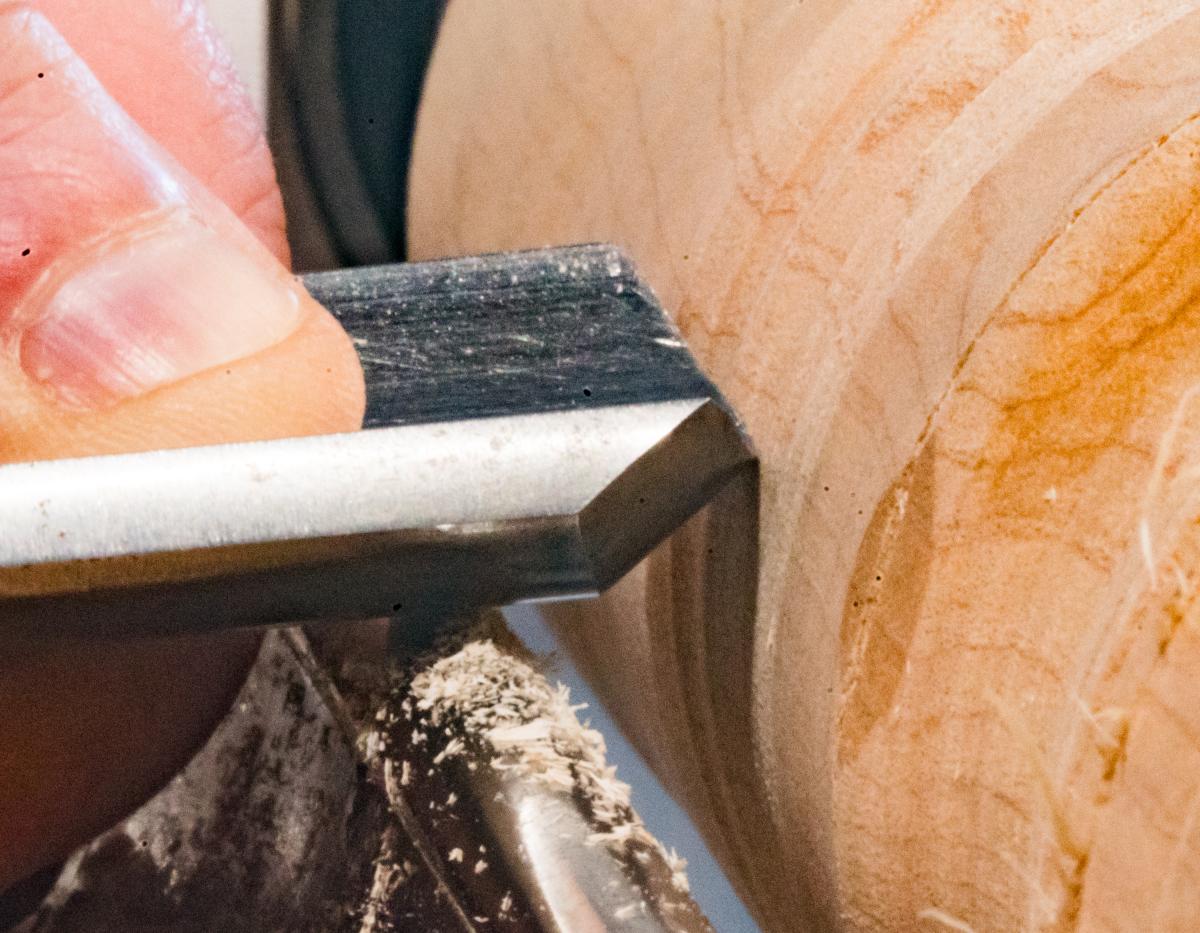 Holding the tool with no support leads to chatter and uneven cutting
The tool is unsupported as in the photo above, it will cut, but even holding the tool as steady as you can, there will be enough movement at the cutting edge so that you will not get a steady, even cut. The cutting edge will bounce up and down, going in the work too deeply, or bounding out entirely. The tool is essentially a see saw.
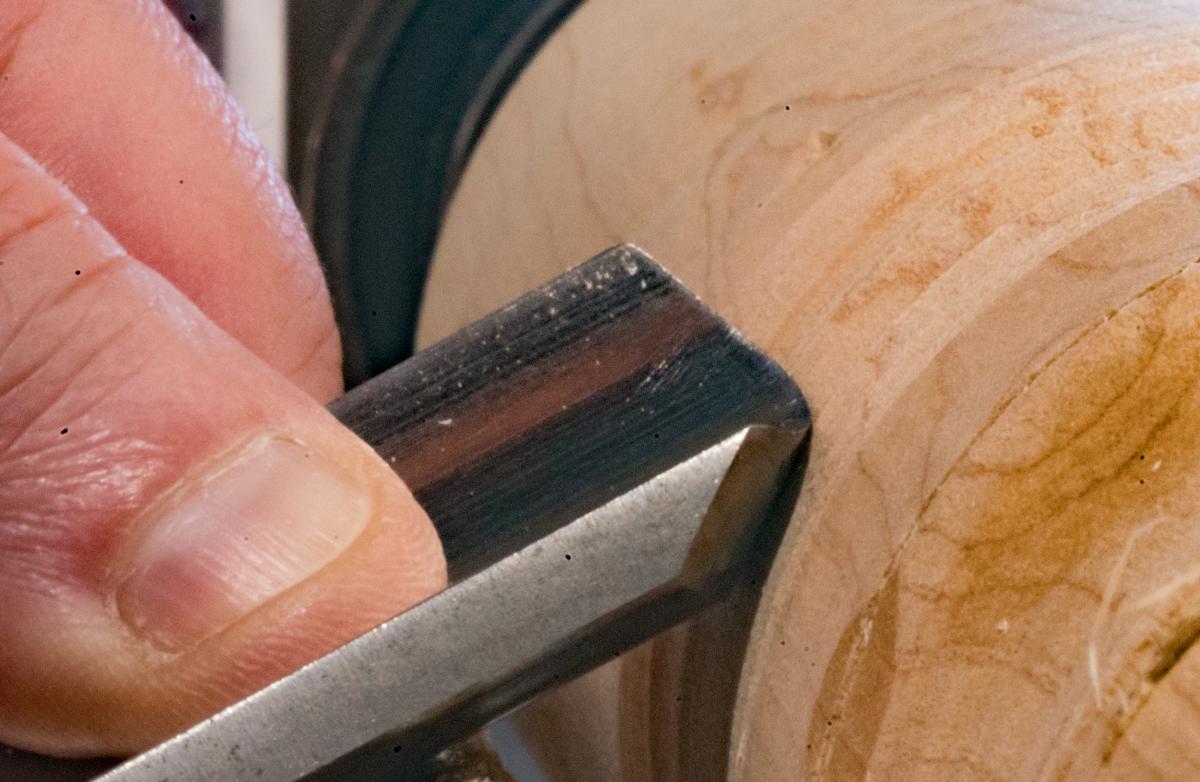 Riding the bevel on the work - a nice clean, smooth surface
The key to smooth, even, shiny surfaces is riding the bevel of the turning tool on the spinning work. In the image above we have two places for support: the tool rest; and the work itself. You can easily hold a steady position because the tool cannot lift out of the cut and you are holding the tool hand up against resistance and the tool cannot dig deeper into the cut because the bevel is rubbing against the work as it turns. You get continuous, long shavings, a smooth surface, and controlled cutting - because the tool is prevented from bouncing in and out of the cut. The position of the tool rest, how far above or below the work centerline it is and how far away the tool rest is from the work is determined to make it is easy for you to position the tool so it naturally allows the tool bevel to rub against the work as the work is turned smaller. Riding the bevel is generally how all turning is done. There are exceptions. The most notable being when you are taking a new piece of stock and turning it from square to round. No matter how much you might want to ride the bevel, between cutting the corners of the stock round, there is no support so steady hand holding may be the best you can do.
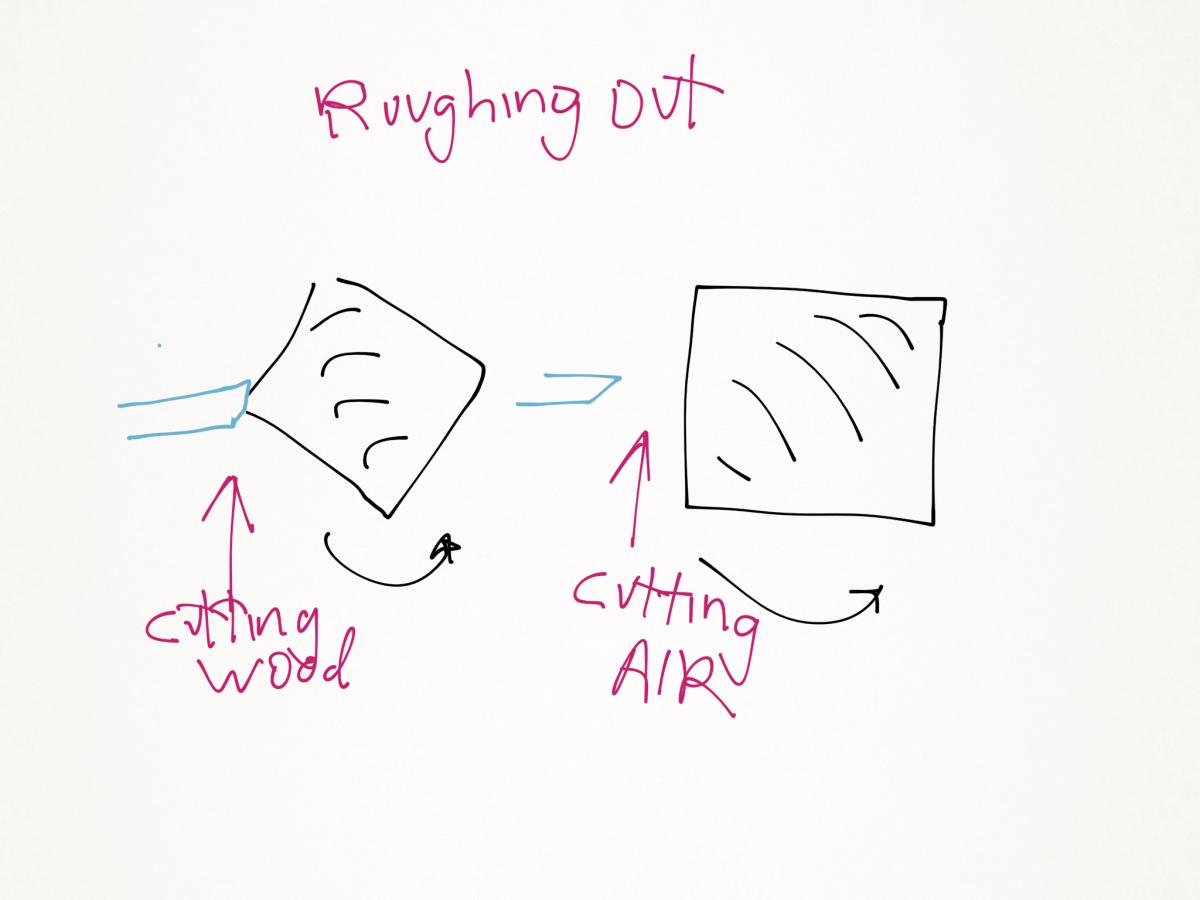 When roughing from square, the tool is unsupported as it rounds the stock
Once I understood these basic principles I could easily focus on easy turning. I don't think for example of my tool rest is high or low, but how well the tool is cutting. If I am getting a ragged cut, or have trouble with control I know to look to see if the tool bevel is supported by the work, or am bouncing free. And the fix becomes obvious.
made some shavings........
 |
| hmm....... |
Made it to the shop late and I was determined to make something. Even if it was something I didn't need. On the flip side I just had the desire to work with my hands and have something to show for the effort. So a box it is but with a twist. The long sides will be thicker than the ends. I can't remember if I have made a box with different thicknesses of the sides. Not only different thicknesses, the dovetails will be on the teeny side.
 |
| made a detour |
While I was figuring out the dimensions of the box I saw a scrap of pine by the tablesaw and resawed it to 3/8" thick. I'll make a box out of it first. Then plan was to get both boxes glued and cooking by the end of the PM session.
 |
| my shavings |
I was able to plane the sawn face smooth and flat without expiring. I didn't have a coughing fit but I had to take 10 to catch my breath.
 |
| not my usual box |
I sized the box so the long sides are twice the size of the ends. I also sawed the sides so that the grain flowed around continuously.
 |
| tails sawn |
I have gotten in the habit of using the dozuki saw for stock thinner then a 1/2". No headaches sawing the tails which was welcomed. No fits or shortness of breath issues.
 |
| no Moxon |
I had thought of using the Moxon to do this but nixed it. If I was making a lot of boxes I would have done that. Instead I used this handy jig for setting the height of the pin board.
 |
| off the saw |
I didn't lose anything with my dovetail skill set. It appears that this type of work is something I can still do. It is relatively stationary and doesn't involve a lot of exertion. Both diagonals agreed on 8 3/4".
 |
| happy accident? |
I thought I had centered the middle tail. The left pin socket is noticeably larger than the right one. I must have read my centering rule wrong. I didn't have my glasses and I didn't want to go topside to get them. Looks like I should have.
 |
| happy face |
The inside corners are gap free. This is something that I don't always get.
 |
| opposite end |
I usually end up with one or two gaps on the inside but not today.
 |
| it is square on the inside |
No need for clamps as the tails/pins are on the snug side. I had to fuss with it a bit to get here. I had used a clamp to close one tail/pin and that threw the diagonals off.
 |
| kind of like the asymmetrical look |
The plan is to glue a piece of 1/8" plywood for the bottom of the box. IMO that would mean making sure the larger pin/tail is at the bottom and the thinner one is under the lid.
Didn't get to the thickness box but it will give me something to look forward to in the AM. I had to go topside during the AM session and that wore me out. I sat down at my desk to catch my breath and once I did, I didn't feel like getting back up. Spoiler alert - stayed there for over an hour.
Called the repair shop this AM and he said that he was out of the shop today. He also said that he has replaced the drive belt several times. I'll drop the lunchbox off to him tomorrow.
accidental woodworker
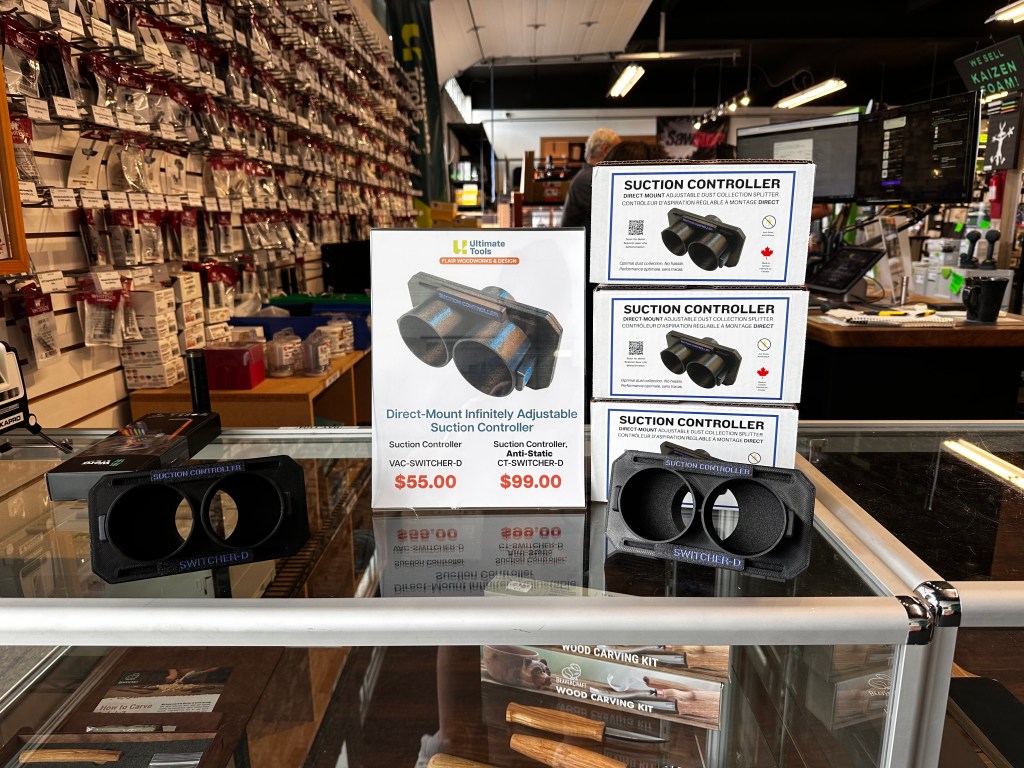
Try Before You Buy at Ultimate Tools Oct 22
Find me at Ultimate Tools this Thursday to learn all about Suction Controller, plus lots of other amazing top-tier tools at their annual Oktober Tool Fest event which is one of the biggest woodworking events in the Lower Mainland.
Other reps will be there to demonstrate and educate you on tools from Mafell, Lamello, Mirka, Sia and Robbox. There will also be lots in-store deals you won’t find anywhere else.
Where: Ultimate Tools, 3847 1st Avenue, Burnaby, BC
When: Thursday October 22, 10 AM to 3 PM
winter has come........
Yesterday was the first day of the heating season for me. The temp dropped down to freezing (0C) overnight and I set the thermostat at 70F. I don't play with it and I'll leave it set at that until I shut off the heat in may/april next year. I struggled taking the radiator covers off and stowing for the season. Coughed a lot and got short of breath quick too. Got it done albeit at an ninety year old man's pace.
 |
| need a good cleaning |
I've been thinking a lot lately about a post by CS at Lost Art Press he posted a few years ago. It was about him going to shop and just looking around. No work just him contemplating the space he occupied. In that post he also wrote about a wood carver who couldn't work anymore but still went to the shop just to be in a familiar space. Enjoying his time there even though he couldn't carve anymore.
I'm feeling a lot like the wood carver now. Two weeks ago I was aligned with CS. Today I went to the shop to do some woodworking and I did nothing. I looked around the shop noting the things I've made and the thought of that not happening again popped up and said hello.
I don't have a warm and fuzzy about getting the console/entry table done now. Or it just might be the last project to leave Ralphie's Workshop. I am going to try and make it even though I will have to work slowly, I find that thought more comforting than sitting on my arse at my desk.
 |
| cherry Welsh stick chair |
I think I waited too long to take my head out of my arse before starting this chair. I have been thinking more and more of selling it because I can't see myself being able to make it anymore. If I do part with it I'll include the templates for it too. I got to sit in a Welsh sitck chair at the Lost Art Press when I took a class there. It was the most comfortable chair I have ever sat in. That is when making one went on the future to do list.
On a brighter note, last night was the best nights sleep I've had in days. Maybe it was my wife coming home from North Carolina that did the trick. Coughed a little after the 3rd toilet trot race but I dropped off right away and didn't wake up again until after 0800.
Wish me luck with the lunchbox planer saga tomorrow.
accidental woodworker
Model 2 Mandolin: Cuban mahogany neck blank
This video is all about making the neck blank from some very special Cuban mahogany. Also, I set myself the challenge of making a head inlay to match the mandolin’s rosette as seen here-
Cheers Gary
Dewalt 734 belt change pt pt V........
 |
| clean up time |
Put all the tools away except for the allen wrenches. Buttoning up the lunchbox was next on the menu. I had planned to go to the tool repair on Jefferson but it didn't happen today. I was getting the directions when I noticed that it isn't open on saturday. Saved me some time and gas on that one. It opens on monday at 0830 and I'll head that way after breakfast at Johnny's Chalet.
 |
| neat and tidy |
This is all I got done today and this took a bazillion hours to get done. I woke up feeling ok but by mid morning I had a headache that felt like it was going to split my skull in two. It was manageable if I sat and did nothing but that sucked pond scum. I had wanted to go to the shop and make a box. After suffering with it I finally took a couple aspirin. I have to be careful with that because I take blood thinners for my A fib.
For the 3rd night in a row I have repeated the coughing fit dance steps. Again last night it was the 3rd time I woke up that was the worse. It looking like the early blog posting is going to be a thing of the past.
Fingers crossed that the tool repair shop will be able to get the belt on the DeWalt. Glad that I got two when I ordered it.
accidental woodworker
The repair
Having removed the rotten timber, it's time to use it as a template to make the new pieces.

Time is of the essence. This building houses a school, and it's easier to do the work when the children are not here i.e. at the weekend.

Transfer the shape of the cruck plate to the new section.

Inserting the new cruck foot.

Inserting the new plate.

A nice tight fit. Bolting through.

A historic chamfer repair had to be removed, before making the cuts to remove the rotten parts. This unfortunately fell into pieces.

So, carefully glued it back together.

Offering it up, so trimming can happen, to fit the new shorter cruck foot.

The boltholes plugged with aged oak, the historic chamfer repair re-fixed over the cruck foot repair, the new architrave and the new oak darkened with it's own juices etc. The first visit from Prides Plastering, to apply a dubbing out coat of lime to the adjacent masonry.
Dewalt 734 belt change pt pt Iv........
 |
| FINALLY |
I tried to get the belt on with the rod but got nowhere. I got a teeny bit of the belt on the big pulley and that was it. The belt would not cooperate at all and after 30 frustrating minutes I removed the rod. I felt like I had given birth when I got the belt partially on both pulleys then.
 |
| blurry pic matches my mood |
I couldn't get the belt to fully engage on either pulley. I did manage to get about 3/4 of the belt onto to the bottom pulley and then I stalled. Even though I got 3/4 of the big pulley, the smaller one was gong in the opposite direction. I started with 1/2 of it on but by the time I got 3/4 on the big one, the smaller one had moved outward and barely had a 1/4 on the smaller pulley.
I cursed and threatened it with going postal on it and still nada. I tried to hit the belt with a hammer as I turned it and that did absolutely nothing. It wouldn't move even one more groove onto either pulley.
 |
| it got worse |
I got most of the bottom pulley on but the smaller one was in danger. The belt was only on two grooves there. What idiotic engineer came up with this design? It shouldn't be this difficult to change a high wear part like this.
 |
| hmm........... |
This was the last thing I tried trying to get the belt onto the pulleys. I turned the switch on and pushed the plug in briefly. I was hoping that the motor turning would cause the belt to ride over onto the pulley. No such luck boys and girls as nothing happened. As the belt didn't change its position on either pulley one iota. The belt didn't shred or break so at least that is a point in my favor.
I tried doing it a couple of more times without any success. Maybe if I had another set of hands I could have used a screwdriver as lever to push the belt as the motor turned it. But I am done trying to do this. Tomorrow I will go to tool center on Jefferson and talk to the service tech about it.
 |
| came today |
I'm glad I didn't wait for this to come in as it took a while for a in stock purchase. To further increase my fun, this kicked my arse all over the house trying to get it open. I could see that the bottom was screwed on but the label was adhered with a glue that wouldn't let go.
 |
| nice looking bit |
This is the first purple colored router bit I have seen. The six cutters and the mass of the head should make for a clean and smooth cut. I'll road test on the twisted sapele board tomorrow or the next day.
Had another rough night sleeping. Woke up 3 times, 2 of them I coughed a little and drifted back off to sleep. On the third wake up I thought I was going to cough up a lung. I watched YouTube for over an hour and tried to sleep again sitting up against the head board. I had stopped coughing and I didn't want to risk another fit going horizontal on my side. "Wandered in/out of sleeping and I finally laid down on my side and after coughing for a while I finally was able to fall asleep.
I don't know what time that was but I didn't roll out of the rack until 0815. Maybe it is time for me to change my blog posting to around lunch time. I felt better today than yesterday when I went vertical. No blah feeling and no feeling tired and washed out. After my first pot of coffee and finishing my two puzzles it was 1030.
Since today was fish 'n chips day I waited until after lunch to do battle with planer. Thinking now that maybe I should have taken the entire day off from it and gone to shop and made a box. At least then I would have something to show for the day.
accidental woodworker
What’s in a name?
I’ve never liked the idea of giving my instruments a name other than one that describes it, i.e. parlour guitar, twin-point mandolin etc. Clearly, the different instruments must have some means of reference, especially as all enquiries for my instruments come via email and a prospective client needs to communicate their needs.
You would probably have seen my previous “New Model Mandolin” build series: I called that instrument “New Model” as, at the time I was undecided on a suitable name.
Around 2007/08 I was designing a couple of instruments to my own shapes. One was a steel-string acoustic guitar which I designated Model 1. Another shape was designed for multi-course instruments and this was designated Model 2. Over the years that shape was scaled down and tweaked to become my electric mandolin and now, the shape of the new acoustic mandolin (temporarily dubbed New Model). So, after much deliberation it seems fitting, henceforth to refer to this new shape mandolin as Model 2 Mandolin. Simple!

The Watch and the Woodworker – Part 1

If someone tries to steal your watch, by all means fight them off. If someone sues you for your watch, hand it over and be glad you got away so lightly. ― John Mortimer
A watch is an essential tool to anyone who must perform a job within contractual time constraints, or when She Who Must Be Obeyed demands punctuality using the cat-o’-nine-tails that is her tongue (ツ). Not critical for fishing, cleaning rifles, or watching TV perhaps, but indispensable when engaged in work-related activities such as installing cabinets, pouring concrete foundations, or erecting structural steel frames.
In this series of articles your most humble and obedient would like to relate a few ways I’ve used my watches at work, and the sticky ends some of them met.
In this first article I will relate a true story of an effective, time-proven way to use an honest wristwatch to stave-off venal, criminal bureaucrats for good purposes. I don’t know the watch’s ultimate fate but, for a time at least, it ended up in the hands of an undesirable person.
As background information, I should first share my sartorial philosophy about timepieces, because after all, fashion is my life (ツ).
In our time, the wristwatch is the only jewelry, besides a wedding ring, a manly man can wear during manly pursuits. That said, my exquisite sartorial standards do not mandate fancy watches, for while a finely crafted diamond watch can make a serious fashion statement, IMO an expensive luxury watch clasped on the wrist says nothing positive about the man, manly or no. That said, at one time in my career in international construction I was compelled to buy, wear, and even drop a luxury clepsydra (wristwatch) in public. No diamonds…
Allow me to explain this contradiction.
At the time of this story I lived in Tokyo and was employed by a major Japanese general contractor, indeed the largest general contractor in the world at the time.
As you are aware, commercial construction requires many sheets of drawings. Nowadays, we think nothing of transmitting vast quantities of digital data instantly and very cheaply, via the internet, data devoid of weight and volume. But at the time of this incident, internet access was available only to a few major research Universities and government agencies, so architectural and technical drawings, which were all drawn by hand at the time and printed out as heavy, bulky, paper blueprints reeking of ammonia copy fluid, were delivered to government agencies, bidders, suppliers, subcontractors, and jobsites either by slow boat, airmail, courier or hand delivery. Accordingly, the cost of reproducing and distributing such bulky documents internationally was a major project cost that made UPS, DHL and Fedex highly profitable back in the day.
Time and traffic aside, the taxes and extortion these drawings and specifications faced when the customs agencies of some countries (actually, many countries taxes and tariffs) got their mitts on them were monumental.
In this case, my employer had been awarded a turn-key hospital construction project inside the Philippines through an agency called JICA. JICA selected the designers, and contractors (always Japanese companies) and funded 100% of the design and construction costs with all payments made following JICA procedures inside Japan. This means there were no transfer of funds within the country where the public hospital was erected.
As you can imagine, while the local residents no doubt appreciated the improved, indeed unprecedented access to health care this facility provided to the poor, the JICA system prevented the local government kleptocrats from embezzling or stealing the project funds, so they hated JICA projects with a dragons’ bitter hate. Gentle Readers familiar with both large bureaucracies and international construction will gasp immediately grasp the ramifications.
Chief among these ramifications, IMHO, is the evidence it provides that corrupt governments would rather their citizens suffered and died if their survival meant local politicians and/or government employees might be denied an opportunity for graft and extortion. This is not even a tiny exaggeration.
I don’t know about now, but at the time Japanese taxpayers and general contractors smiled on JICA projects because it provided a an actual, physical, world-class hospital to people in third-world countries desperately in need of health care quickly, reliably and at a reasonable cost, thereby showing Japan’s benevolence to countries the Japanese military ravaged during past foreign adventures, all while maximizing retention of taxpayer funds within Japan. The Philippines is one such country.
But graft, corruption and outright theft are always a problem with construction in the Philippines, and the local politicians, at least those I knew at the time, also loathed JICA projects because funds for the construction work were paid directly to the Japanese construction companies, like my employer, in Japan, giving the famously corrupt government in Manila no opportunity to embezzle them. Likewise, Japanese politicians, also extravagantly corrupt, loathed JICA projects because the opportunities for graft and embezzlement were much much fewer than a standard construction project.
Here’s a word to the wise: Be extremely distrustful of any politician in your nation that goes to a foreign country to discuss, negotiate, or visit a government-funded construction project because it’s almost guaranteed that they will use the opportunity open an account in the Bank of China and arranage to receive bribes from foreign governments, contractors and suppliers free from the risk of detection of wrongdoing by their own government. I say this based on direct experience.
But I digress. Meanwhile, back in Manila, at that time customs demanded a payment of 25% of the full value of the actual physical construction work reflected in the drawings. Not just the cost of producing and/or printing the documents, but the cash cost of placing physical concrete and erecting actual steel. That’s a lot of money, millions of US dollars in fact, and involved a big time delay while the amount is evaluated and negotiated.
But as with most problems, there was a way to sidestep the problem. To whit, my superiors in Tokyo asked me to courier the drawings to Manila on several occasions. The reasons for this, as it was explained to me, is that Japanese companies have a history of being generally more agreeable to demands for bribes, so they are pressed harder than American citizens, such as your humble, befuddled servant, who have a reputation for refusing demands for bribes entirely, and then angrily calling on embassies to support them against undue pressure from foreign governments. It’s illegal under American law to pay bribes, donchano.
But because vague assurances from Philippine government officials of speedy, honest treatment could not be relied upon, in preparation for my visit at Manila Customs, my superiors required me to buy a Rolex watch, with my own funds, with the promise they would reimburse me in due time. So I bought a GMT-Master II.
At the airport I retrieved my bags and three big packages of specs and drawings and toddled off to customs inspection. As soon as the agents at Manila customs saw the heavy pile of drawings their eyes lit up, but before they actually demanded a percentage of the total construction cost, I followed my superior’s instructions, extended my left arm over the stainless steel inspection table, displayed the watch, deliberately released the catch on the watch band, and allowed the watch to fall clattering onto the table.
The inspector quickly picked up and examined the watch, and glanced at me questioningly. I just nodded to him respectfully, loaded up my documents, grabbed my travel bag, and left without saying a word. As I was passing through the doors isolating the inspection area, I glanced back and saw the custom inspector smile like a maniac, stuff my watch into his pocket, and wave his next victim to his station. And so the ancient game of taxes, tariffs, bribes and extortion continued.
Of course, my associates were waiting outside the airport in an automobile by the curb to receive the drawings. We drove to the office to drop them off, and then went out to one of the many clubs in Manila to relax until my return flight to Tokyo was ready to depart.
Why a Rolex GMT.Master II watch, you say and not the Breitling Navitimer James Bond wore in Thunderball or Scaramanga’s Rolex Cellini King Midas seen in The Man with the Golden Gun, or even the economical Swatch GE218 that Blowfeld wore with such panache? This was before the fake “Swiss Made” watches deceptively sold by Rolex recently destroyed their reputation were available, but until recently Rolex watches were immediately recognizable and were considered as good or better than cash in many countries, including the Philippines. Indeed, it was standard operating procedure back in the day for businessmen of all nations to wear a Rolex watch as a last-ditch source of emergency funds, especially since the prestige and value of this brand of watch was instantly recognizable, unlike a cheaper Omega or a more-valuable but little-known Patek Phillipe.
BTW, this is exactly why the solid gold Rolex Presidential watch sold so well for a time in many backwards countries.
And why was I instructed to ostentatiously and noisily drop the watch onto the metal table and then walk away without a word? Three reasons. First, because if one offers government employees cash, it’s obviously a bribe, a crime even if the customs officer demanded the bribe at gunpoint. And as in the United States, superior officers are always eager to use the color of authority to steal cash from subordinates. Just ask Congress, US military, or the IRS where they misplace billions of US dollars every year. But a watch is just a timepiece without a receipt.
Second, human avarice being what it is, an argument about the amount or method of a cash payment is likely to arise, especially if the prospective recipient has the power to demand a look into one’s wallet, as the man with the gun does. The Rolex simplifies all that.
Third, if one pays cash, unlike a single timepiece that cannot be easily divvied-up among other customs officials, arguments and long delays in backrooms will always arise. But if the bakshish is just a single watch of obvious value that cannot be divvied-up like cash, dealing with the custom agent’s coworkers and relatives becomes his problem to resolve after his shift is over and you and the drawings are long gone. Indeed, if he’s clever and discrete, they may never know the transaction occurred.
And lastly, if the customs agent suddenly decides a watch is not enough compensation, and in mighty, puffed-up, hypocritical umbrage tries to turn the tables by claiming a crime has been perpetrated, you can play dumb and insist you innocently, clumsily, or accidentally dropped the watch, and you thought the agent kindly picked it up to return it to you. Cash would not work for this approach.
Clever no? I didn’t think this technique up, but I saw it work well 5 times. Welcome to the wonderful world of international construction.
While it was good to provide a hospital to poor people, I’m not proud of my role in this tale. Gentle Reader will draw your own conclusions from this account, but I will be so bold as to state that it’s a stretch to criticize the person being extorted when the person doing the extortion is one government official among many making the same demand, and he has a gun.
Corruption always lead to destruction of civilizations and the suffering and death of innocents.
In future articles in this series well consider the attributes of a useful watch for the woodworker, and examples of how to use one to improve one’s efficiency at work.
YMHOS
If you have questions or would like to learn more about our tools, please click the “Pricelist” link here or at the top of the page and use the “Contact Us” form located immediately below.
Please share your insights and comments with everyone in the form located further below labeled “Leave a Reply.” We aren’t evil Google, fascist facebook, or a Whitehouse staffer and so won’t sell, share, or profitably “misplace” your information. If I lie may all my sawteeth shatter.
 Ursula Andress, at one time considered by many in the West to be the most beautiful woman in the work, decked out as a blonde Ayesha
Dewalt 734 belt change pt pt III........
Had an absolute horrible night. I woke up 3 times, and 3 three times I had coughing fit that lasted for a bazillion hours. The upside of that was I was able to fall back asleep once things calmed down. Not the best night I have had and it was awfully close to being the worse one.
I rolled out of the rack late and felt blah all day long. Not sick blah or tired blah but something entirely new for me. I played with the DeWalt a few times but most of the day I spent molding my butt cheeks to my desk chair. The crappy blah feeling didn't go away but I did get bone weary tired in the late afternoon.
My patience with getting the belt changed is wearing super thin. If I can't get it changed in the AM (if I'm up to it) I'll bring it to a tool repair center. I found one on Jefferson Blvd which is only 5 minutes from my house.
 |
| hmm....... |
I watched the YouTube vid again but it was muted. I learn better visually over reading or an oral rending. I was listening to a podcast at the same time. I watched it twice to make sure I understood how he maneuvered the belt unto the big pulley.
 |
| ouch |
I spent more then 5 minutes trying to screw the rod back on and nada. Initially I thought that it wasn't engaging the first threads but that wasn't the problem. The rod is threaded left handed. I was putting the rod back in because that is the way the vid has it.
 |
| nope, nope, and nope |
I couldn't get the belt to partially engage on the bottom pulley. I could get it to pass by the rod after the 3rd attempt but couldn't get it started. The vid made a point of not levering against the rod and damaging the threads. I was able to get the screwdriver under the belt and the tip on the nut. Tired to pull the belt and turn it at the same time and got nowhere.
I left this here as is and watched the YouTube vid again with the audio this time. Discovered a tidbit that I missed from watching it muted. I had been putting the belt first fully on the top black pulley but I should have been putting only 1/2 of it on that pulley. I revised the battle plan for the AM.
accidental woodworker
Dewalt 734 belt change pt pt II........
Things didn't go merrily, merrily down the lane today. Spent the AM at the DMV getting my license renewed. The clerks there must attend 6 months learning how to be arrogant and exasperating all the while smiling smugly. IMO the forms are confusing, and the instructions when available make it even more confusing to fill out. After filling the pie hole I drew up a new battle plan for replacing the belt.
 |
| my absolute best goofy looks |
Cleaning up the two pulleys was a royal PITA. Holding a flashlight to see WTF I was doing and trying to scrape the remnants of the old belt off took me almost two hours. The lighting SNAFU was the worse annoyance to deal with until it came time to put the new belt on. BTW the goofy looks didn't help one iota.
 |
| hmm....... |
I wanted to take this pulley guard off but I stripped out the screw. Made it awkward trying to get a pick and a steel wire brush on the small pulley. I could get the front 1/4" easy enough but the back had me cursing up a storm.
 |
| finally |
Managed to get the big pulley cleaned up. I turned it slowly and got all the little spots I had missed. It looked brandy new to me. The smaller, black pulley to top left was not being as cooperative.
 |
| it worked |
I got the acetone to clean up the big pulley and I wasn't expecting it to do anything with the belt residue. It softened and removed it. It worked on the black pulley but it wasn't as easy removing it. However, it did soften it sufficiently that I could get a pick at it and remove it.
I thought of drilling out the screw on the black pulley cover and went so far as to find my set of screw extractors. I only two, one for a tiny screw and one for a 1/4-20. Neither of them would have worked here. Briefly thought of drilling it out too but nixed it. I endured the tedious process of wiping it with acetone, picking out with a pick and knife, and then wiping up what I could. Wash, rinse, and repeat 25 bazillion times before the pulley was clean.
 |
| another hmm....... |
I couldn't see how you could one, get the belt behind this rod and two, then get it on the bigger pulley. To my thinking this rod has to go. Started with removing the plate at the bottom held on with two screws.
 |
| nope |
I got the plate at the bottom off but the rod wouldn't unscrew so I nixed doing that. I tried to get the belt onto to the big pulley and nada. I couldn't get it downward so I could get a piece of it onto the bottom of the pulley.
 |
| this sucked pond scum |
I had to remove this sprocket in order to unscrew the rod. Up to this point all the screws were imperial but not so on the bottom boys and girls. Here it was, lets switch over to metric. The two set screws holding the sprocket were 3mm held on with blue locktite.
 |
| off and out of the way |
The bottom plate on this is set in a groove on the rod which locks in the proper position of the rod. Nice touch that it doesn't need to be aligned or adjusted.
 |
| frustrating 30 minutes |
I tried everything I could think of to lever the belt onto the bottom pulley and nothing was working. I had soaked the belt in hot water from the tap for about 10 minutes. I don't think the water was hot enough because the belt hadn't seemed to stretch at all.
 |
| because I'm brain dead |
I also like pissing into a head wind and say it is raining. Let the belt soak in boiling water, off the fire, for ten minutes. This was no better and the first hot water experiment. The belt didn't even feel hot to the touch.
 |
| No Mas |
I called it day mostly because I was getting nowhere getting the belt on. Instead I went back on YouTube and looked up the belt vid again. I couldn't find the one I watched where the guy did the hot water trick but I did find one YouTube vid from 'ereplacement' that was an eye opener.
First off I found out that you can remove just the side panels without having to take off the top. Secondly and most important is you don't have to remove the threaded rod. He showed how to get the belt in position on the big pulley after getting it on the smaller one. Then he uses two screwdrivers levering against the rod and using the nut on the big pulley as the fulcrum point. Zippty Doo Dah and the belt was on.
I don't remember seeing this vid when I searched the other day. If I did I might have ignored it thinking it would be an advertisement for 'ereplacement'. I will try the belt replacement dance steps in the AM following this vid (which I bookmarked). Right now all I want to do to the planer is see how well it will survive me going postal on it with a 3lb sledge hammer.
accidental woodworker
Three-Tier Auger Bit Box
A couple months ago I came into possession of an old Russell Jennings auger bit box. Somewhere along its life, someone had altered the box by removing from the first two tiers the grooved shelves that held the auger bits safe from rattling around.
 |
| The old box |
 |
| The top tier with grooved shelf removed and ugly compartments installed |
 |
| Middle tier with grooved shelf removed |
 |
| Bottom tier with grooved shelf still intact |
This got me thinking about how to repair the box. A few years ago I made a different (but similar) type of box for a set of auger bits, so I was confident I could recreate the grooved shelves. But in the end I decided to make a whole new Russell Jennings style of box from scratch.
 |
| My version of the three-tiered box |
I don't know what wood the original boxes were made from, but mine is oak with poplar bit trays. The Russell Jennings boxes are made with 1/8" box joints at the four corners and no doubt they were made as a single box and then sawn apart to create the three tiers. Due to the narrow recycled oak I was using, I decided to make mine as three separate boxes, each joined at the corners with 1/4" box joint fingers.
Before making the boxes, I played around with making the grooved trays. It took some trial and error to get the layout right so that all the bits would fit in their respective trays, and so that the box would have the right dimensions. If I remember correctly, the box needed to be 4 1/8" front to back, with 3/8" thick sides, which left 3 3/8" width in which to fit a bunch of auger bits.
 |
| Middle tier laid out - these need not be perfect half circles |
 |
| Here's the middle tray partially grooved |
I think I made each layout curve about 1/16" greater in diameter than the bit that would fit in it. The grooves were cut starting with a plow plane. Then, depending on the size of the groove, I followed with either round planes or scrapers in a scratch stock . For the largest grooves in the bottom tray, I also used a gouge to chop away some waste.
 |
| Top tier almost done, plow plane and scratch stock in background |
 |
| Middle tier was done with plow plane and a small round plane |
 |
| Here's a preview of the three tiers |
 |
| Grooves in one of the tier's ends |
 |
| Forming a rabbet: saw close, then clean with chisels and rabbet plane |
 |
| The bottom tier was special with this rabbet ... |
 |
| ... and a rabbet on the underside so the tray's bottom would be in line with the box's bottom |
One more detail: the square tapered shank of auger bits is wider than the business end for the 1/4", 5/16" and 3/8" bits, so they don't sit right in the box unless the end where the shanks of those bits rest is relieved.
 |
| An old Russell Jennings box showing the relieved area |
 |
| Marking out |
 |
| After careful paring with chisels |
 |
| Now they play nice together |
The hardware is nothing special. I used cheap butt hinges and front clasps from Lee Valley. Most of the small brass screws I had were 1/2" long, so I had to cut them down to 3/8" so they wouldn't go through to the inside of the box. Screw holes were pre-drilled and the screws were waxed to ease them into the hard oak. The hinges were not mortised into the box but were surface-mounted, similar to the way some old Russell Jennings boxes were made.
 |
| Hinges on the back |
The front clasps were nailed on and I predrilled holes for the nails.
 |
| Installing the clasps |
 |
| Clasps on the front |
I gave the outsides of the box 3 coats of shellac and a coat of wax. The box is about 3/16" taller than the old boxes. I could have easily gotten the correct height in my box because my top tier tray was deeper than it needed to be. But overall, I'm happy with it.
Something unexpected: I got a free can of shellac on "freecycle" and it was cloudy. I've been mixing my own shellac for years and it's always clear. But I tested this shellac on a scrap and it hardened properly. Anybody have this issue with some cloudy shellac?
 |
| Cloudy shellac |
If I was a real maniac, I'd try to duplicate the label that R-J put on the inside of the lid of their auger bit boxes (see pic #2 above). I'll leave that for the real gung ho out there. All for now. I'll leave this with a couple of glamour shots.
 |
| The finished box |
 |
| And with bits on display |
Dewalt 734 belt change........
The weather forecast changed and now there was rain in the morning and cloudy skies in the PM. Based on that I decided to wait on changing the belt until tomorrow. The skies looked like they would open up at any moment and drop rain like a cow letting loose on a flat rock.
 |
| done |
Got the jig set so both aprons are inset an 1/8" from the outside edge. The first leg was 1 1/4" and this one is 1 3/16". The dowels didn't bypass each other so I had to adjust and play with them until the aprons seated fully on the legs gap free.
 |
| only a 16th |
I was surprised that I could see a difference between the two thicknesses of the legs. Once this one has the chamfers on it, it should look a little more thinner and slender.
Stopped here and did some grocery shopping and dropped off a package at FedEx. Decided that I would change the belt in the back hallway rather then wait until the next day.
 |
| ready to do battle |
Didn't know it here but I hadn't brought all the tools I would need. I ended doing the one thing I wanted to avoid at all costs and that was trotting up and down the stairs getting things I forgot. Getting the outer shell off the planer was painless and incredibly easy to do.
 |
| worth it |
I purposely made this little tray to hold screws etc etc. These things can go MIA in a heartbeat. As long as I don't knock it over I should have them come time to put it back together.
 |
| this sucks pond scum |
The old belt had melted on the bigger pulley. The smaller one (up to the left) had some melted crappola but not as much. I have to remove and clean this up before I can put on the new belt. It doesn't look like it is going to easy to do.
 |
| found it |
The block with the knives wasn't turning which was making cleaning the big pulley a ROYAL PITA. Now that I found this I won't have to flip the planer 180 so I could have access to the bottom of the pulley.
 |
| incoming headache |
I got some of the melted crap cleaned off and stopped. I went back to the shop and got my vacuum and more tools. That wore me out and I sat at my desk to rest and fell asleep. When I woke up I tried to get the belt on - just to give it a look see.
Getting the new belt on isn't going to easy. The belt has to stretch about a 1/4" to fit. The procedure says to install the new belt first on the top, smaller pulley and the bigger one next. The bigger pulley has a rod in front of it. No mention of any hints to help. The YouTube vids I watched, one of them soaked the belt in boiling water which helped him. I still have to clean the pulleys before I can have fun, fun, fun with the new belt.
accidental woodworker
Pages

Please Leave a Reply Cancel reply
Comment
Name
Email
Website
Turn on JavaScript to leave a comment.