
Hand Tool Headlines
The Woodworking Blogs Aggregator
“Glory to God in the highest heaven, and on earth peace to those on whom his favor rests.” - Luke 2:14
Be sure to visit the Hand Tool Headlines section - scores of my favorite woodworking blogs in one place.
Norse Woodsmith Blog Feeds
Seek and Ye Shall Find (perhaps)
 E. Hoppus, "Mr. Hoppus's Measurer", London, 1777
Before the internet, finding things in a book could be challenging. A library with a good librarian could be essential for success if your topic was obscure. But even with the book in hand, a table of contents only got you to the general neighborhood and you might need an index for the actual item. Library indexes date from ancient Greece and Egypt but the indices at the end of the books are a thirteenth century innovation. Tool catalogs really are a late 18th century invention (not entirely). In the picture at the top, we have an 1777 edition of "Mr. Hoppus's Measurer," a book mostly of tables and formulas for computing the value of timber and other items. But the back has a more narrative look at some useful items likes saws and their prices. Hoppus also has a table of contents at the beginning of the book - but no index.
Why am I thinking about the quest for knowledge? It's because I think all time how hard it is for people to find us, and how hard it may be for them to find the things they want from us. My favorite job at Tools for Working Wood is interacting with customers in person. Unfortunately I don't spend most of my time doing that. My main jobs are as follows: paying bills, doing all the bookkeeping, figuring out how to make tools, designing tools based on what I figured out, writing a blog, and caring for and maintaining our website.
I realize I am no damn good at some of these tasks - as many of you know, when you are a small business owner, you still have to do a task even if you are no damn good at it - but Ive actually developed competence at some of them. Competent enough? Its hard to know. We occasionally hear from customers when something really really good happens, but we always hear from some customers when something bad happens.
Bad can mean a lot of things, both to our customer and to us. The nature of complaining is that most complaints are aired to people who cant do much about them - typically whoever is there at the time. As a merchant, I know we are probably not going to hear complaints from people who are new to our site or casual browsers. They will just leave if they cant find what they want.
So the thing I am concerned about and we don't really hear from you enough about is, can you find the things you want to get on our website? We are particularly attuned to this topic because we just changed the websites search engine. (This is why the words enhanced by Google now appear in the search box in the upper right hand corner.) The search engine covers products for sale as well as information in the blogs. So I have a question for you: when you look at our website, can you find what you're looking for? I mean either by typing in a product in the search box, or by drilling down in the list of departments or links from products to products? When you get there, do you find what you're looking for? Between tariffs and high fuel costs, we are out of certain items, and Ashley Iles and Ray Iles products have always been a challenge to have in full stock. But we do have a lot of items that you nevertheless cant find and you may just think we don't stock it. It is those items that concern us the most. We are also interested in products you wished we carried but dont. (Customer requests are literally why we carry Odies Oil, Pica pencils and Fastcap; we look into all customer suggestions but sometimes the wholesale terms are too unfavorable to a little guy like us to consider.)
So we welcome your thoughts about how to make search better. Please add your comments below. And we - and many strangers - thank you.
The picture below is from the index at the end of Randle Holme's 1688 The Academy of Armory (York, England). Not a catalog but full of useful information. The index is invaluable. 19th and 20th century tool catalogs moved the index to the front so you could easily find what you were looking for.
 Randle Holme, "The Academy of Armory," York, England, 1688
Hidden Kindness in Georges

My sons learned to sharpen saws from me. After a few minutes, they understood the essentiality of direct thrusts and certain angles with files into and through the gullets uniting each two teeth. The saw thrust is the uniting factor. With handsaw file-sharpening of any type, you are cutting two teeth or the equivalent of one; as the saw file passes into the gullet, it sharpens both the back of one tooth and, in the same stroke, the front of the other adjacent tooth. Generally, this is good and fine. Sometimes, occasionally, we might micro-adjust an individual tooth that needs extra input because it's uneven or damaged. In such cases, we may only file the back or the front of a particular tooth, just to resize or correct its profile to better align and match the other teeth.


I think that people rarely see early on that sharpness and sharpening in-house is a non-negotiable, but we soon come to realise that without sharp tools the work becomes drudgery. I used to tell students in my classes, "If you are not prepared to sharpen and sharpen even mid-task, you should take up machining." You see, we really can't send a saw to be sharpened if we want to become real woodworkers. Cutting edges don't wear so much to dullness but edge-fracture. It's not a water-washing-over-stone wear out but the fracture of edges minute by minute.
 Even really rugged saw plates pitted both sides will give you a good saw if
 I called over to my son and asked him to sharpen one of my saws for me. He was fifteen years old at the time. I gave him the file, he looked at the saw teeth and picked up a flat file as well. Pulling the stool out, he positioned himself with the saw held in a saw chock in the vise, and he first topped (jointed USA) the saw teeth very minimally before filing the teeth. The thing is this. I don't need anyone else to sharpen my saw teeth. I have sharpened my various saws, overlapping them here and there because I do use half a dozen different ones. This probably means a saw every two weeks. Since my 61 years of doing this, that's 25 sharpenings in a year, so we're looking at 1500 saw sharpenings, but then I have sharpened saws for the schools I have had too , along with those of friends and such, acquaintances. I'd add as many again, that being the case, so let's settle on 3,000 sessions of saw sharpening. That's around 200 hours. That could be around 2.4 million saw teeth I have sharpened individually.

It was in 1965, towards the end of the year, a dark winter's afternoon with snow gathering outside at a rapid rate, when George tasked me, "Paul, can you sharpen my saws for me, please?" He handed me two saw files. Stubbs.
 One of my former workshops. It takes something to pack up and move on. More than a house for me. There have been many moves for this man. I am evolving as I grow into occupying my space here on earth as it is in heaven, `i think.
I pulled up a bench stool, locked the handsaw in the vise and started sharpening his very old and well-seasoned 26" Spear & Jackson handsaw. Apart from my filing steel, the shop was warm and quiet. The machines were all shut down, spindle moulder, tenoner, planers and tablesaws. That was quite usual near the end of day. We swept every nook and cranny because we didn't want to leave anything that would spread a fire. With the foreman gone, everyone picked up a brush and dustpan, a broom and shovel; the shavings were bagged in burlap bags to feed the boiler for heating first thing in the morning when old Jack or Billy, the two elderly bricklayers and labourers well passed their sell-by date, but the boss didn't want to see them without the work they loved. This was a more thorough clean-up, more than a gathering and keeping the floor clear and safe as in the day's maintenance times.
 I cut these out of 3/4" pine right in the middle of a class in Texas in front of 20 students because no one could "see" what the difference was between rip- and cross-cut teeth was. This transformed my teaching because they all could physically see the saw file angles from my using a massive, imitation wooden saw file in the gullets, the rolling of the pitch for more or less aggression, things like that.
My eyes searched for the glinting reflections to each tooth. The file strokes, the angle, had to match the previous ones that engaged in the gullets as presets for me to follow. George was not a hard taskmaster, but he did expect thoroughness from me. At that time, I liked the idea that I was doing my bit for George. When he took the saws to cast his critical over them, he declared each one, "Good enough."
 Sharpening saws becomes pure therapy in the positive sense of making something barely wrong right. My saws do not dull visibly. My fingers touch the teeth lightly and if they do not prick the skin and hold under the lightest touch then I stop, take the file, touch the teeth with a half-length stroke and three minutes later I am back on task.
George did the same with his other tools from time to time. Planes and chisels, an auger bit now and then. Rarely did I need to go over something again, and in the end I never did. Bill, old Bill, too often asked me to sharpen his saws, admitting that his, "Eyes ain't any good, 'n' more."
 My axe is 150 years old. George taught me to use one even at the workbench in furniture making and joinery, along with sharpening. He used it differently though, like a handless drawknife, to shape the bulk of a bevel in long grain, such like that.
Often kindnesses need no words, but we don't realise at the time that a task set might not obviate the intent. In my mid-sixties I realised that George did not need me to sharpen his saws and that I was not doing him a favour but he me. You see, he knew I needed more practice and risked his saws to me to give me the added experience. I did the same with my kids when they were learning, too. Bill, on the other hand, old Bill, needed genuine help. His eyes were shot, along with a steady hand and the feel it takes for the file to cut crisply. I continued to sharpen his saws until his time came to leave.
No, this is not my saw and nor was it one of Georges. I post it to show how badly a saw can be sharpened. Believe it or not, the teeth were sharp and apart from the occasional 'grab', it did saw in an okay way. Spectacular Tool
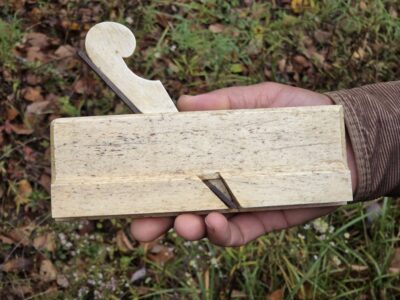
Reflecting on the bountiful tools I saw last weekend at the PATINA tool shindig I was reminded of a tool my friend Justin showed me when he visited a few months ago. Fashioned entirely out of a whale bone, it is spectacular.
Miles's desk pt IX........
What a day, what a day. Glad it is over as it was very frustrating at times but I showed a lot of constraint with nothing being broken or enjoying free flying lessons. I started this journey by going to the VA in the AM to make an appointment. The West Roxbury VA put in an order for an echocardiogram but they scheduled it for May and the CT guided biopsy is in april. Defeats the purpose of the echo needing to be done before the CT biopsy.
Normally this would have been an easy thing - just sign into health evet and message my PCP. Have her get me an echo here at the Providence VA. The rub? I couldn't sign into health evet. But I was able to talk to the clinic rep and she left a message explaining the hiccup to my PCP. Now I wait until they call me.
That didn't that long and I was back at the barn a little over an hour later.
That was errand #1. Errand #2 was dropping off a pair jeans I needed to have taken up. I have short legs and Wally World doesn't sell jeans in my size which is a 28 1/2" leg. Finally wised up and on the way home I stopped at the tailor I used before and they are no more. The location (which is conveniently close to my house) is closing. They are permanently moving to another address.
No biggie, I went to the other location and they aren't open yet. The windows were papered shut and there was a building permit on the shuttered front door. It is going to be a while before they will be open for business.
Found another tailor and it is one my wife had used for a long time. $10 to get my inseam taken up to 28 1/2". I'll find out on friday if it pays off. BTW Lands End sells jeans in my size and it is the only mfg that I know of that will do custom sizes. However, Wally World jeans are $20 and Lands End are $50 plus.
After I was done with errands #1 & #2, and getting gas, I started to deal with the login dot gov hiccup. This is where the frustration exploded. The security associated with these sites makes me nutso - my wife left to go shopping while I did battle with it. I endured and the reward I got was being able to log in finally.
Fixed my health evet login and it worked. Signed in/out four times to make sure it wasn't a fluke. Got my IRS 1099Rs from the last two retirement accounts. Found out that one of my retirement accounts is still intact. I never set it up after I retired from the VA. Not looking forward to the fun setting that up will be. Lost $2317 last year. On a brighter note, since 2021 (when I retired), it has grown over $21K.
I got to the shop after 1300 and I didn't get a lot of time on the pond. Puttered mostly muttering to myself before killing the lights and going topside.
 |
| hmm...... |
Chopped the last mortise in the bottom rail. The chip out is visible and gluing it back down did diddly with hiding/blending it in. At least it is on the bottom and won't be a flashing neon sign hiccup.
 |
| hmm..... |
I thought I had made this mortise (the chip one) wider but I hadn't. The slat is wider in both directions then the mortise is. Big smiley happy face on.
 |
| Houston we have a problem |
I laid out the mortises on the wrong side of the top rail. I had put the rails into the legs to make sure that mortises were in line from the bottom to the top rail. Couldn't do that because there were no mortises on the underside of the top rail. The flip side of the coin this turned out to be lucky for me. The errant mortises will never be seen once the top goes on.
 |
| I'm an idiot |
Checking the other side and what to my unbelieving eyes did I see. The same hiccup with the mortises laid out on the wrong edge.
 |
| the why |
At least I know why I had a serious brain fart twice. Hopefully I'll remember this when I go the two long back rails. Anyway, I saw top labeled on the rails and that is where I did the mortises. Didn't think that all the way through twice.
 |
| getting frustrated |
I must have had a ton of residual nutso energy from straightening out my log in issues because I screwed this up. The front rail should have been flipped 180 with no mortises laid out on it. Oh well it was still a semi productive day for me.
 |
| came today |
Trying a new shellac for me. I usually get blonde mostly because this wasn't in stock when I need to order some. The blonde has a hint of tint to it and I'm curious as to how clear this shellac will be.
 |
| two things for me in one day |
Feels like xmas almost. I already read one of the articles and it calmed me down. I'll probably finish this by tomorrow at the latest.
accidental woodworker
New Model Mandolin: 2
I would have bent my first set of sides during my first year at the London College of Furniture (1976/77) and I’ve bent a fair few bits of wood since. It never ceases to amaze me what you can do with a drop of moisture and a bending iron. I wasn’t 100% sure about the extreme bending that this new shape would need but as you’ll see (spoiler alert) it all went well. So, in part two, I make the rim of the mandolin: bend the sides, fit various blocks, linings etc and use my radius dish for fitting the back. Also, I get the neck blank made too! Quite a lot to take in, so get yourself a cup of tea.
Cheers Gary
Miles's desk pt VIII.......
 |
| sneak peek |
Dry clamped the base and set the top on it. I haven't that got to its final size yet but I wanted to check that I got it right. Spoiler alert, I did.
 |
| dry clamped base |
This is looking good IMO. Simple, plain, and functional. Thinking about doing something with the bottom of the legs - maybe a small taper?
 |
| hmm....... |
Three of the four legs have cracks in them at the top. The tenons all fit snug and a few were obviously too snug. I'll glue the cracks and set them aside to cook until tomorrow.
 |
| glued and cooking |
Just to be sure I'll keep these clamps until tomorrow. On the fourth leg I tried to open any hidden cracks in it with a chisel leveraged against the mortise walls. No cracks or even the slightest hint of any.
 |
| slats |
The slats are slightly over 3/4" x 3/8". The mortises are a frog hair under 3/4" x 3/8". The plan all along was to plane each slat to fit. I want the tenons to be gap free in the mortises.
 |
| ain't happening |
I haven't used this mortise machine in over 5 years? The switch is toast and I had to replace the starting capacitor. It still turned on (switch is now plug it in/out) without any sparks and ran smoothly. However, the widest rail is too tall to fit under the mortising chisel. The shortest one barely fit, there was barely a 32nd of clearance. Scratched the idea of using the machine to chop the mortises.
 |
| first step |
I have done slats in this manner 3 or 4 times already. I found that taking a chip on all four inside edges first helps a lot. It greatly helps with keeping the top of the mortise clean and defined.
 |
| first mortise done |
It shouldn't take more than one or two swipes of a plane to clean up and fit the slats to the mortise.
 |
| more 3/8 and less than a 1/2 |
I am eyeballing the depth of the mortises. I want them roughly to be 3/8-1/2 inch deep. The slats are not structural so there isn't any need for the mortises to be deeper than this. It is also the same depth I did on previous slat mortises.
 |
| sigh |
Had two boo boos chopping the mortises on the first rail. The first was a big chip blew out on the 3/8 width. Super glued that back down ok. The second one was a split/crack that said hello when I chiseled down on the long mortise wall. Glued that one back together with yellow glue.
 |
| sigh, again |
After waiting 30 minutes I started chopping the mortises again and another split/crack shook hands with me again. Glued that one and the first again because it wanted attention too. Clamped it and set it aside to cook.
 |
| ready to chop |
Got the other 3 rails ready to chop the mortises. I went with 9 slats on each side. After eyeballing the layout adding another 2 slats (11 total) didn't make much of a difference. I might add extra to the back though as it is several inches longer than the sides.
accidental woodworker
Miles's desk pt VII..........
 |
| surprise |
The glue bond from the PVA so far has been very easy to break with just a few gentle taps of a mallet. I tapped the bottom of the vertical divider first, then a few on the back of it. I was surprised to see that I had used the same dovetail joinery that I had used on the rails.
Before I can see if this will come free, I'll have to unscrew the drawer guides at the front. Fingers crossed that I'll be able to break it free intact then reglue it hiccup free.
 |
| one more |
I thought this was done but it ain't so boys and girls. Workshop dust settled on the shelf and if felt 100 grit sandpaper. I rubbed it down with 4-0 steel wool and applied the last coat of shellac.
 |
| splitting the cheeks off |
None of the cheeks ran into the center of the tenon. For the most part they split straight down with a few running out toward the outside face.
 |
| done |
Quick and easy to whack this out. It took me about 45 minutes to do all 7 rails.
 |
| first one |
Haunch not done, just fitting the tenons to the mortises first.
 |
| fitting the top front rail |
I have to fit and dry clamp all the rails first. Once that is done I can layout and do the spindles on the sides and the back.
 |
| dry fitted |
I hadn't realized that there was such a color difference between the front drawer rail and the legs. However, the grain pattern I like a lot and it will be a focal point of the desk once it is done.
 |
| ugh |
Got a gap on the left bottom side. I fiddled and faddled with it for almost an hour trying to close it up.
 |
| closed up |
I fettled this in small increments which is why it took so long. I used my shoulder plane to knock down the back shoulder - from eyeballing it, it was tight on the back and a gap on the front. (oops it would appear upon editing that I didn't post the correct pic)
 |
| first dry fit |
This looks a bit bigger than my desk even though this one is few inches smaller in both directions. No gaps anywhere - I was able to close up all the shoulders tight with the clamps.
 |
| last two rails |
I got the first 5 rails fitted by 1457. Decided to stay past quitting time and fit the last two. Got those done by 1546. Shut the lights and headed topside.
I had a few hiccups along the way. Nothing that caused a shutdown but required a few minor tweaks. I did the haunch wrong on two rails - neither boo boo will show once the rails are glued and cooked. The last one was the back top rail.
 |
| sigh |
I wasn't paying attention and when I fitted the tenons and the knot hole ended up on the outside face. Got lucky and I was able to reverse the tenons into the opposite mortises. I had to thin one tenon to get it to fit. It was too snug and split the leg. I'll have to glue them up before I do the rails.
accidental woodworker
My Piece for the Woodcarving Illustrated magazine
Just a quick blog post about my carving being featured in the Fall 2025 issue of Woodcarving Illustrated. I wrote a step by step guide on how I create my whimsical houses and accompanied it with detailed photographs. It was a fun little project.
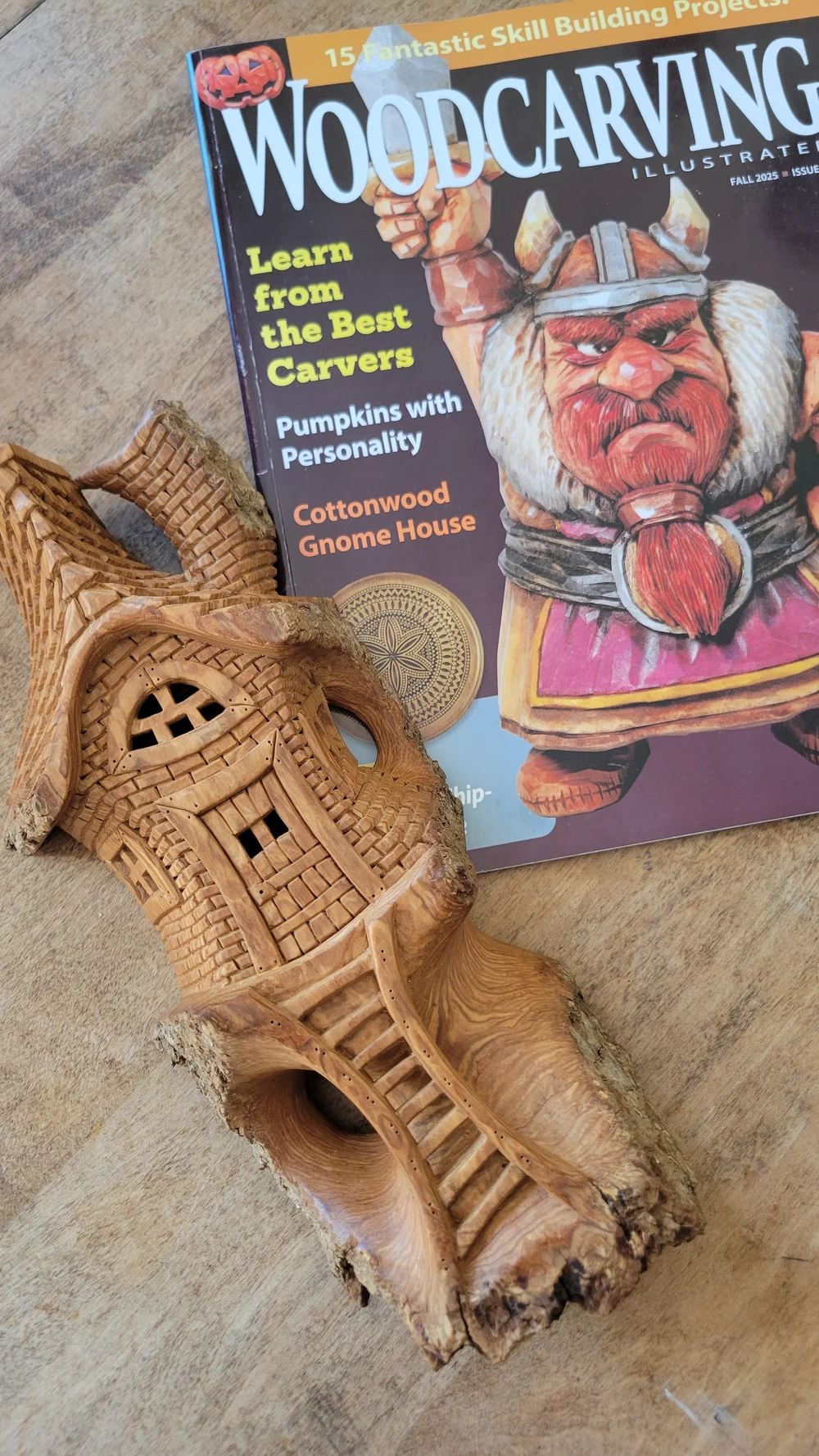
The piece is named ‘‘Guide’s Cottage’’ and is around 14 inches tall, done in cottonwood bark from British Columbia.

Why are you reading this?
Miles's desk pt VI & Leo's dresser pt I........
I had 3 things on the 'A' to do list and two were good and one went south on the express. The express one was frustrating and I wish I could have reached out and grabbed and gave it free introductory flying lessons. But I digress so on with the keyboard diarrhea.
 |
| the first good thing |
I was determined today to at least get all the mortises done for the desk. I had to add this piece of a 2x4 for the router. Without it was getting tippy while at the end of the cut. All of the top rails will have a haunch and this facilitated making that easier and safer.
 |
| yikes |
On the last mortise the router bit gave up the ship. Got lucky that it broke off and didn't go nutso and chew up the mortise walls. I finished getting to depth with a solid carbide 1/4" diameter up cut spiral bit. Cleaner and nicer finish then the broken router bit did.
 |
| outside mortise wall |
The plan was to make the tenon a wee bit wider by chiseling the outside wall. I had set the router bit a few frog hairs off the outside of the layout line.
 |
| hmm..... |
I took off a strong 32nd on all 12 mortises.
 |
| dips and dings |
All of the dips and dings happened on the outside mortise walls. Chiseling didn't remove them entirely, but enough. The shoulders on the rails will hide all of the dips and dings.
 |
| done |
It took a while and it wasn't until the 3rd leg that I hit my stride and developed a rhythm doing the mortises. Got the mortises completed a lot quicker than I would have if done with a mallet and a chisel.
I think if I use the router again for mortising that I will make a cradle for the legs. Doing it on the workbench was a PITA due to the vacuum enclosures thing a ma bobs on the router. I got a wee bit frustrated with them and I ended up breaking them off with a mallet. After they were gone things progressed a lot smoother.
BTW I tried to remove the vacuum hood/enclosures but I couldn't figure it out. It looked to me that they were a permanent things. I don't think that I will miss them because I had no way to hook up my vacuum to it anyways.
 |
| erasing the layout lines |
Used my high frog 4 1/2 to plane off the layout lines. I didn't have any issues with squirrely reversing grain tearing out.
 |
| interesting |
I had forgotten about this black milk paint. When I stirred it there was some bottom settling but I had no problems stirring it up and getting it lump free. I painted a scrap of pine and the adhesion seemed to be as good as the first time I used it. I am clueless as to what bad milk paint would look like, smell, or what the consistency should be.
 |
| shoulder work |
Mortises done - ends squared off and the outside walls chiseled. Next up was sawing the shoulders on the 7 rails. I didn't think I would get them all done today but I did. I sawed the last one at 1505.
 |
| LN tapered carcass saw |
This is the 3rd time I used this tapered LN carcass saw. I bought this when I had sent my other LN carcass saw to them to be sharpened. I didn't want to be without one while it was being sharpened. I bought the tapered one because the straight blade carcass saws were out of stock.
 |
| done |
Tomorrow I'll start on the tenons. The plan is to chisel the cheeks and plane them to fit the mortises with my rabbeting blockplane.
 |
| hmm....... |
I hadn't planned on doing this but the rail came off with gentle persuasion with a block of wood and a mallet. The fit of the rail is snug and I'm thinking now of using yellow glue - tite bond - to secure it.
 |
| hmm...... |
I found the can of gray paint but it didn't look so good. It is almost two years old and had skinned over on the top. I got it from Benjamin Moore and I'm sure they have it in my customer data base.
 |
| hmm..... |
I remember now how I rabbeted the back of the rail. I glued & nailed on a strip of pine but the 'rabbet' stayed attached to the plywood. I'll have to figure out how to attach the plywood to the back of the rail.
 |
| kept going |
Popped off the third rail and this time the 'rabbet' came with the rail. I pulled it off, scraped the old glue off it and the back of the rail and glued and nailed it back on. The dust panels aren't structural and aren't necessary to be glued/secured to the back of the rails.
 |
| glued and cooking again |
Used the same nails to register and secure the 'rabbet' again. I stuck in the vise to ensure a good glue bond this time.
The dresser is almost fixed now. It went a lot quicker and easier than the nightmare scenarios I was running through the brain bucket. Maybe I can talk my wife into painting it when I fix glue failures.
I spent over an hour on the southern express trying to log into my government accounts to get my IRS 1099 forms. It was an absolute shit show. There are too many accounts and all are different. The problem is I only log into them 2-3 times a year and they have expirations on the time for passwords. It seems they system forgets you and you have to start from ground zero to verify and log in again. I got two 1099s and I have two more to get. Not looking forward to that happy time.
accidental woodworker
The Japanese Gennou & Handle Part 23 – Finishing the Job
A man in love is incomplete until he has married. Then he’s finished.
– Zsa Zsa Gabor
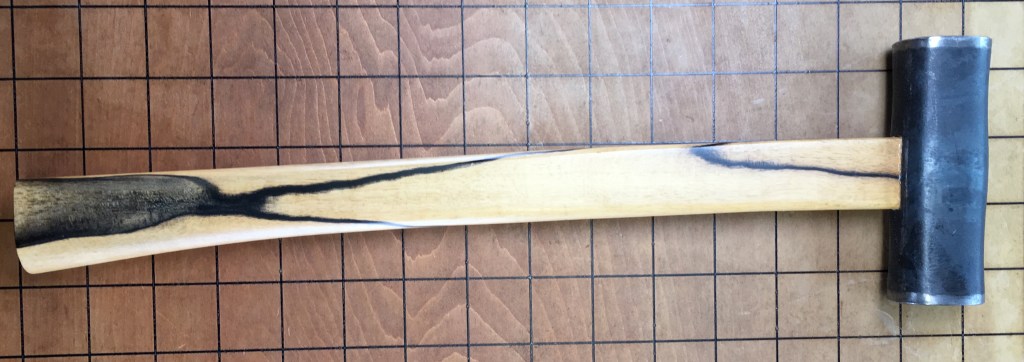
This is the last article in our series about designing and making a handle for a Japanese gennou hammer.
In previous articles in this series Beloved Customer completed designing, shaping and fitting the handle of your gennou hammer and attached the head. Then you tested it and perhaps made adjustments. Assuming Beloved Customer is satisfied with the results of those adjustments, at least for now, the time has come to sand it and apply a finish.
Finishing Options
There are a couple of approaches your humble servant might propose on the subject of finishing tool handles. The first is perhaps the oldest, and easiest, and that’s to do nothing. After all, tools are made for hands not museums, and flashy finishes too often make otherwise workmanlike tools look silly.
In addition, most woods (except for those that might cause allergic reactions) perform just fine unfinished, thankee kindly. In this “au natural” approach, you may choose to leave tool marks on the surface of the handle without sanding them into oblivion, lending your handle undeniable gravitas and dignity, even character.
An unsealed, unfinished handle will, however, unavoidably become stained and discolored, and it’s head may not stay attached as long as a well-sealed, well-finished handle. I say this from experience.
A good light-duty finish material for an au-natural handle is a quality non-slip floor paste wax like Johnson’s well-known product in the yellow metal can. Does it seal the wood? No, but it does help keep the handle looking cleaner. Why floor paste wax? Some waxes, for instance those used to polish furniture and automobile paint, are intended to provide a slick surface that encourages water to run off and to which dirt doesn’t adhere well. History has shown that slippery waxes used on floors will result in slips, falls, and a transfer of wealth to the legal profession. For the same reason, carnuba automotive wax is not ideal for tool handles, while non-slip floor wax is.
And then there are the chemical finishes such as linseed oil (BLO), milk finish, tung oil, shellac, varnish, lacquer, polyurethane, etc. To one degree or another, these chemicals tend to seal the wood reducing the penetration of dirt and oil, and (sometimes) slowing the movement of moisture into and out of the wood.
But what chemical finish is best suited to a gennou handle? It is far beyond the scope of this humble scribble to properly describe, much less evaluate, the many varieties of finish applied to wood, so I will simply provide a few comments.
Linseed oil and BLO, a by-product of the flax plant, are organic materials used for centuries if not millennia as a traditional finish in Europe. It was once used widely for paint and, until it was replaced by rubber and later petroleum products, flooring and waterproofing materials. Have you heard of “linoleum?” Of course, this was back in the day when lead was a common ingredient in paint and makeup. Linseed oil no longer has any value as a finishing material for wood because it never really dries without adding problematic, even toxic, chemicals called “driers,” it seals poorly, collects dirt, and discolors badly over time. But because it’s constantly mentioned in old writings, which many people trust just because they are old, linseed oil products are still in-use today. To advocates of linseed oil products I say “make sure you soak your oily rags in water and dry them outside well away from any fuel (like your house).”
I am a fan of the modern milk paints, but do not like it for tool handles. Nonetheless, it’s a valid option.
Tung oil is an ancient finish, but the price nowadays far exceeds its value, assuming you can even find an unadulterated source.
Shellac creates a beautiful surface coating but it’s far too delicate for tool handles.
Standard synthetic varnish, nitrocellulose lacquer, urethane and polyurethane are readily available, easy to use and can create a beautiful, durable finish, but when used in the traditional manner, the surface film coating they produce eventually chips and cracks with time, exposure to ultraviolet light, and expansion and contraction of the wood to which they have been applied. And every scratch accelerates this degradation.
Why is degradation of film finishes the a problem you say? The obvious downside of a once beautiful finish looking ratty aside, every defect in a surface film finish promotes the movement of moisture into and out of the wood, and of course increases the swelling and shrinkage of the wood it’s intended to protect. What most people don’t realize is that, as time goes by, the solvents and compounds in film finishes intended to provide flexibility in dealing with expansion and contraction of the wood dissipate causing the finish to gradually become more brittle, and break down and crack at a ever-increasing rate, independent of dings and other defects.
In modern times, the use of latex rubber in water-based paints has greatly reduced this problem, but such paints are not especially durable as a tool handle finish.
Sanding
If the au-naturel approach appeals to you, I recommend erasing marks left by files and rasps and replacing them with crisp marks and cleanly cut surfaces left by sharp edged tools like knives, carving tools, and spokeshaves. Unless a chemical sealer/finish material is applied afterward, a plain sanded finish is probably the worst surface treatment possible, whereas a surface cleaned with sharp blades will serve you better. I often use this texture for the endgrain butts of my hammers and saws.
If, on the other hand, you prefer a smoother finish, and are prepared to apply a chemical finish, then by all means sand away. But please do not sand the tenon. If you decide to sand the handle before installing the head, please apply masking tape protection to the tenon.
How fine should you sand your handle? I think 600 grit is fine enough, but I’ve gone as high as 1200 grit on fine-grained, hard woods like black persimmon. Did using such fine sandpaper make a difference? Nah.
After you’ve sanded the surface to where you like it, the next job is to eliminate hidden hairs. No, this does not involve applying hot wax to delicate areas of the body and then violently ripping out body hair so that you look delightfully-sleek in your new sequin string bikini, but rather it’s the job of encouraging the naughty ends of wood fibers still connected to the handle, but currently pressed flat onto and into the handle’s surface, to stand up so we can cut them off using sandpaper.
Dealing with these fiber is always important when finishing wood because, with time and moisture, they may pop up over time creating rough patches in the finish encouraging degradation. Once they are standing and no longer hidden, we can cut them off at the base with sandpaper to create a durable, smooth surface long-term even when exposed to moisture and sweat.
Although it’s not used much nowadays, sanding sealer was originally a shellac product developed specifically for this purpose.
To raise hairs, lightly wet the handle’s surface (but never the tenon) with water and allow it to dry completely. Some hasty people like to dry the wood quickly with a forced-air blower or even propane torch at this point to make any loose fibers stand up immediately in preparation for the next sanding pass. But simply allowing the wood to dry naturally is effective too.
This is an ancient, very effective technique. Please do this at least twice, after which you can apply the finish material.
 Kanō Hōgai, Two_Dragons_in_Clouds (1885), ink on paper. Philadelphia Museum of Art. Father and son dragons are depicted playing in the clouds.
The London Finish
There’s a durable wood finishing technique I learned from custom gunstock makers that I wrote about in an earlier article about handplanes called the London Finish. This is the finish I recommend for hammer handles too. It can be as subtle or as flashy as you like.
A pretty handle is nice, but the key objectives for applying a finish to your gennou handle should be (1) to moderate swelling and shrinking of the tenon during seasonal and climactic changes in humidity; and (2) to prevent oil and dirt from penetrating the wood making it look grubby. This matters because such swelling and shrinking can cause the head of your gennou to loosen and do naughty, acrobatic stuff at inconvenient times. And a greasy, dirty handle is no way to treat a friend.
If the head is attached when applying the chemical finish of your choice (I recommend it be so), please tape it well to keep finish off the metal. Apply masking tape to the hammer head on all four sides of the eye, but leave the end of the wooden tenon exposed.
Tape the rest of the head well with masking tape.
Soak the finish material (flat varnish or polyurethane thinned 100% with high-quality thinner) into the eye and the butt as deeply and thoroughly as possible. Plan for three or four applications allowing time for the material to soak in and dry.
Do no use low VOC thinners as they contain politically-correct compounds of water, acetone, emulsifiers and other counterproductive substances the State of California’s poorly-educated but thoroughly-conflicted and richly-corrupt lawyers have determined will save the polar bears, but that will weaken the finish.
If you faceted the butt and want to keep it that way, you must be careful when sanding it or the facets will disappear. This is a matter of personal preference.
Of course, be sure to apply lots of finish to other surfaces of the handle, and wet sand them well as described in the article linked to above. Don’t allow a surface film to dry except for the first time as described in the webpage linked to above.
Hammers are lifelong tools, but too often handles are not. You can help your gennou’s head stay tight longer, stay cleaner, and look better longer by applying a London Finish instead of a thick surface film finish.
YMHOS

If you have questions or would like to learn more about our tools, please use the questions form located immediately below or email us at Covingtonandsons@gmail.com. Please share your insights and comments with everyone in the form located further below labeled “Leave a Reply.” We aren’t evil Google, incompetent facebook, or gossipy X and so won’t sell, share, or profitably “misplace” your information. Promise.
A list of our gennou heads: C&S Tools – Gennou Hammer Head Pricelists & Photos
Previous Posts in The Japanese Gennou Hammer & Handle Series
- Part 1 – Introduction
- Part 2 – Ergonomics
- Part 3 – What is a Gennou?
- Part 4 – The Varieties of Gennou: Kataguchi, Ryoguchi & Daruma
- Part 5 – Kigoroshi
- Part 6 – The Ergonomic Anaya
- Part 7 – The Unblinking Eye
- Part 8 – Head Style & Weight
- Part 9 – Factory vs. Hand-forged Gennou Heads
- Part 10 – Laminated Gennou Heads
- Part 11 – Decorative Gennou Heads
- Part 12 – The Drawing: Part 1/6
- Part 13 – The Drawing: Part 2/6
- Part 14 – The Drawing: Part 3/6
- Part 15 – The Drawing: Part 4/6
- Part 16 – The Drawing: Part 5/6
- Part 17 – The Drawing: Part 6/6
- Part 18 – Wood Selection
- Part 19 – Laying-out the Handle
- Part 20 – Making Sawdust
- Part 21 – Installing the Head
- Part 23 – Finishing the Job
The front page.
A lot of work has gone in so far. It's good to be appreciated.

On the front page, and more inside.


Ploughless Ploughing Grooves

This blog post is of course free, but you might want to watch the video we made and join your fellow enthusiasts. Here is the link. If a picture does paint a thousand words, then a video could do more. Enjoy the following:
Hard to imagine so little wood can give back so much. Imagine, four lifetime tools designed and made to last for 150 years of full-time daily use from a few scraps of wood that. If you bought it, the wood might cost no more than £8. Oh! Interesting. You didn't need more than the real power of hand tool woodworking. Not a machine in sight. Imagine.So you don't own a tablesaw or a so-called power router. If you're like me, you don't want these space hogging screaming banshees anyway. Thriving without them truly improves your self high-demand life. The small cluster above would take me a couple of hours of machine-free woodworking, I get the ideal exercise to renew and maintain my whole body and mind and my happiness is quite complete. No need to make a bunch of jigs, buy in an array of support supplies or rely on dust and chip extraction, wear dust masks, eye and ear protection for any of it and I could listen to a podcast or music as well.
 We don't all own a plough plane to plough with, and sometimes we need a precisely made groove, yet we'd rather do it using our own hands and work totally in self-powered ways throughout our days. I have dug out many a recessed channel in wood without a plough plane close to hand.
I know not everyone owns a plough plane and when you need a short length of groove or channel in wood you might not want the cost and trouble of buying one in. I've made this ploughless groove often enough through the years because not all grooves go all the way through for different reasons. Generally, plough planing grooves rely on the groove going all the way through. Take your time and follow the steps, and it will work for you too. Here is the video but hope you'll stiil read through this post. Enjoy!
 Using your imagination, use this picture to inspire you. Your hands pick up a quarter-inch chisel. You've sawn the walls with a tenon saw, and all you are doing now is tap, tapping a few chops in between the two kerfs to split-separate the fibres with or along the grain. Keep reading!
Step One:
It's best to set the mortise gauge to the width you want and to mark the parallel lines in the place you need them. This process parts the surface fibres, which is just a good and practical strategy.
 If you do not have a mortise gauge, just use a marking gauge, working from both sides of your workpiece.
Step Two:
With a sharp, pointed knife, carefully define the walls of the groove slightly deeper by pulling the knife point into the gauge lines to cut deeper into the fibres. Watch for grain change in direction and counter any straying grain intent on taking you off course. Sometimes you simply need to change direction 180º and go the opposite way. Sometimes you simply lower the angle so the blade rather than the point severs the fibres.
 Deepen the gauge lines with a pointed knife, ready for sawing. You could install the guide first if you want to. Often, I do not use any fence, and that is why you don't see me using it here.
Step Three:
I suggest you do this, though I often do not; Superglue a strip of wood right on the gauge line so that saw cuts are with thin the groove area. Three tabs of glue dots sped up with accelerator secures the strip firmly enough to work to with the saw strip in two seconds. . .
 . . . But I added one for this article. The simplest and most practical way to attach a one time or temporary fence to guide tools like saws and chisels is to use clamps, but that is not always practical on narrow edges. I usually use superglue with a squirt or two of accelerator. This accelerator sets the glue in under five seconds, and two or three dots will usually be enough.
 Adding a brief and short burst of accelerator corresponding to the superglue blobs means that, when setting the guide to the workpiece, the set is almost instant, and you are ready to register your tools to it.
 No margin, just tight to the line, works perfectly well. The saw plate rides to the guide. If the depth is critical, you can clamp a depth guide to the saw plate itself so that the saw stops cutting when the depth guide hits the surface of the long guide you are working to. I probably would just go for a guesstimate depth.
Step Four:
With a mid-sized tenon saw (12" or so), start at the point furthest away from you and saw with short strokes, using the point of the saw inside your gauge line, and moving backwards until all of the teeth engage. With subsequent strokes, lowering the saw as you go, saw down as far as your intended groove depth.
 The saw kerf of my tenon saw deepens the walls to depth with a few strokes. My 5mm depth on a short length of ten inches takes only ten strokes, and the end result is a pristine, to-the-line sidewall to any groove.
 A swift strike splits the glue line right down the middle of the hardened glue, but not usually damaging the wood. Residue is easily chiselled away with no harm to the cutting edge of the tools. Both separated pieces can be used many times over.
Step Five:
With both walls sawn down to depth, use an appropriate sized chisel to develop stop cuts as you might say a mortise. Work bevel down and backwards. This will part the fibres by short split-cuts that can then be removed with jab-cuts to remove the bulk of the waste
 We call these chop cuts. Work from the point furthest away from you and come backwards. You will gauge the distance between chops according to your wood type. They all split differently. Even so, 6mm apart is plenty and at those short distances the splits come quickly. By this, we rely on the characteristic, long-grain splitability of grain to split longwise along the grain. The waste wood is easily lifted away with a few jabs with the chisel bevel-down.
 Here is the fast result of bevel-down jabbing to lift the fibres away and ready for the poor man's router plane (below) to level the field.
Step Six:
A simple hand plane router can be made from any odd scrap of wood and a suitably sized chisel. In my case, the groove is 1/4" and I installed a 3/16" chisel through a tight-walled hole by tapping it into place. With the first strokes in the groove it will usually feel a little jarring, but the jaggedness can be countered by tilting forward to reduce depth of cut. Subsequent cuts at a lower angle remove material smoothly.
 Simple solutions help to make woodworking both enjoyable and doable in the zone. This is the original Paul Sellers' Poor Man's Router. Go to this link to watch the simplicity of making and using one. This one I am showing above is a small version. For my blog post, go here. Notice that the bevel of the chisel faces down, not up. It makes a huge difference to the finish. Oh, ignore the groove. It was a scrap.
 Although this usually delivers a perfect recess, sometimes it might not be as smooth as you want, but the bottom will establish a level you can work with just fine without compromise. It's important to tilt the plane forward in the opening strokes. You can control the depth of cut this way, and it saves incremental shallow setting to speed up the process.
The result is good, and especially in close-grained beech.
 My end result is as perfect as it gets, and that's because grain orientation aligns with the stars. The advantage of routing the bottom with a hand router plane like this one is the ability to reorient the plane accordingly.
Tools used:
Mortise or marking gauge
Knife. I use a Stanley 0-10-598 folding pocket knife
A 1/4" and 3/16" bevel-edged chisel
Chisel hammer or mallet
Tenon saw
another one bit me on the butt.......
About 4 years ago (?) Tools for Working Wood sold a white PVA glue. I bought a small bottle to try and I liked it. I liked it a lot and I bought a gallon. No problems with it and it worked differently then yellow tite bond. However, things went south with the last gallon I bought. Things I glued up with it were falling apart. Glue joints were going south in droves. TFWW gave me a refund on the gallon I bought and as far as I know they don't sell it anymore.
I made a lot of things and I am not sure of what I made with this glue. So far 5 projects I glued up with it have failed. I was able to reglue them with tite bond without any hiccups. When my wife got back from North Carolina she brought another glue failure home. The dresser I had made for Leo was coming undone. I'll be fixing it along with all the other things I have on my plate now.
 |
| almost there |
With the exception of the end grain tops of the ends, this bookshelf has 5 coats of shellac on it. I only have to get as many on the tops of the ends. I've been searching for hole to stick this in and so far nada. I really want to keep this and the books in the shop somewhere.
 |
| sigh |
It doesn't look that bad from 8 feet away. I unscrewed the drawer enclosure on the top to make it easier to bring it down to the shop. Amanda told me that it was getting impossible to open and close the drawers.
 |
| right side |
All of the cross rails came loose on the right. On the left side only
two are loose and two are still secure. Or at least I couldn't jar or
move them with gentle taps of a mallet.
 |
| hmm..... |
This was encouraging - I was able to easily clamp the ends of the rails tight tight to the sides. I think I'll use epoxy to secure them this time. I'm not sure that I'll be able to remove the rails, scrape the bad glue off, and reglue them. I don't know if the white PVA glue will loosen with heat and moisture.
 |
| dust panels |
I don't remember how I secured the dust panels. From feeling the underneath of the rails it I think the dust panels are in a rabbet and not a groove. The glue bond there wasn't good enough to keep the rails in place.
The back rails are still secure - they don't have the dovetail joinery that I used on the front rails. The back rails are secured with screws from the back plywood panel into the rails. It makes sense that the screws are keeps things secure and tidy on the back.
 |
| one done |
I am rusty with using a big boy router. I made a couple of dings on the mortise walls. I had to push the router against the rotation of the bit. A little hairy trying to keep the edge guide up tight against the stock. I like how clean and precise the mortise came out. Instead of doing anymore I'm going to wait until the AM.
Getting the dresser out of the car and down into the cellar took a toll on me. I'm feeling my age because it took me a lot longer to get into the shop then I remember getting it out of the shop a couple years ago. (finished this in 07/2024) Not feeling sore yet but I do feel like taking a nap big time.
Ordered some shellac yesterday and with S/H it came to $72.95. It has gone up again but I'll keep buying it because it is my favorite finish. I have been looking for something called a 4 part finish. Shellac, linseed oil, beeswax, and ????. I read an article about it (no recipe) and it was the finish valued by old masters. Still hunting down what the ???? part is, maybe it is alcohol?
accidental woodworker
Cleaning up an E. C. Atkins Crosscut Handsaw
Last time I wrote about hammering out the kink that this saw had. When I was satisfied with the plate's straightness, I moved on to the handle, the cleaning of the plate, and then sharpening.
The finish on the beech handle scraped easily and after filing and sanding it smooth, I gave it a couple coats of BLO. I much prefer the feel of an oil finish over a varnish or poly finish.
 |
| The handle ready for finish |
 |
| A few days later after the BLO had dried |
I also took a wire wheel in a drill to clean up the saw bolts and medallion. They really shine up nicely when rubbed on a strop.
For the plate, I started with a razor blade to scrape off the heaviest rust and grime. Then I used sandpaper, eventually using a stick with sandpaper wrapped around it to help remove the rust and grunge that had built up over time. Sanding included grits of about 50 up to 220 (or 400?) and it looks pretty respectable now, though there are still some rough marks or light pitting. There was no etched maker's mark on the saw plate, so I didn't have to avoid any areas with the sanding.
 |
| The plate before cleaning |
 |
| Sanded in sections - a lot of elbow grease expended |
 |
| Still some light pitting |
 |
| But the plate looks so much better than before |
 |
| This pic shows the degree of curvature of the breasted tooth line |
I took great care in sharpening the saw. The breasted tooth line needed a lot of jointing to get down to a shiny bare metal spot on every tooth tip. I was very careful to file the teeth so as not to end up with alternating deep and shallow gullets (cows and calves). I used about 15 degrees rake and 25 degrees fleam. The saw was over-set by a lot, so I stoned the tooth line on both sides several times to knock down the set.
 |
| Looks razor sharp to me |
I shined up the brass screws and nuts and put it back together. The saw looks great and I'm sure it will be a nice user saw for decades to come.
 |
| Thar' she blows! |
Last thing: I didn't have a screwdriver that fit the saw nuts properly, so I made one from a piece of an old saw blade, a plumbing fitting, and a hunk of cherry. Last year I made a similar screwdriver for bench plane cap-iron screws and this one is almost identical but with a thinner blade.
 |
| The saw screws are much happier with their own custom-fit driver |
 |
| Fits well enough to stay in the slot |
Another nice saw in the collection. I've used the saw a couple of times now, and it cuts like a hot knife through butter. Sweeet!
two more checked off.........
 |
| a teeny bit |
Out of the clamps and on the flat reference surface with some rocking. Not enough that I am going to play with removing it. Now that this is done I'll have to find a hole to stick it in somewhere in the shop. It will hold all my reference books in one spot now.
 |
| reference line |
Laying out my reference line for the tapered pins. Ended up putting in 3 on each end. Two of them bled some glue and it looked like I drilled the holes for them at an angle rather then at 90°.
 |
| sneak peek |
The bookshelf is big enough for a couple of bigger reference books. The grey one is Robert Wearing's book the the next one is a shop reference book.
 |
| wood putty |
Decided to fill the gaps with wood putty over filling them with wood shims. Once books are in it the 'gaps' won't be seen anymore.
 |
| hmm....... |
Felt like I had no thumbs and an IQ ten points less than a lima bean. Couldn't figure out how the micro adjust thing work. Took a lot fiddling before I got it. But the big hiccup was turning the damn thing on.
The switch is built into one of the knobs. To turn it on you have to depress one part down and then squeeze another part of the switch. You have to do it in a sequence that initially escaped me. I was thinking about returning it because I thought it was defective. Finally got it to turn on but I couldn't duplicate it after I shut it off. Took a few but I finally figured out the push down and squeeze sequence.
 |
| one more to go |
Got the last coat on the back first thing in the shop. Two coats on the front until the final check mark goes in the done column.
 |
| this is surprising |
Instead of a stamped metal wrench, this one is actually cast metal. Metric too, rather than imperial. DeWalt is an american company but this router was originally made by Elu in Germany and now is made in Canada.
 |
| test cut |
This test cut took a while. Mostly figuring out how to turn it on and then setting the edge guide. I set the bit to be in between the pencil lines. I didn't do the mortising today but tomorrow for sure. I concentrated on getting the frames and the bookshelf done.
Found a new You Tube called Blond Mary. It is about a female automotive mechanic from somewhere in Europe. Not eye candy You Tube stuff but a competent mechanic who also does body work. So far it appears that she works mostly on Hyunda/Mazda cars and vans. When I was 16 I tried to get into an automotive tech school but I couldn't afford the tools. I like watching You Tube vids rebuilding engines and she does a lot of it. Not a lot of explaining and it is wordless.
accidental woodworker
Imitation is the Sincerest Form of Flattery
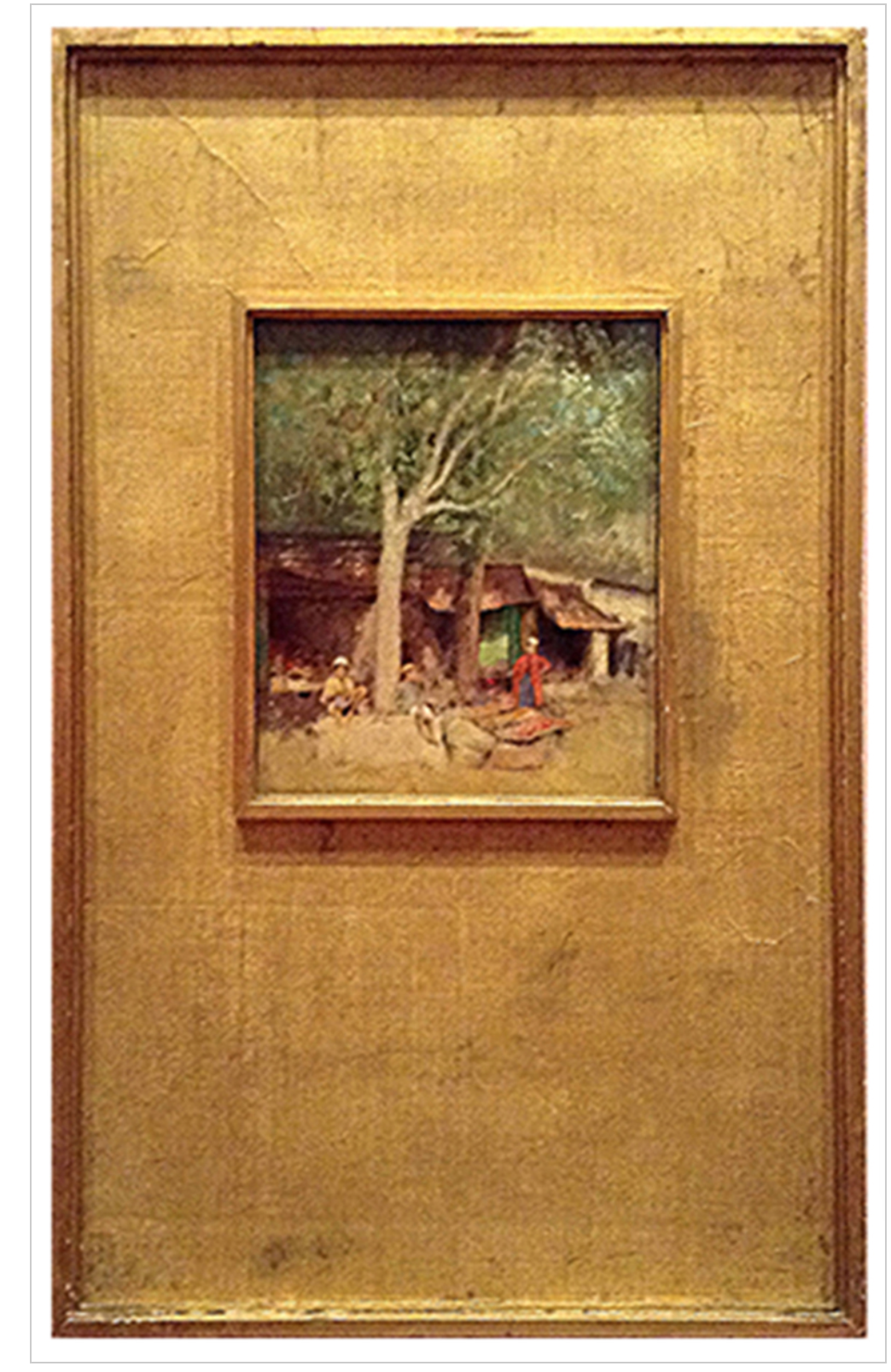

I’m betting that many of you have heard the phrase so that’s why I’m using it for this blog. It’s a phrase that has been attributed to many different people. This frame showed up on my Pinterest one day and it really appealed to me. It was originally from The Frame Blog which discussed Australian artists work from the late 1800’s. Those frames were made in Japan. The blog showed some of the construction details which consisted of the moldings assembled with miters and cross dowel construction. The framework was covered with paper or cloth. My wife recently completed a 10″x10″ figurative painting and I thought her painting would be a good fit for this style of frame. This work of her’s is going to her gallery, Meyer Vogl in Charleston, SC. It’s for their Ten Year Anniversary show the end of March.
The first part I made was the spandrel. That’s the piece that is inside of the frame; for tabernacle frames they are often curved or arched at the top. From the blog I learned that this frame had a lattice like arrangement of wood which was covered by material or paper. I chose to use 1/4″ MDF for that but still needed to figure a way to support the painting inside of the spandrel. Unfortunately I neglected to take a picture of that before cutting it open but milled some pieces of Basswood 13/16″ square which were glued, pin nailed and clamped to the back of the MDF. The reason for 13/16″ is so that I could pin nail from the backside with 1″ nails and not go through the front — that would not have been good!
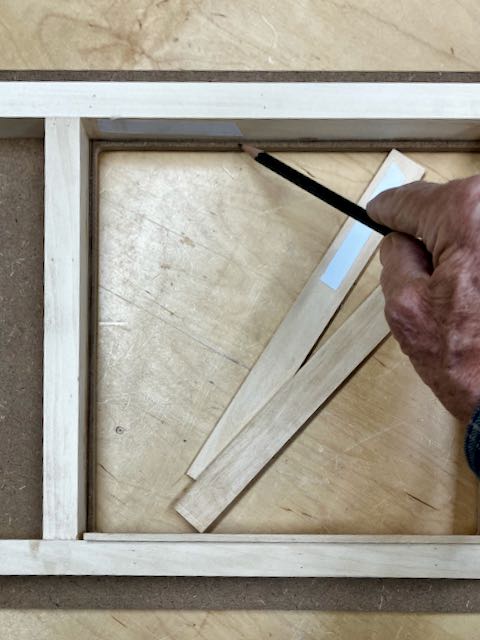 Sight edge after removing 3/16″ spacer
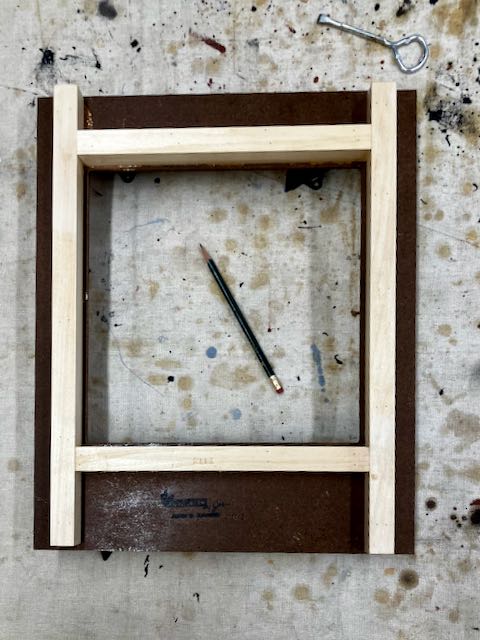 Completed spandler
The exact opening in the grid on the back is 10″ x 10″ and was removed on the router table with a pattern cutting bit. However; the opening needs a rabbet for the painting to sit behind. I used 3/16″ spacers which were attached with double sided tape. The first step was cutting the opening with a pattern cutting bit on the router table. Next, a small roundover bit formed a radius. You can see the rabbet in the left picture after the 3/16″ spacers were removed. The picture on the right shows the completed spandrel sealed with 4-5 coats of Zinsser seal coat shellac. There was some debate in my mind about using the MDF for the spandrel since it can be affected by moisture. Since I had MDF in my shop and had success with a very large tabernacle frame commission decided to use it. In addition to multiple coats of sealing shellac the next step will be a yellow burnisher/sealer followed by slow set oil size, and finally imitation gold leaf.
Once the spandrel was made it was time to start creating the molding for the frame. I liked the small, unobtrusive molding on the original piece. I’m imitating that so started out with 3/4″ x 2 3/4″ Basswood. Simplicity was my goal so the top of it has a shallow profile created with a router bit used to make tray bottoms. Knowing it’s almost impossible to center it exactly the insides were marked so that the rabbet is on the same side of each piece. Before cutting the rabbet I took the time to sand a slight radius on the upper edges to prevent the gold leaf from cracking (left picture below). The rabbet was cut on the tablesaw with a rip blade. Marks were made with a marking gauge, the first cut was done flat at the top of the rabbet. Cutting off the remainder of it required careful set up with feather boards and my shop made push stick (right picture below). It took some careful set up and planning but the creating the molding was a success. I know I only need 4 pieces for a frame but cut some extra just in case.
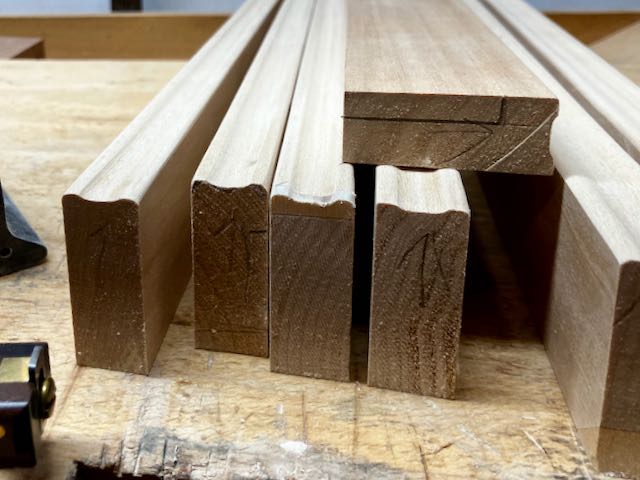 Profile in progress before creating the rabbet
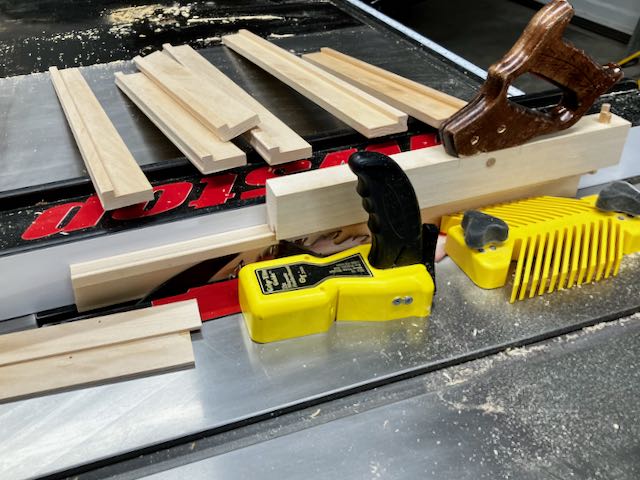 Rip blade for rabbeting
The frame was assembled in the usual way, after cutting the miters it was glued up and clamped with a band clamp overnight.
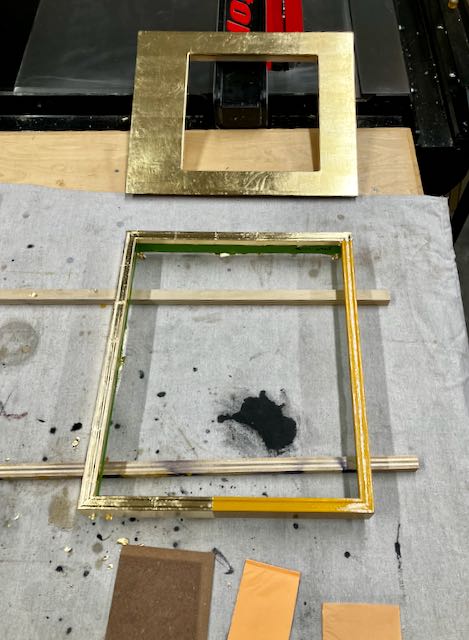
My usual procedure is to apply a coat of Zinsser seal coat shellac to the frame followed by Yellow burnisher sealer. I use slow set, oil based size and gilded the frame and the spandler at the same time. I wait at least 24 hours then burnish the imitation gold leaf with 4/0 Liberon oil free steel wool. The final finish on both of them is several coats of Platinum Blonde shellac applied with an airbrush. To mellow out the gloss of shellac, Liberon wax is applied with 2500 Mirlon abrasive pad. All that’s left is assembling the frame and spandrel.
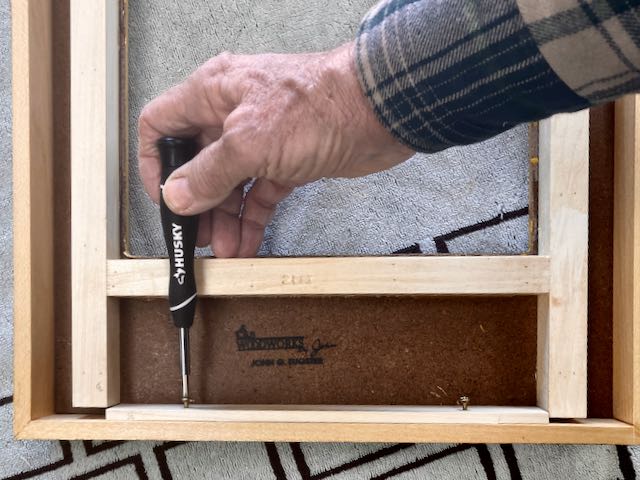
This was a bit of a challenge since there is a very limited amount of space to insert a fastener between the frame and the lattice work on the spandrel for attachment. That dilemma was solved by using a piece of Basswood that I had pre-drilled holes at a slight angle. After putting that piece in place the holes were marked with a pencil. A gimlet was used to create an angled starter hole into the frame for an eventual screw. That part of the frame is only 3/8″ thick so very careful to not go through with the screw. Assembly was successful — no screws p
Here’s a better picture of the finished project than the one above in the comparison shot. I concentrated when laying the leaf to keep the lay lines continuous through the cut out area where the painting is. The painting is on panel and was secured with points.
First Light by Diane Eugster Are All Those Old Turning Manuals Wrong?
 Hulot, pere "L'Art du tourneur mecanicien" 1775
I've always been puzzled why most of the turning tools listed in classic books on turning (published in the 17th - 19th centuries) are what we would now call scraping tools. One possible rationale is that scrapers are a lot easier to make than forged tools like gouges.
As I found myself diving more deeply into the literature, I discovered a couple of things. Early tool catalogs that show turning tools don't show a lot of scrapers.
They show gouges - as you would expect. Pre-1850s tool catalogs show gouges and instructional books from that era show a few gouges along with pages of scrapers. By the second half of the 19th century, this situation changes. Perhaps the tools were hard to make but I am unpersuaded that this is the only reason for the changing landscape.
For a more satisfying answer, let's look at the turning sections in Mechanick Exercises by Joseph Moxon, published in 1680. I have not been able to figure out where Moxon took his pictures from or if they are original. As in the joinery section, the book's turning chapter features what is considered the first set of instructions. Moxon very clearly states that you use gouges when turning softwood. But it gets interesting when Moxon lists the softwoods: "The softwood turners use is commonly either Maple, Alder, Birch, Beach, Elm, Oak, Fir and &c. and for some particular purposes each of these sorts are best."
If you have ever worked Elm or Oak, you will readily agree they are not "softwoods." Did Moxon make a mistake? No. He is differentiating between the woods that are normally used for turning furniture. The woods turners use for making everything from bowls to banisters, and differentiating it from the super hardwoods -ivory, ebony and boxwood among them. These were materials that were used for ornamental turning and by rich people who turned as a hobby. If you are a professional 17th century turner, you were not buying expensive instructional books on turning; you were using your funds to buy gouges and hook tools so that you would be able to make 300 banisters. On the other hand, if you were a wealthy person interested in decorative arts, you might decide to take up turning - and a book on how to turn ivory and other exotic materials might come in handy. Using gouges and other typical tools on ivory, especially in a human-powered lathe, would not really work, since the material is much too hard. But scrapers will work, and they would give you a good finish that could easily be polished up.
This also explains to me why so many of the fancy books by Plumier, Hulot, or Bergeron, devote so much space to scrapers and exotic fixtures for ornamental turning. None of these books are really about the bog-standard turning that professionals did at the time and still do, the standard work for architectural woodworking.
The next question is, When did amateurs start doing regular work and stop doing ornamental turning? That is a different story
that has to do a lot with the rise of the middle-class in the 19th century. The treadle lathe played its part in that story, which we should save for another time.
All the images in this blog post come from Hulot's 1775 "L'Art du tourneur mecanicien." Most of the early books on turning, including Moxon and earlier works, show images of turning tools, but Hulot is the most comprehensive. All of the books basically show one or two gouges. In the image above, we see the tools for "softwoods"; all the later images are for various scrapers for hard materials, including metal. In the last image, we also have chasing tools for making threads on ivory, hardwood, and soft metals (internal and external, coarse and fine). Getting back to the first page for softwoods, the familiar gouge and skew are shown, although you don't have the variety of roughing, bowl, etc, and other gouges that we are familiar with nowadays. These tools hadn't been invented yet. The hook tools shown on the bottom left of the page were common at the time, and very useful. Moxon describes them as the first tool you would use for roughing out stock. He also hints that hook tools basically do the same thing as gouges but they were harder to use. Hook tools are easy to make, but the flex in the hook makes them a little tricky to handle, and therefore potentially dangerous. (I do not think any company currently makes them today.) All tools, especially lathe tools, get a lot of wear and tear in actual use, and the steel of the time was expensive. Sharpening stones of the time were soft and slow acting, and while a larger shop might have a grindstone, it was cumbersome and time consuming to grind and then hone the tools. Hook tools are far easier to make and keep sharp than gouges, which is why they were more popular (until steel became less expensive and sharpening easier). But only for "soft woods."
The other pages show tools for drilling, internal turning, more scrapers and thread chases. These were used on all materials, especially very hard materials. Except for the thread chasing tools, the average scrapers were very easy to make and easily sharpened.
 Hulot, pere "L'Art du tourneur mecanicien" 1775
 Hulot, pere "L'Art du tourneur mecanicien" 1775
 Hulot, pere "L'Art du tourneur mecanicien" 1775
Black milk paint pt II........
 |
| still good (after dinner) |
The milk paint consistency is still good. No evidence it is wanting to turn into a blob of jello. Putting the 3rd and final coat of paint on the front of the frames.
 |
| front and sides done |
In the AM I'll put a second coat on the back and the inside of the rabbet. A couple of coats of shellac and I'll be ready to bring these to Maria.
 |
| AM milk painting |
The backs can get away with 2 coats as they won't be seen once the matting and glass are installed. All the visible show surfaces have 3 coats.
 |
| fingers crossed |
There were some lumps this time but they stirred up easily and disappeared. The consistency is the same as when I first made it. I think I may have solved (at least for me) how to make milk paint. With my first two batches I obsessed about using too much water. On the red and black batches I didn't. I used more water and the results were a huge improvement. Now I just have to get some time on the road to see how long lasting it is.
 |
| hmm........ |
I blew the heat gun on two sides and clamped it up. I applied pressure while eyeballing the it to guess-ta-mate how flat the frame was. Left it to cook overnight and now it is time to see if I clap my hands or cry.
 |
| made it worse |
I think I clamped the wrong corners. The twist almost doubled over what it was. On to plan #2.
 |
| oops |
There will be no plan #2. This side popped off while I was clamping the frame again. Two more sides popped off when I dropped it.
 |
| hmm...... |
The yellowish areas are glue that didn't soak into the end grain. Wasn't expecting this.
I lost over half of the pics and the post from this point. Blogger was not responding so I closed out the browser and opened a new session and over half of it disappeared. Note to self - don't do that again.
 |
| the after pic |
Went back to the shop and shot two more pics. This one was originally done at 1440. I started making it at 0820. A lot of crappola unfolded in between. I made two huge, malodorous brain farts making this.
The first one was about the back slats. I sawed the tails on each end and laid them out on the back edge of the ends. The problem popped up and shook hands when I tried to fit the tails into the pin sockets. Two ends fit and two ends didn't. I had sawn the tails on two ends opposite of the other end. No way the back slats were fitting but one a positive spin, all four tails fit in the pin sockets.
The second brain fart was with the pin sockets. I had sawn and chopped them correctly on the first end edge. The pin sockets go on the back edge. Unfortunately for me on the 2nd end I put the pin sockets on the front edge. No amount of swearing, offering free flying lessons changed that. I tossed both ends and back slats into the shitcan and started over again.
 |
| tapered bamboo pins |
I glued one of these in each end of the back slats. After the bookshelf comes out of the clamps I will put some into the shelf from each end.
I didn't dovetail the 2nd bookshelf instead I put the back slats into notches. I am experimenting with this way of installing the back slats. Will glue and a tapered pin be sufficient to one, stay in place, and two keep the books from pushing it off?.
Tomorrow I'll start shellac on the bookshelf and the pic frames. Mortising the legs for the rails is at the top of the A list.
accidental woodworker
Black milk paint........
 |
| final prep |
I had filled the nail holes and a few dings with wood putty yesterday. Today I sanded them smooth with a 120 grit sanding stick. I use these sanding sticks a lot, much more than I thought I would. They have proven to be handier than I anticipated. BTW, I use the 120 grit stick 100 times more than any other one.
 |
| prepping for black milk paint |
Got the black pigment dye mixed and ready to go. I have 1 oz of lime ready - I'll add it to the water after the quark is in the whizzing machine.
 |
| 9 1/4 ounces of quark |
Making the quark is just as easy to do as the lime and the dye. One thing I'm still struggling with is the whizzing machine. It has two faults with the first being that the whizzing container is too small. Once the lime and dye are added to the quark the contents extend way above the max line. The 2nd hiccup is that it doesn't have sufficient power to whiz up the paint. It struggles and especially so with the quark. It barely breaks it down. I'm looking for a small kitchen blender with a larger container and a more powerful motor - something at least a 1000 watts.
 |
| hmm...... |
This batch is a wee bit thicker than the red milk paint batch. It is still much looser than than the blue milk paint. Stirring it didn't loosen it but I added some water a couple of times (1 TBSP each time) until it got to the consistency of the red milk paint batch. I think if I hadn't added water thinning it, it would have turned into a blob of black jello.
 |
| hmm....... |
I have four of these books from the Lost Art Press. I'm in a lull so I decided to make a small bookshelf for them. Chris says that more of these small books are coming and I'll be ready. I'm using 1/2" thick New Zealand pine I got from Lowes.
 |
| changed already |
I didn't want to saw up the 2nd board to get the two back slats so I made two of them from cherry. Changed my mind on that when I found a scrap of NZ pine to get two back slats. Now the entire bookshelf is the same wood.
 |
| practice run |
Instead of putting the back slats in a blind mortise I'm thinking of using a dovetail joint.
 |
| not my best dovetail |
Gaps and definitely not self supporting but doable. Laid out the back of the pin socket wrong but it didn't matter. I sawed both the pin and tail with my dozuki saw.
 |
| ta da |
Second try and much better. No gaps and a snug fit off the saw. I think this will work and I'll pin the joint with a dowel for insurance.
 |
| hmm...... |
The books will rest against the back slat without any problems. The wedging action of the joint will keep it in place and the books will rest against it. I'll have to stay on my toes so I saw the pin in the correct orientation.
 |
| ready to go |
Not much wood needed for it. I'll start on this in the AM as it was already past quitting time.
 |
| haven't forgotten it |
Due my unknown lung issues I decided to employ more machine work in the making Miles's desk to speed things up. I'm doing it strictly as a time savings but I'll still be doing handwork too. I ordered a plunge router from Amazon (hasn't come yet) and I'll use that to make the mortises. I'll do the tenons and the fitting by hand.
 |
| hmm....... |
Spiral up cut router bits. I don't think that I have ever used either one. But I digress as both will still be unused. The diameter is 6mm and the cutting depth is 7/8". The mortises need to be about 5/16" and one inch deep. I'll be using a double flute, 1/4" x 1" router bit instead.
 |
| 2 hours later |
Some foam on the top but the paint underneath still had the same consistency. After rubbing down the frames with the grey pad I painted on a 2nd coat. Coverage was good after one but two was better.
Had some problems with the SD card with the last 3 pics not cooperating. They wouldn't upload into the blogger. One of the pics was my attempt at untwisting one of the pic frames. I'll post it and how it turned out in tomorrow's post.
accidental woodworker
Pages

Leave a comment Cancel reply