
Hand Tool Headlines
The Woodworking Blogs Aggregator
“Glory to God in the highest heaven, and on earth peace to those on whom his favor rests.” - Luke 2:14
Be sure to visit the Hand Tool Headlines section - scores of my favorite woodworking blogs in one place.
Hand Tools
router planing sled........
 |
| hmm....... |
Yesterday the handle was still tacky as were the top inside edges. Three days after the last coat went on it was still not dry to the touch. I soaked a rag with alcohol and rung out until it was almost dry. I wiped down the handle and the inside top of the long sides. When I checked it today, there was no tackiness anywhere I checked. I'm beginning to think the cheap shellac I bought wasn't the idea I have ever had.
 |
| white wood 2x4 |
Made a run to Lowes in the AM and bought a 8 foot 2x4 and a 2x4 foot 1/2" plywood panel. That wasn't enough to make what I had floating around in the brain bucket. I needed angle iron and the prices I saw at Lowes almost caused me to have an involuntary bowel movement. It wasn't even thick wall angle too but the thin (1/8") that would probably sag with the weight of the router. Nixed pissing away that much money for something that wouldn't work.
 |
| 1/2" plywood |
This 2x4 panel was $27 and it was the cheapest one. I wanted to buy a 2x4, 3/4" thick panel but none of them were flat/straight. This one looked to be flat/straight when I eyeballed it.
 |
| sneak peek |
I really don't plan on using this router sled after this but you should never say never in woodworking. I ordered a 2" router planing bit from Grizzly but I don't know when I'll get it. I will screw the two outside bearers up from the bottom of the plywood into them. The span of it will be the width of the board plus 4 1/2". In this case it will be 10 3/4".
 |
| nope |
This was the router I planned initially to use but the up/down travel is toast. I don't know how much depth of cut I can get with it - the base plate is just shy of 3/8" thick.
 |
| got room with router #2 |
The bit is 2" in diameter and there is room for the bit at the bottom of the base. It will clear the metal infrastructure so I don't have to worry about destroying it and making this into a heavy paperweight.
 |
| hmm....... |
Went off a tangent here that ate up a boatload of time. I was going to put an auxiliary base on the bottom and I needed to find some longer length screws to do that.
 |
| minor hiccup |
The first screw I checked it threaded without any hiccups. The other three didn't want to cooperate. The problem - the first hole was threaded all the way to the outside. The other three weren't. The threaded portion had a blank area at the outside top edge. I had to tap them before I could screw in the screw.
 |
| sigh |
Dawned on me after I did the threading that I didn't need to do it. The router will ride on the angle iron and doesn't need an auxiliary base to do that. The headache was the original screws didn't fit now. They were 10-24 and I tapped the holes for 10-32. I made a run to Ace to buy 4 new 10-32 x 3/8, FH machine screws.
 |
| hmm..... |
I am pretty sure that the bearers don't need to be flat/straight end to end. Both of the ones I have are slightly bowed end to end. To my thinking, nothing will butt up against the bearers and only the height of the two of them needs to be dead nuts accurate. But me being me, decided to plane the cup/bow on one face and the hump on the opposite face. I used the factory edge of the plywood panel as my straight edge for the bearers.
 |
| done |
The bearer is flush with the edge of the plywood, end to end.
 |
| big hump |
The hump runs from about 7-8 inches in from each end. I didn't have any hiccups planing it flat.
 |
| wash, rinse, and repeat for #2 |
No hiccups or headaches with removing the bow/cup/humps with either bearer. The height of the two is dead flush along their entire lengths.
 |
| pays to be pack rat sometimes |
I don't have to buy any high priced angle iron. These blue things are from a router table I haven't used for over 12 years. They feel stiff enough to handle the weight of the router and I don't have to pay for them.
 |
| this will work |
I will screw into the rail guide board with two #12 screws. The router base will determine the width of the rail guide boards.
 |
| hmm....... |
I can double up the angle irons. The holes in both line up so I don't have to do any drilling. This should make them stiffer and less prone to sagging with the router sliding back and forth on them.
Quit here for day mostly because I had a headache that was wrecking havoc with my eyeballs. That and I was feeling tired right to the bones again. Not sure how much longer the tired feeling will hang around but I don't have to worry about another chemo cocktail party happening.
The cough is better and the pills that doc gave worked but didn't entirely make the coughing go away. I am not coughing nearly as much and I haven't had a 2-3 minute of spasm coughing fit which I appreciate. The cough is subsiding and it is a bit more manageable but the shortness of breath is starting to suck pond scum big time. I am dealing with that just like I deal with the coughing. Take it as it comes and continue on when it ends.
accidental woodworker
New Live-Edge Cribbage Boards
I’ve been quietly working on a bunch of cribbage boards this year, including a complete custom board with the longest list of requirements I’ve seen that took about 6 weeks to design. If you have an idea for a custom cribbage board, let me know!
This weekend, I put the finishing touches on a batch of 7 live-edge cribbage boards including one of the curviest boards I’ve ever made and a couple of the largest I’ve made.
My process of making cribbage boards starts with me standing over a downed tree (fallen by a storm or removed for some reason – never cut down for the wood) and deciding where I can get the most interesting cribbage boards. I cut the tree into lengths and bring them back to my shop for processing. I resaw the small logs into boards with my bandsaw and let them air dry for usually two years or more. Once dry, I plane them, giving me the first true look at the actual surface of the cribbage board. Then I lay out the hole patterns, carefully following the live edge and drill the holes. I prefer to layout three tracks, but sometimes there is room for only two. I have also been asked to make the odd board with four tracks. If there is room, I add a scoreboard.
I like making use of crotches where a branch… um… branches out from the main part of the board. The branch makes the shape much more visually interesting and provides some different design options. And, if the board is not too wide, it fits in my standard cribbage board shipping boxes. Here’s an example – Cribbage Board #68 from my latest batch.
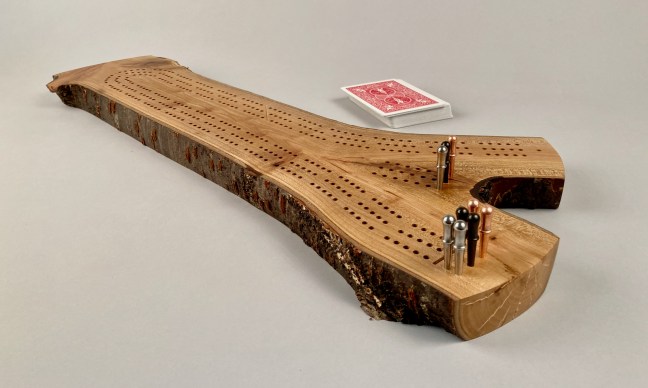
Here’s another crotch piece with some really neat figure that I used for Cribbage Board #70. The part of the wood that continued straight was quite narrow, so if the track went down that section, it would require a tight hairpin to get back out. I usually try to avoid sharp corners as it makes the alignment between the tracks look odd. So, for this one, I chose to place the scoring field there instead.
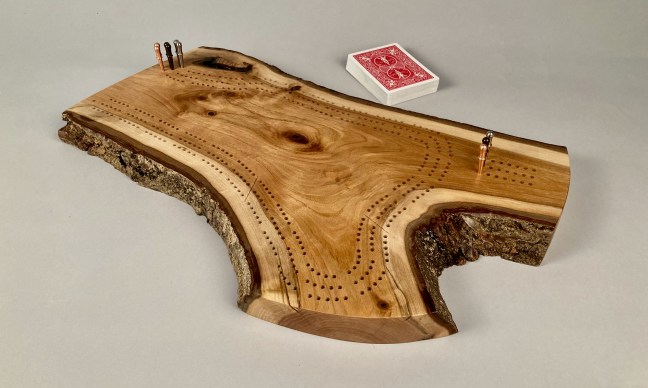
Usually when I cut a log into cribbage boards, I get 2-4 from the same section of log, depending on how thick the log is and what defects are present. I got two boards out of this section and Cribbage Board #69 is the other product. You can tell by the shape, colouring and grain that these two boards came from the same section of log. But they are not identical in shape. You can see that both legs are nice and wide, with lots of room to make sweeping corners. But, the heart of the tree shows in this board as dark lines that I didn’t wish to cross. So, instead, I ran the track around three sides of the board and placed the scoreboard opposite the end of the track.
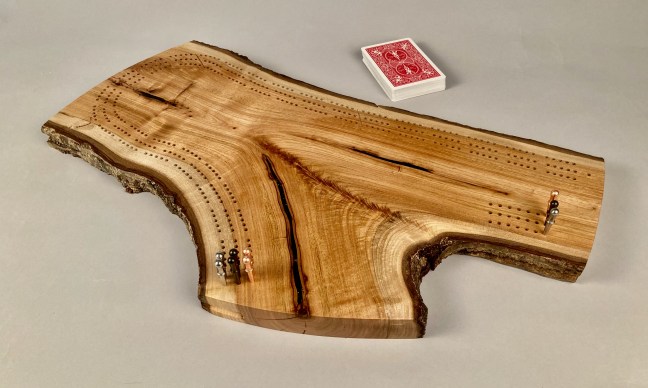
Head on over to my Cribbage Boards page to see everything from this batch, and other available cribbage boards. Each one comes with high-quality metal pegs made in the USA from copper, stainless steel, and black steel. As always, they ship free across Canada and USA.
A Different Way of Thinking, Doing, Being
This video had been sitting in my “to watch” queue for a while, and once I watched it I was delighted I did. (this channel has more than a little whiff of hypercomputationality about it, a/k/a artificial “intelligence,” but the content is pretty darn interesting)
It brought to mind a couple unrelated items.
The first was the reminder this excerpt from the apostle Paul’s letter to the Philippians:
Finally, brethren, whatsoever things are true, whatsoever things are honest, whatsoever things are just, whatsoever things are pure, whatsoever things are lovely, whatsoever things are of good report; if there be any virtue, and if there be any praise, think on these things.
Then came the memory of me teaching bench skills to an intern. I demonstrated making a dovetail and left her to execute the same exercise from start to finish. After almost an hour-and-a-half, she came into my space and was clearly exasperated. She had cut several dovetail sets, none of them worth anything other than kindling. She asked me to show her the complete process again, and that was when she got really angry.
“I’ve been working on these forever and you just come in and do it in fifteen minutes,” she fumed.
“Not exactly,” I replied. “I did it in thirty years and fifteen minutes.”
After watching this video, I understand why I prefer to start out my day sweeping the floor. It’s what gets me going.
Just don’t ask me to work sitting cross-legged on the floor.
flattening 8/4 stock........
 |
| ready to do battle |
The front one with the X is the corkscrew board I couldn't flatten yesterday. Before I expended any more calories on that one, I checked the back one which I had gotten flat and twist free.
 |
| sigh |
It moved a wee bit over night. Not much but more than I could ignore. I'll let it relax and I'll deal with it after I finish the hissy fit throwing board.
 |
| 2nd board |
I wasn't surprised that this board still had a healthy amount of twist shaking hands with me.
 |
| Houston, WTF??? |
This board according to the sticks was twist free. The 4 foot straight edge says it is flat end to end. However, when that face is down on the bench the board rocks like it is nuclear powered. There is a 1/4" gap on the rocking ends. I don't understand this. I feel like the board is a corkscrew. One hand says it is flat and straight but it is rocking like crazy on the bench.
 |
| hmm........ |
Eyeballed this board with my best goofy looks and nada. I threatened it with the best expletives an ex sailor could dream up and still nothing. I checked it again thinking I had a hump around the middle but I didn't. What I did find that the left end, for about 6-7 inches, was scalloped. The rest of the board was higher but that wouldn't be the cause for the wacky rocking.
 |
| new game plan |
Decided to step back to square one and flatten the board again. This time the scallop will be gone and there won't be any light under the straight edge from end to end.
 |
| #4 |
Used the #4 last after the # 6. The #6 ate up most of the meat I had to knock down. The #4 went straight across flattening and smoothing the scallops.
 |
| ???? |
It says I am flat. When I grab one end of the straight edge, it moves about a 1/3 of the way down from the opposite end. Same with the opposite diagonal. However, when flipped face down on the bench the same wacky rocking was still there.
 |
| still twisted |
This sucked the wind out of my sails big time. Getting at my wits end with this board. Why is this one so )_@&Q%&)(@%*_ wacky and the other was the exact opposite.
 |
| sigh |
The board is rocking like it is a corkscrew. When I sighted down the board it looked flat and straight. The opposite face rocked just a wacky as the other face. I had flattened the other face too, I made 5 runs with the #6 - 4 criss crosses and two straight across. Did absolutely nothing to get even a hint of the rocking removed.
 |
| glutton for punishment |
Checked it for twist again and surprise it was back. The first 3rd was good, the middle one had a lot, and the final 3rd had a little. Planed the twist off with the #4 and checked the 3rds again and they were all twist free.
 |
| nope |
The rocking was still there giggling at me. On a brighter note, it wasn't as bad. I would guess that about 1/2 the rocking said bye bye.
Stopped the planing/flattening here again. I don't understand why the board is rocking like it is. But I'm done trying to do it with the way I know how to do it. I've been thinking of two alternative methods. One is a planer sled for the lunchbox planer. I have tried this once before about 20-25 years ago at my shop in Westerly with good results.
The 2nd method banging around in the brain bucket is a router planing sled. I have tried this one too but not to flatten a board but to remove carved initials in a panel. That worked well and I was happy with the resulting surface. I am leaning in the2nd method vice the planer sled.
Looked online for a router planing bit and the price for them is all over the dial. Grizzly had the cheapest price I have found so far at $37 but the S/H is $20. On the flip side is the delivery time. I can use that time to make the jig. I could also use a 3/4" dado router bit as the planer bit. I have to time to think about it.
accidental woodworker
console/entry way table........
I made it to Kosezela Lumber in the AM and bought a 7 foot, 8/4 board of poplar. I didn't want 8/4 but the pickings were on the slim side. There was some 6/4 stock but it was only canary wood and teak. I took the scenic route back to the barn which took almost 2 hours. Been years since I have just driven around aimlessly. After lunch I wandered down to the shop to play with the poplar board.
 |
| 8/4 poplar 7 feet long and 6 inches wide |
This is rough sawn and at that it was 2 1/4" thick. I got a 7 footer because the width wouldn't give up four legs.
 |
| hmm....... |
The tray isn't tacky anywhere I checked.
 |
| party pooper |
The tote is tacky free except for the handle. Don't know why but I know it would gum up sandpaper and steel wool. It will have plenty of time to set up before the wife comes home from North Carolina.
 |
| before I play with the planes |
Started with sawing the board in half. There is no way I would ever attempt to flatten one face as it is. It will be easier to do it twice before I run it through the lunchbox planer.
 |
| broke out the big guns |
I tried 3 different hand crosscut saws and nada. The kerf pitched itself shut so I sawed it in half with the cordless skilsaw.
 |
| yikes |
I have flattened a lot of boards but this one has to be #1 for the amount of twist in less then 4 feet.
 |
| maybe a quarter of the way |
Started the flattening the way I always do by criss crossing the board R to L and then L to R. I got this far and I had to stop to catch my breath. I worked out that I could only get about a 1/4 more after each rest period. Made for slow going but there is no time line on this.
 |
| two more runs |
I made two more criss cross runs before I was satisfied with the board. I'm not that concerned with how much wood I hog off - the legs for the table are only going to be 1 1/8" to 1 1/4". I want the legs to be slender and delicate looking.
 |
| got a surprise |
After I was done with the criss crossing I sighted the board over the sticks again. 99% of the twist was gone. I was not expecting this based on the amount of twist I originally saw.
 |
| done |
Planed the board smooth with the 5 1/2" and I'm calling this board done. It is more then flat and straight enough to run through the lunchbox planer, IMO.
 |
| last step |
Four foot straight edge (actually 50" long) to ensure it is flat and straight end to end. One diagonal was flat and the other one said I had a hump. A few dance steps later and both diagonals agreed - this face was flat and straight end to end.
 |
| 2nd board |
Doing this one kicked my arse all around the shop. I was expecting it to behave like the first board but it threw a hissy fit. After criss crossing, the twist was still giggling at me. It was like I hadn't planed the board at all and was checking the rough sawn board. I ended up planing this board in thirds rather then trying to flatten it by just checking at the ends.
 |
| hmm...... |
This board gave funny readings on the thirds. The first two I managed to get flat over the sticks but the last third was off. Got that flat and when I checked the middle again (which was good) it was now out in La La Land.
 |
| finally got it |
It took me over hour to get to this point. Got all 3 of the thirds to be flat over the sticks but the end to end showed twist still.
 |
| will I make it |
The board was now twist free every which way I could check it. Started with the 5 1/2 to smooth out the scallops in the board.
 |
| cutting it close |
I was hoping to get this board done today too (before 1500) but it didn't happen boys and girls. After I got the board smooth with the 5 1/2, I checked for flat with the 4 foot straight edge. Everything went straight down the crapper after that. Both diagonals screamed hump and I finally got that planed off but when I checked for twist I said NO MAS. The board was flat and straight but half of the twist was back again. I'll get back to it in the AM.
accidental woodworker
rough day.......
I had a podiatry appointment this AM and that is about the only thing that went well for me today. I rolled out of the rack around 0630 feeling blah, Not nauseous but an unwell feeling that sucked pond scum. That really never went away but rose up for a while and then gradually subsided, off and on.
I'm taking that as the side effects from my last chemo cocktail party. On the flip side of the coin, I had my worse day for being short of breath. Just waking from my desk to the kitchen for a coffee refill was an ordeal. What up the fun level was coughing while trying to catch my breath.
I had stopped on the way home from the VA to get my friday fish 'n chips. I survived eating that without any coughing fits. That is one thing that worries me about eating out - going into spasms of coughing uncontrollably. The shortness of breath I just have to wait a few for but the cough is still kicking my arse.
 |
| done |
I had gone back to the shop last night after dinner to check on this. It was still tacky so I left it to set up until the AM. In the AM the tackiness I felt the previous night was gone so I got the 3rd and final coat on the tote and the tray.
 |
| 7 hours later |
The handle is tacky feeling along with the end panels. The tray bottom felt tacky too but the rest wasn't. This is the the cheap shellac I got last month. So far everything I have shellaced with it hasn't dried quickly. I'll let this cook some more until the AM.
I think I will make the console/entry table my wife wants out of poplar. I have more than enough of that for the top/shelf and aprons. One of the things I had on the to do list for today was to get stock for the legs. That didn't happen and I'm not sure it will happen tomorrow neither. It is going to be a wait and see for me.
accidental woodworker
tool tote finish.......
I woke up after 0700 this AM and I had slept like I was dead. I got up once for the toilet trot races and immediately fell asleep again. Me thinks I over did it yesterday in the shop. It was productive day but I'm paying the price for it now. I didn't want to do anything today except veg out in my chair. The only thing I got done from what I had planned for today was putting shellac on the tool tote. Maybe tomorrow I'll have a wee bit more energy.
 |
| minor me steak |
The wedge didn't expand the tenon end much. That was mostly due to the size of the wedge but also because I centered the wedge. I should have done a double wedge, one each closer to the outside faces. I don't do enough wedging so I'm still learning.
One other thing I did wrong was the depth of the wedge kerf. I made it too shallow and the most of it extended out past the mortise on the outside face. I had thought of putting a shoulder at each end of the handle but I didn't. Something to file away in the brain bucket for the next one.
 |
| prepping |
Sanded the tote with 120 and that was it.
 |
| sanding sticks |
I had planed the end grain on the angles so I didn't have to do much with the sanding sticks to get them ready for shellac.
 |
| insurance |
I had wicked super glue all around the edges on both sides of the end panels. The wedge ain't given me a warm and fuzzy so I'm going to pin the handle (at each end) with a 1/8" dowel.
 |
| 2 coats |
It was a stretch coming back to the shop for the 2nd coat. I spent most of the PM sitting and wandering in and out of sleeping. I'll try to get back to the shop after dinner to get the 3rd and final coat on.
On the first trip to the shop I checked my wood and I have some cherry and a lot of poplar to make the console/entry table for my wife. She wants a shallow depth - 8 to 9 inches and a height of 3 feet. I can do that but I don't have any cherry or poplar thick enough for legs.
accidental woodworker
Looking After the Body at the Bench
Disclosure: This article was paid for by Huuman Life GmbH.
My boy asked for a bookshelf he could one day hand down to his own kids. Building for family is as good a reason as any to keep working wood by hand.
Anyone who works all by hand knows how much of the job the body carries. Ripping, planing, chopping and carving take strength, yet most of us mind our bodies far less than our tools. We tune planes, set cap irons and hone edges out of habit. Let a plane go dull and it wastes more time than one kept in good nick, and the body is no different. The arms pull their weight, but a long day at the bench is hard on the grip, upper back and legs too. So what helps? Most of it you can do at home or in the workshop with next to no kit.
 Photo: Anna Shvets, Pexels
Then there’s the bench itself. A low bench puts your legs and core behind the plane instead of leaving the whole stroke to the arms. When I carve, I raise my bench to 40 inches (1016mm) so the work comes up closer to my eyes and I’m not leaning down to it. For planing I keep it low, and the time I tested a higher bench settled that.
Every tool in a hand tool workshop must be held, and much of the muscle doing that holding sits in the forearm. Steering a plane while the body drives it, or holding a saw on the line through a long rip, keeps the grip working for hours. Sharp teeth, good light and a well-tuned saw mean less force is needed, so you can keep a light grip. On average, grip strength peaks in early adulthood, holds through middle age and then starts to drop. You can still build it in your sixties and seventies. Work that makes the hands hang on as they do at the bench is worth your time.
The simplest thing is to carry something. Pick up a couple of solid offcuts, or two buckets part filled with water, walk the length of the yard and back a few times, standing tall. That works the grip, the forearms and the upper back together, and you can edge the load up as you get stronger.
Planing at a low bench all day only works if your legs and back hold up. They’re what cop the load when you pull boards off the stack or spin a long one end for end. Regular exercise seems to make back trouble less likely. Back support belts and shoe insoles don’t appear to make a difference. Get up from a sturdy chair without using your hands. Bend at the hips with a flat back to pick something off the floor, and do a bit more of that carrying. Start light, then add weight or use a lower seat as it gets easy.
 Photo of me planing
Twice a week, with the work getting a little harder as you go, is usually enough to build strength, even past sixty-five. For those who already train with weights, the training plan on Huuman’s blog, which starts at two days a week, shows one way to lay out a week like that.
Planing, sawing and chopping keep your arms out in front and your head over the work. So give the muscles between the shoulder blades some work pulling the shoulders back. Loop a resistance band low round a heavy bench leg and it does the job. Step back, pull your hands to your ribs and squeeze the shoulder blades together. A dozen or so each time you pause for a breather is a good start.
Heavy stock prep doesn’t have to be knocked over in one day. A morning at the plane, then an afternoon of marking out, sharpening or finishing, is easier on the hands and back.
Huuman Life reached out to me. I’ve had ongoing trouble with my back, so I was interested enough to look into what they were doing. I liked what I saw. The Huuman app takes a straightforward approach to building and maintaining the strength we need to keep doing the things we actually enjoy. It covers strength, movement and recovery, which are all useful areas to work on if you want to keep at this.
If I didn’t think Huuman Life was worth recommending, I wouldn’t have written this article. I don’t write in favour of something simply because someone offers to pay me. I looked into Huuman, liked what I saw, and thought it was something worth sharing with people who want to keep themselves strong enough to carry on working wood.
For those of us who work wood by hand, staying strong counts for plenty. We ask a lot of our hands, shoulders, back and legs, and the older we get the more we need to look after them. The aim isn’t to turn the workshop into a gym. It’s to keep the body strong enough that we can carry on planing, sawing, chopping and carving for years to come.
For me, that’s really what it’s about. We don’t work wood by hand because we want to spend our lives exercising. We do it because we love making things. If a little time spent looking after the body means we can stay at the bench and keep doing it, then it’s time well spent. I’d like to still be at it when my boy’s kids are filling that bookshelf.
None of this takes long or asks for much in the way of kit. It just needs doing regularly, like sharpening.
Disclaimer: This is general guidance, not medical advice. If anything hurts, or you have a heart condition or anything that affects how you move, speak with your GP or a physio before starting anything new.
Gerrymandering
One component of my activities organizing and streamlining barn/shop space and function this year has been taking a page from the American political handbook, wherein electoral district has been reconfigured to render a permanent advantage. This process is known as Gerrymandering in honor of it first practitioner, early 19th Century Boston politician Eldrige Gerry. Ostensibly this practice has been attributed to partisan advantage, but in practice it has mostly been used to protect incumbents. (Actually, only one Party has this strategy figured out and the other is just spinning on its thumb.)
In my case the spatial reorganization has been centered on the question, “How often did I use this particular tool or supply?” If the answer was, “Not in several years,” the item(s) got moved from a place of relatively easy access into deep(er) storage.
Given the termination of workshop activities here, thus no longer needing classroom or dormitory space, I have plenty of available space to use for storage and archiving. Lots of stuff has been relocated to reflect more current usage.
One instance of that was removing the leather, mother-of-pearl, and veneer inventories in the giant map case in my main shop workspace. I had already reconfigured the top of the cabinet quite a while ago to serve as the location for processing beeswax and shellac wax, and the occasional batch of Mel’s Wax. The leather inventory consumed four drawers, the MOP four drawers, and the special veneers three drawers.
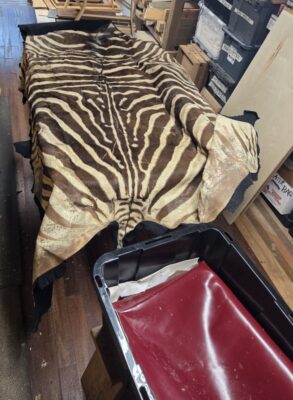
The mother -of-pearl went into two large storage bins now located on the shelves now ringing the former classroom. The specialty veneers went underneath a rolling worktable that is moved to wherever it is needed (I have a giant stash of walnut and cherry veneers up in the former dorm space), and the leather went into two giant storage bins and a large plastic trash can now relocated on top of that veneer stash.
Seriously, what in the work was I doing with a complete buffalo hide and a zebra skin rug? And a big pile of elephant hide?
Who knows.
The map case was about 90% empty, available for a large inventory of different tools that had previously occupied a nearby cabinet.
Gerrymandering, my friends. Gerrymandering.
How to Apply Wood Finish to a Wooden Hand Plane
tool tote is done........
Had a great day in the shop along with feeling pretty good. I got 3 hours in the AM session and almost 3 hours in the PM. It has been a long time since that has happened. I only had two coughing fits but even then they weren't as long as they used to be. I snapped a bazillion pics too so I think I'll go with pics with captions and as little verbiage as is possible for me.
 |
| tray dry fitted and original tote bottom repurposed |
 |
| nope - stock isn't thick enough and too close to the angles |
 |
| using 1/8" dowels - two down from the top |
 |
| two angled ones inserted above the break |
 |
| 2nd handle mortise fitted |
 |
| wee bit too snug |
 |
| dry fit alignment checked out |
 |
| inside joints are gap free |
 |
| rounding the bottom edge of the handle |
 |
| some spoke shave action with 100 grit last |
 |
| saw kerf for the wedges |
 |
| handle fits - 5/8" sticking out both ends |
 |
| tray glued and clamped |
 |
| cherry for the wedges |
 |
| fitted in the kerf |
Didn't realize it here but I made the wedges too thin and the saw kerf too shallow.
 |
| tray grabbie thing |
Showed a pic of the finished tote to my wife and she like the tray. Surprise again.
 |
| saved the cut outs for the glue up |
 |
| flushing the plywood to the tray |
 |
| flushed the top corners |
 |
| half laps for the tray handle |
 |
| gap on the bottom had to trim the half laps |
 |
| tray handle glued and cooking |
 |
| flushing the ends with a blockplane and 120 grit |
 |
| rounding the top of the handle |
 |
| 100 grit - no sharp arrises comfortable to the hand |
 |
| miller dowels to help the rabbets |
 |
| 1/8" dowels |
There isn't enough meat to use miller dowels on the ends.
 |
| why I used 1/8" dowels |
 |
| had to angle the 1/8" dowels |
 |
| glamour pic #1 |
 |
| ooh and aah glamour pic #2 |
I will slap on three coats of shellac because I'm sure my wife will paint it.
The wife just gave me another honey do - she wants a small console/entry table. Wood choice left up to me. Surprise again.
accidental woodworker
Fein Turbo II Foam Replacement
Recently, for reasons I shall not mention on this hand tools blog, I retrieved my old Fein Turbo II (model 9-55-13) shop vac from storage, where it's been for the last 13 years. It's probably 25 years old now. I mentioned this to a friend in passing and he said "Oh, make sure the sound-deadening foam isn't all falling apart. You'll know it is if you get black foam bits coming out of the exhaust." Well guess what - he was exactly right.
 |
| The Fein shop vac |
 |
| Bits of black foam all over the floor |
He said that happened to his Fein Turbo II and he fixed it with new foam. He's a real tech guy and he had laser-cut new foam pieces for his. I don't know how long ago that was, but he still had his drawings and leftover foam, so he laser-cut me a new set of foam pieces. This post is about replacing the sound foam in the vacuum.
In the Fein owner's manual, the foam pieces are called the "cover soundproofing", the "side soundproofing", and the "motor soundproofing".
Disassembly was straightforward. I'm usually a bit nervous about taking things apart, thinking I might not be able to get it back together. Taking pictures as I go really helps.
 |
| Taking the float cage off from the underside of the lid |
 |
| Revealed some crumbling foam |
 |
| I replaced this later with extra pieces of foam |
 |
| Some screws here ... |
 |
| ... and some screws down in this trench |
 |
| Then turn it right side up and the top comes off to show some really messed up, crumbly, dirty cover soundproofing foam |
 |
| A closer view of the cover foam that typically stays in the lid |
 |
| This shows the three pieces of thicker side soundproofing foam |
 |
| And there's a 1/2" thick motor soundproofing foam piece that goes around the perimeter deeper inside the unit that took removing more screws to get to |
I didn't get any pictures of replacing that motor soundproofing piece, but it was probably about 3" x 20" x 1/2".
The cover soundproofing pieces were about 1/2" thick. Here's one of the pieces cut and being placed in the top casing. I don't have dimensions for these pieces, but I recall seeing a YouTube video of someone replacing the foam and they had a free download with dimensions for those of you who need to replace your foam.
 |
| This piece fits into the underside of the lid ... |
 |
| ... like so, with the two other pieces that fit into the underside of the lid |
 |
| Here's the cover soundproofing foam pressed into place |
 |
| But there's a small complication |
One of the original foam pieces was held in place in the center of the lid with four "push nuts". I had to cut the original nuts out with tin snips and, since I didn't have any push nuts, I fashioned some out of a brass furniture grommet.
 |
| Close-up of the original push nuts. They are on plastic studs that were molded with the lid and I didn't want to break them off. |
 |
| The grommets that I used to make new push nuts |
 |
| New push nut holding the foam in place |
The three thicker (1") side soundproofing foam pieces just drop into empty spaces. My friend cut the three of them to different lengths - I was never certain why, but I suspect that's how his original ones looked and I didn't measure the ones that came out of my vacuum. Each piece has two semi-circular cutouts, presumably for air flow.
 |
| Three thicker pieces in place |
All that was left was to reassemble to unit. As I was doing that, I was reminded of the little round foam piece under the float cage. I was able to glue together some foam scraps to get a piece big enough to cut out the round shape and fit it into the opening.
 |
The new piece, with two super-glued seams |
For anyone needing to replace their foam, I have three extra of the 1" thick laser-cut pieces - the ones shown two pictures above this. If anyone wants them, I'd be happy to send them to you. Just send me a message using the "contact me" gadget somewhere on this blog page. Use a different browser if "contact me" doesn't show up on your view.
A Post Amana Shout Out
 Having a drink with Matt and Julia
Heres a shout-out to Julia Kalthoff, the Swedish axe-maker. We first became acquainted with Julia via an article in Quercus magazine, and immediately started carrying her axes thereafter. We finally met Julia in person at Handworks. She came all the way from Stockholm! Weve been out of stock of the axes for a while but good news were expecting a shipment next month.
I also met for the first time Matt Johnson, a woodworker based in Iowa who was helping Julia with her booth and logistics. This is an example of camaraderie that we love to see in the woodworking community. We had dinner with them both, and Matt showed me his portfolio of some really wonderful work. Take a look here. He's got a great modernist take on the Arts and Crafts style, which I like a lot. Im also a sucker for walnut, my favorite wood. In addition to being a furniture maker, Matt also is a spoon maker and teaches spoon making.
 Julia Kalthoff in her booth at Handworks
It was great meeting people in Amana. Some of the people I was meeting for the first time said they felt they knew me already, and its because they read the blog, which was fun. It was especially great to meet some of the people who had bought the Folding Treadle lathe from the pre-order list and had actually begun using it. (Reports: they are having a lot of fun with the lathe!)
An update on the lathe. We have finished the pre-orders. We have a few lathes in stock that we are offering to people who have previously put their names down to be notified when we have lathe to sell. When those are gone, there will be a bit of a break while we change vendors for the base. After that we should have lathes available for everyone.
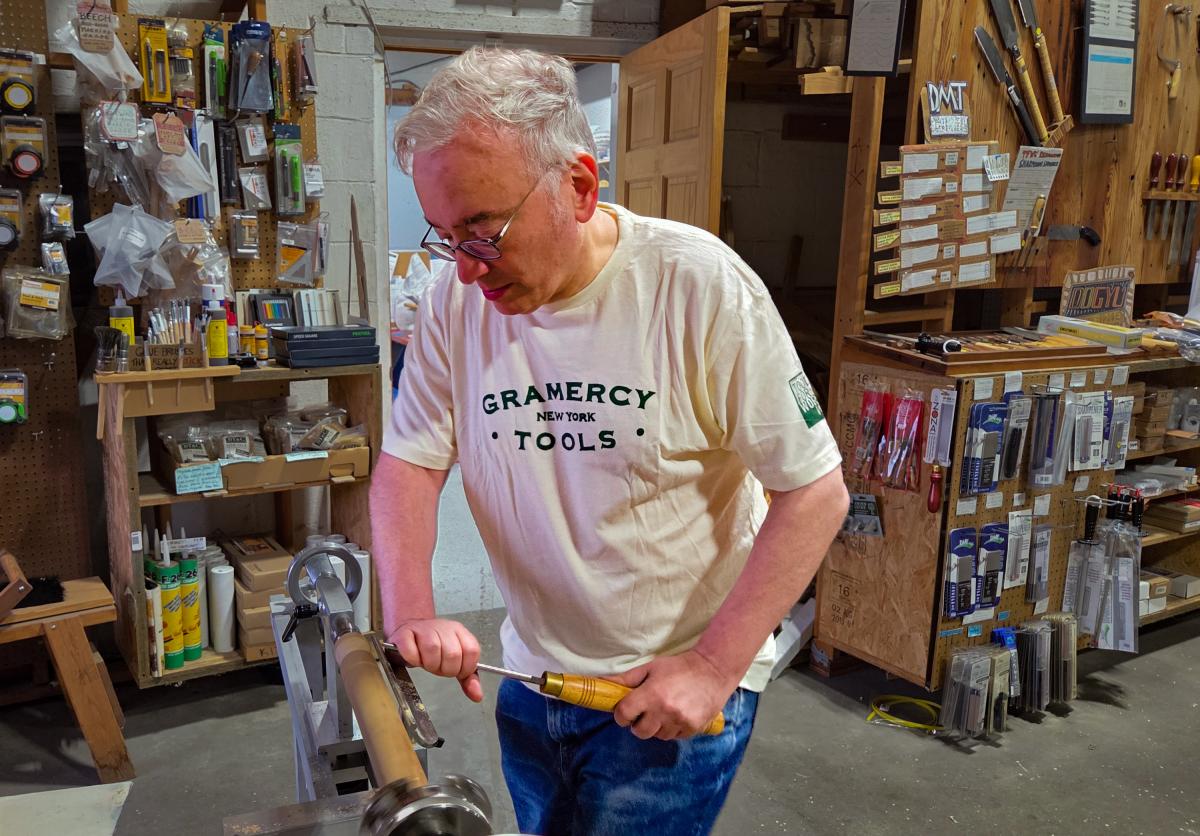
Possibly the most important part of the treadle lathe experience is shared by most of the hand tools we stock. There is no motor - it is Powered By You. You are not a machine operator. With hand tools, you are the machine. This give you a sense of control and participation that many people find extremely satisfying. So we put this idea on a T-Shirt with an original design and artwork by Alyson, whom many of you met at Handworks (and others of you have spoken to when you've called on Mondays and Wednesdays). We had to rush the T-Shirt so we would have them in time for Handworks, but now the dust has settled and we can make them generally available here.

tool tote pt II.............
Caught up on lost sleep from monday today. I didn't roll out of the rack until after 0700. I found it hard to get motivated and spent most of the morning engrossed in You Tube. I started watching one vid and that led to another and another and another. By the time I had my fill it was after 1000. It didn't help matters much that I felt nauseous and tired too.
I finally made it to the shop just before lunch to spend a few working on the tote. After filling the pie hole for lunch, I went back to the shop then and worked until I killed the lights at 1502.
 |
| first change |
The initial plan called for the bottom of the tote to be 1/2" plywood (actually 12mm). Decided that would be too much weight for the size of the tool tote. My wife won't be putting any power tools in it. Swapping that out for 1/4" plywood.
 |
| missed it |
The end panels had plane tracks on both faces. Used the #3 to smooth the tracks and followed that up with 120 grit in the RO sander.
 |
| handle layout |
I didn't want to use a dowel for the carrying handle so I'm using a rectangular one that I will round the bottom corners off. It will protrude about a 1/4" on both outside faces and I'll wedge it to secure it.
 |
| nope |
It looks too clunky to my eye. The sides and the height of the ends looks good but the end width is too much.
 |
| better |
If this isn't wide enough for my wife I'll make another one. I would have liked to have had all the tools on hand but I am going with just the pic of the blow pack looks like.
 |
| angles need some work |
Before I can glue up the tote I had to saw the angles on the ends, clean and smooth them, chop the two mortises for the handle,then dry fit it and saw it to length.
 |
| fitting the bottom |
Screwed up on the first one making the length of it too short. I measured for that one and this one I'm marking it directly off the tote. Started with the width to fit in the ends first.
 |
| sigh |
Shoulda, coulda, but didn't do it this way. This is where I went out into La La Land. I didn't account for the end panels and ending up making the first bottom a 1/2" short. Can't go wrong marking it directly this way.
 |
| new bottom fitted but |
Got an ugly gap on this corner. The other three are tight. From looking at this I can't see if it is the end panel or the side that needs help.
 |
| it was the end panel |
I couldn't fully correct this. There was some saw blade wobble and if I planed it smooth I would have to saw the other end panel to match it.
 |
| yikes |
I seems I was a wee bit too aggressive chopping the first mortise. This throws a monkey wrench into the time line, eh?
 |
| 2nd mortise |
No hiccups so far with the 2nd mortise. Will it fit? A loose fit isn't a deal killer because a wedge will expand the 'tenon' some.
 |
| snuggish |
I'm happy with the fit and I'll have to cool my heels are getting the length.
 |
| sigh |
It is better it happened now rather then later. This popped off when I sanded it. These two boo boos are making me rethink the end panels. I will have to reinforce the breaks with more then glue. I have tonight to dream up something.
 |
| cooking away |
The breaks were clean and went back together seamlessly. I'll let these set up until the AM.
 |
| tray bearers |
Sanded the sides and glued and nailed the tray bearers on. The drop down on the bearers is 1 1/4" and the tray will be one inch deep. This is it for today boys and girls. I have had a wicked headache simmering all day and it picked this time to shake hands with me.
accidental woodworker
a new honey do project.........
My wife asked me for a tool tote. She bought a blow pack of 'apartment tools' and said that it was too confusing. But obviously all of those tools tossed together in a tote magically unconfuses a heap of tools. I have learned not to try and decipher her reasoning on some things. I started on the tote this AM.
 |
| ta da |
Look at what the idiot couldn't see. I thought of this last night just before I hit the rack. It just popped into the brain bucket and I verified it first thing in the shop this AM.
 |
| updated glamour pic |
I didn't need the domed nut I stole from the other tenon cutter. This wing nut would have looked better IMO if left bare metal but it was pitted and ugly looking.
 |
| MIA depth indicator |
I kind of know this works already. The scale for the thickness of the tenon is confusing. I couldn't get it to fully engage on the largest diameters. I'll play with more later.
 |
| tool tote |
I was going to make the tote out of this 1x12 7 footer and changed my mind. I have a lot of pine off cuts scattered around the shop that I can use first.
 |
| hmm..... |
I am making a small classic carpenter tote with a tray. I don't have enough stock here for it. The end panels will be about 10-ish inches wide and 12-13 inches tall. You can't get 12-13 inches out of a 1x12. I'll have to glue up for the ends.
 |
| too thick |
I am going to size the stock to 9/16" thick to help reduce some of the weight. Started prepping for that by establishing a reference edge and face first.
 |
| end panels |
Got the panels glued up oversized on the width and a 1/2" on the height. The plan was to size these two in the PM session.
 |
| not quite |
The tray is going to be made of 3/8" thick pine and this is not a perfect resaw on the bandsaw. Initially the blade twisted when I first pushed the stock into the blade. However, the rest of it looked decent. It wasn't tapered and outside faces appeared to be parallel looking. The bandsaw marks were heavy though and I made the resaw thicker to account for that.
 |
| hmm.... |
Did a couple of more test cuts with similar outcomes. The blade still deflected and twisted but not as much this time. I tried to feed the stock into the blade slowly applying pressure against the stock tight to the fence. Helped but didn't eliminate it entirely. Scratched resawing the tray stock on the bandsaw.
 |
| tote long sides |
These are oversized in the width and length. Still trying to get a feel for them. My wife gave me 9x14 for the tote size, not too shallow and with no lid. I'm thinking of 10-11 by 15 for the tote. I don't think her 9x14 is the OD for the tote.
 |
| tray stock |
Resawed it on the tablesaw. Got some thick pine veneer (on the right) that I like but will probably never find a use for. That ain't going to stop me from finding a home for it.
 |
| first long side |
Marked the board and started with the #6 planing down close to the knife lines. This was tough going for me and it took a long time. Partially soaked my shirt sweating but catching my breath was the hiccup. This should have taken me maybe 10-15 minutes to knock out. Instead it took me over an hour to do both. I had to slow down and take a break to catch my breath before I could plane again.
It wasn't life threatening and I got through it albeit a lot slower and a lot more tired. Initially it was rough with a lot of coughing but that seemed to improve and lessen the longer I worked at it.
 |
| wash, rinse, and repeat for #2 |
I'm not sure if this is something I'll be able to do again. This is a relatively small thicknessing project but I'll wait and see. I just will have to accept that I can't be the speed demon doing this.
 |
| blurry acceptance pic |
These two panels don't have to be exactly the same thickness within +/- an atom. They are less then a frog hair from being flush with each other. Good enough for a tool tote.
 |
| start of the PM session |
Late start as I ran out of gas. I had a sandwich for lunch and then nada. Didn't feel like standing up and going to shop for over an hour. I finally went back and started to plane the end panels.
 |
| troublemaker first panel |
It ain't cooperating. It isn't twisted and this diagonal is throwing a hissy fit. Getting the reference face and edge can be a PITA sometimes.
 |
| hmm....... |
This thicknessing session went a lot better then the first one. I only got winded a couple of times and then only because I pushed the envelope. The coughing was way down too - no spasm fits, just a couple quick ones.
 |
| done |
Went quicker but these are smaller then the sides. A bit awkward due to the grain orientation running on the short width vice the longer length. I tend to not do good planing with the grain on stock this size but it came out acceptable.
 |
| best laid plans of mice and men |
accidental woodworker
adjustable tenon cutter........
 |
| clean up first |
I had to clean up the shop and put things away. It seems that I only have a clear and clean workbench top when I start a new project.
 |
| hmm........ |
I can't bring myself to shitcan these leftover slats. There has to be something I can make with them. Nothing was rattling around the brain bucket so I'll have to find a interim home for them until then.
 |
| another pile |
I really thought something would pop up besides a box but nada. This cherry is too nice looking to go to the landfill. Finding a home for this pile is going to be difficult but I will figure it out.
 |
| side by side |
I needed the left one to get the right one together. Initially I had put the iron 180 out from where it should have been.
 |
| sigh |
I lost the gizmo that sets the height of the tenon. I have the securing screw for it but not indicator. I searched the shop for almost an hour but no joy.
 |
| done |
I painted this the same two colors it had when I got it. There are a couple of spots I left bare even though there were still a few faint paint spots. I left the two sliding surfaces clean and paint free.
 |
| sigh |
This was missing this nut and I took it from the tenon cutter. I looked on McMaster-Carr for a replacement but I couldn't find one. The top is domed and the bottom is flat - what is the name of this nut?
 |
| glamour pic #1 |
Engells Coach shop uses an adjustable tenon cutter in a drill press. I thought about trying to get that setup on my drill press. It would certainly make doing the chair tenons easier.
 |
| business end |
There is a scale for size that I'll have to check for accuracy. I will have fettle, adjust, and swear at getting the iron positioned correctly. I've did those dance steps when I got it. The iron is sharp and ready to go.
accidental woodworker
Making a Mandolin Rosette
I’ve just started building my next mandolin. In this video, I look at making its rosette in quite some detail. Hope that you find it interesting.
Cheers Gary
night stand done..........
 |
| top goes on first |
I have six coats on the top and I was happy with the look and the shine. Clamped the top to the base - the towel was to keep the clamp heads from marring the top. I was surprised that these clamps alone pulled the top down tight to the base all around. I was expecting the slat sides to have daylight that they didn't.
 |
| wash, rinse, repeat for the shelf |
Got the shelf positioned and clamped and then I flipped it to screw in the table top clips.
 |
| hmm........ |
Clips screwed in and there is a bit of daylight on the slat edges. From the bottom I could see the clip was visible from the there. However, on the opposite side I couldn't see it.
 |
| hmm........ |
I had to do one more coat of shellac. There were four boo boos from the clamp pads. I didn't think with the towel that would happen. I had used wax paper on the shelf and nada. Zero hiccups with the clamp pads there. Easy fix - quick rub with 4-0 steel wool followed with some shellac.
 |
| first glamour pic |
This is a good match for the tall drawer unit I just made for my wife. The oak legs look pretty good IMO against the poplar.
 |
| 2nd pic |
Feel iffy about the bottom shelf. Not entirely happy with the margins with it but it is what it is. In reflection I think it was a better choice then a shelf that fit between the legs front to back.
 |
| last pic |
After I shot this pic I went looking around the house and I found 8 things I had made that had slats in them. I don't know what it is about them but they have become a signature of things I make.
accidental woodworker
night stand pt X..............
Three days out from my last chemo cocktail and I ain't feeling so good. Not any of the nasty side effects but just feeling blah. Woke up a wee bit on the nauseous side but a pill knocked that down into the dirt. Glad that I didn't have a lot going in the shop. Slapping shellac on projects is slow going so that is working in my favor. Looking forward to feeling better in the AM.
 |
| hmm...... |
Both of them passed with flying colors. After dinner I had checked them and there was zero raised grain anywhere I checked. I got a coat of shellac on it then and the 3rd coat went on this AM.
 |
| done |
I rubbed the carcass down with 4-0 steel wool and brushed on a final coat of shellac. It looked ok with the bazillion coats I sprayed on but I decided to brush on the final coat.
 |
| getting two more |
As is the bearer is held on with one center screw and glue. I don't think that is sufficient to hold the top down tight. All of the downward pulling force from the screws into the tops will be on the ends of the bearers. It is just glue there securing the bearer so I am adding on more screw close to the bearer screw slot at each end.
 |
| had to put a finish one |
I have several wax and mystery finish solutions to pick from and I chose this one. It is a simple one coat finish to apply. You apply it with a brush until no more of the oil soaks in. Wait a few and wipe off the excess before the oil gets tacky.
 |
| oil applied and wiped off |
The oil certainly made the end grain of the plywood pop. The box underneath is the same plywood but it has no finish on it. I like the look of the finish on the rasp box over the raw unfinished look of the bottom box. The finish only needs 8 hours to dry so it should be ready to use in the AM.
 |
| 4th one coming |
Been a couple of hours after the 3rd coat and the 4th is getting slapped on now. I rubbed the 3rd coat with 4-0 steel wool before putting on the 4th. The build is coming along nicely but I think it is still going to take one or two more to satisfy me. So this should be at the ooh and aah stage by sunday at the latest.
 |
| fingers crossed |
I have two coats on this and there are still some partially covered spots. Painting on what I hope will be the last coat. I'll check on it in the AM.
We have high winds and rain in my part of the universe. The wind has been picking up steadily all day but no where near the strength the weather seers predicted. So far no rain and same seers are saying the rain could bring on flooding. Supposed to be wednesday before the sun peeks out again to say hello.
accidental woodworker
night stand pt IX............
 |
| I let it cook |
I resisted the urge to play with this after supper last night. It is better I let it cook because it it only held together with glue.
 |
| why not? |
Decided to spray shellac the entire base. There are still a lot of tricky drip and run spots for brushed on shellac to go nutso.
 |
| lid separated |
Did the lid on the tablesaw. I don't know how but I got a step on one of the short sides. I had to plane and sand it flush more than I wanted to. thankfully I had more the enough depth to give up.
 |
| cherry keepers |
I planned on mitering the corners but changed my mind. The short end pieces would have been toast. The butt joint corners will work for this. I also didn't have any more cherry to make two new pieces.
 |
| hmm....... |
The files fit in the box but they aren't secure. They can bang around inside the box and possibly damage their teeth. I need to keep them in place in the box somehow.
 |
| hmm....... |
I got a 3rd coat on the shelf and the top last night after dinner. It felt dry to the touch and smooth. It wasn't tacky anywhere I checked. One more coat and the backs of these two will be done.
 |
| glued and cooking |
I'll let this cook for a few hours and then I'll fit the lid to the bottom.
 |
| holder |
This works, the files can't bang around and touch each other.
 |
| oops |
I had sized the holder to fit inside the lid. Missed that the lid didn't have keepers to account for. I sawed a wee bit less than 1/8" off each side.
 |
| hmm..... |
Initially it didn't fit but I sanded the outside edge with a 100 grit sanding stick. I kept at it until I got the lid to fit in either orientation. I got a snug fit too.
 |
| done |
I planed a chamfer on the top/bottom outside edges. I like this look and it hides that the joint line isn't perfectly straight.
 |
| holder thing glued and cooking |
The holder keeps the rasps safe in this static position. But with the lid on the rasps can get up and dance around with each other.
 |
| not anymore |
This short block is a few frog hairs below the bottom edge of lid. That is still enough to keep the rasps from jumping out of the holder when the box is moved and handled. I'm not going to put any finish on it for now.
 |
| any surprises forth coming? |
It was in the green areas that had the raised grain on the bottom. Both of these were planed and sanded with 220 grit. Both felt smooth to the touch all over. I put on the first coat of shellac and I'll check it after dinner. I don't know what to expect but hopefully it will be a normal first coat of dried shellac.
Haven't been sleeping well the past few days. After sleeping through the night I am now waking up around 0200-0300 and not falling back to sleep. So I toss and turn and sometimes I watch You Tube. Neither of them make me sleepy and I didn't get out of the rack until 0730 today. It was nice to sleep through the night and fall back asleep after getting up for the toilet trot races. Fingers crossed it will come back.
accidental woodworker
Pages
