
Hand Tool Headlines
The Woodworking Blogs Aggregator
“Glory to God in the highest heaven, and on earth peace to those on whom his favor rests.” - Luke 2:14
Be sure to visit the Hand Tool Headlines section - scores of my favorite woodworking blogs in one place.
MVFlaim Furnituremaker


Repairing an Old Table
Last weekend, my wife Anita bought this old side table at an antique mall. She loved the way it looked, but it was pretty wobbly and ready to fall apart. She asked me if I could stabilize it and I told her I could so she bought it.

The issue with the table was that it was coming loose in the back and the legs were wonky so she asked me to put a stretcher in the back to stanle everything.

A bigger problem with the table was actually its drawer. It was somewhat repaired back in the day but done improperly, so it really didn’t work at all. The one drawer bottom side was completely gone, so I had to deconstruct the drawer in order to fix it.


I grabbed a piece of scrap pine that matched well enough to use for the parts of the table I was going to fix. Then I cut and glued everything together.


I added a stretcher to back to stabilize the legs. I cut the piece to fit, and then I used my Festool Domino to cut the through tenon. There is nothing like using a 21st-century tool to repair a 19th-century table.


After the glue dried, I cut a Dao down the side of the drawer to fit the drawer bottom in. Then I nailed the bottom to drawer so that it would fit better and not fall in.


A couple of hours in the shop and the table is ready for another hundred years of service. I’m not going to do anything to the back stretcher to make it match the rest of the table. I doubt no one will even notice it.


Buying Old Tools
When you’re looking at where to buy old tools, you need to decide where to go. When I started collecting tools back in the 1980s, the main places were antique shows and flea markets. Even after all these years, these are still the two easiest places to find general woodworking tools at a good price. You get to look at what you’re buying to see how good the condition is. Then you can barter on the price if you want with the seller. Large antique shows and flea markets have hundreds of vendors during the show. If you’re looking for common planes, chisels, and saws, this is the best place to be. After buying tools for forty years, this is still the primary place where I buy tools.
However, since the ’80s, numerous other places to buy old tools have opened up. Mainly because of the internet. eBay is by far the easiest way to find what type of tool you’re looking for. A simple quick search can lead you right to the type of tool you’re looking for as well as its vintage. Prominent eBay sellers will take multiple pictures of the tool and include a solid description of what you’re buying. On eBay, you can either wait for the auction to be over or simply buy it with a Buy It Now button. eBay is where I’ve been selling my restored tools for the past twenty years and will probably continue to do so for the next twenty.
Antique tool sellers’ personal websites are also another resource. They, too, will categorize their inventory into a search format so that you can easily find what you’re looking for. Tool collector websites often sell tools that are in good to mint condition, so little restoration may be needed. With this, the pricing on their tools will often be more than what certain eBay sellers will have, but not always.
Online classifieds like Craigslist and Facebook Marketplace are another option. In my experience using those platforms, I’ve I have found that sellers are often very vague in their description and only include one or two pictures of what they’re selling. I rarely buy tools through those two platforms as I don’t like having to schedule a time to meet up with the seller, and prices are often too high anyway.
Along with Facebook Marketplace, Facebook tool groups is another way to buy old tools. There are dozens of tool collecting groups on Facebook that specialize everything from restoring workbenches to using stanley planes to collecting infill planes. The members of the group will post pictures of the tools they want to sell along with their price. There are also Facebook groups where you can bid on tools like an auction or even swap tools for trade. I have never bought anything from any of these groups as I have heard and seen too many scammers listing tools they don’t even own just to take money from the buyer and split. Others may have had luck with these groups.
Yard sales is another way to buy old tools. However, the yard sales around me are always filled with clothes and baby toys. Driving around town from a yard sale to yard sale is a painful way for me to spend a Saturday afternoon. Unless it’s a barn sale out in the country, I generally skip any community yard sale, with one very large exception, The US 127 World’s Longest Yard Sale!
The US 127 World’s Longest Yard Sale runs from Michigan to Alabama on state route US 127 the first weekend of August. This sale is hundreds of miles long and has thousands of vendors who set up from the Thursday through Sunday of the show. In fact, the sale is so large that many sellers will set up the weekend before the show even starts. Anything and everything is sold during this show. Every year, I spend several days traveling up and down US 127 between Ohio and Tennessee looking for old tools. Some years I hit the jackpot, others I get skunked only coming home with a handful of tools. But the show is amazing. I call it the Super Bowl of Antique Shows.
Another good place to buy old tools is from tool collector associations. The largest is the Mid-West Tool Collectors Association, but there are a few smaller regional assoctions like The Ohio Tool Collectors and PATINA. Each association will have shows several times a year around the country where members meet up and show and sell their tools. It’s a great way to meet fellow tool collectors and learn about the tools they own. It’s one of the best ways to learn about old tools and how they work.
The most fun I have buying old tools is from antique tool auctions. I prefer the live ones, but their are a lot more that appear online that I participate in. Live auctions are full of action as the auctioneer bids out the tool to the gallery. I get a rush trying to win something I’ve been waiting several minutes to hit the auction block. I’m always hoping that I’m the only one who wants the tool, and in some cases, that has happened, but for the most part, I have to bid against my fellow tool collectors. I always have a set price of what I want to pay and also take into consideration if there is a buyers premium and tax taken on top of my bid. Buyers premium is a fee many auction companies will use in order to cover some of the cost of setting up the auction. Many times, the buyers premium will be 10-15%. However, I’ve seen some as high as 20%. You’ll need to be careful when bidding so you don’t inadvertently overpay for your tool. If a buyers premium is 15% and they charge tax, I automatically adjust my bid fees to 20% in my head. So, if I’m willing to pay $100 for a tool, my max bid will be $80.00. $80.00 bid + $12.00 buyers premium, + $6.00 tax comes to $98.00.
My First Show
Yesterday, I did something that I have never done in 20 years of selling antique tools. I set up a booth at the Burlington Antique Show in Burlington, KY.
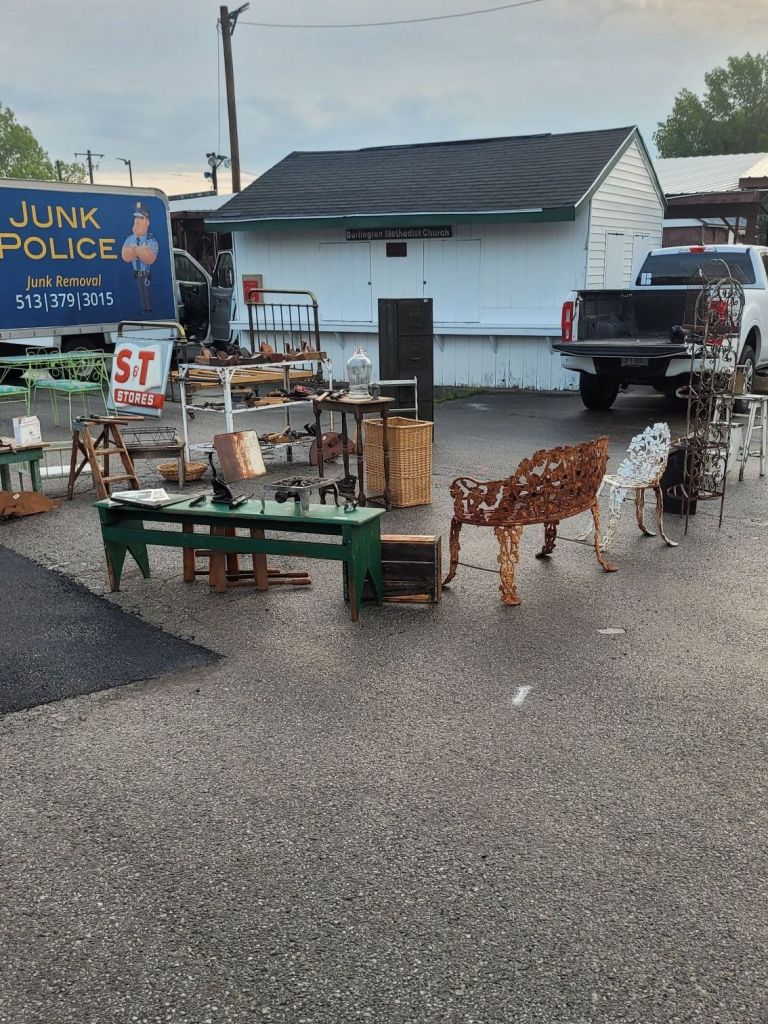
The reason for my booth was that my wife, Anita, is down sizing her booth rentals at the new antique mall she is in. She’s been renting two rooms for the past few months. While her sales have been phenomenal, she found taking care of two rooms, filling it up with antiques was too much to bear. Plus, the majority of the sales were coming from the one room by the register. The furniture she was selling in the back room, she was getting off her Facebook Marketplace ads. She told me she doesn’t need to spend $400 a month in rent if she could just as easily sell it in the garage instead. Makes sense to me.
So Saturday night, we loaded some of the stuff that was still in the back room and shoved it in my truck to head to the antique show in the morning. Since I was going to work the show, I decided to bring some of my tools with me and put them out for sale.
I decided to bring tools that were too big to ship. I sell planes and smaller items on eBay all the time, but shipping large items has always been a pain in the ass. First, it’s hard to find a box to fit the tool, and then it’s hard to estimate total shipping if I don’t have the box on hand. I’ve been burned more times than not when it comes to shipping big tools.
I woke up at 4:00am and headed out the door at 4:45, arriving at the fairgrounds at 5:30 am. This gave me 30 minutes to unload and set up the booth. I didn’t have too much stuff as all I had was what I could fit in my pickup truck, but hopefully, I had enough to make it worth my time.
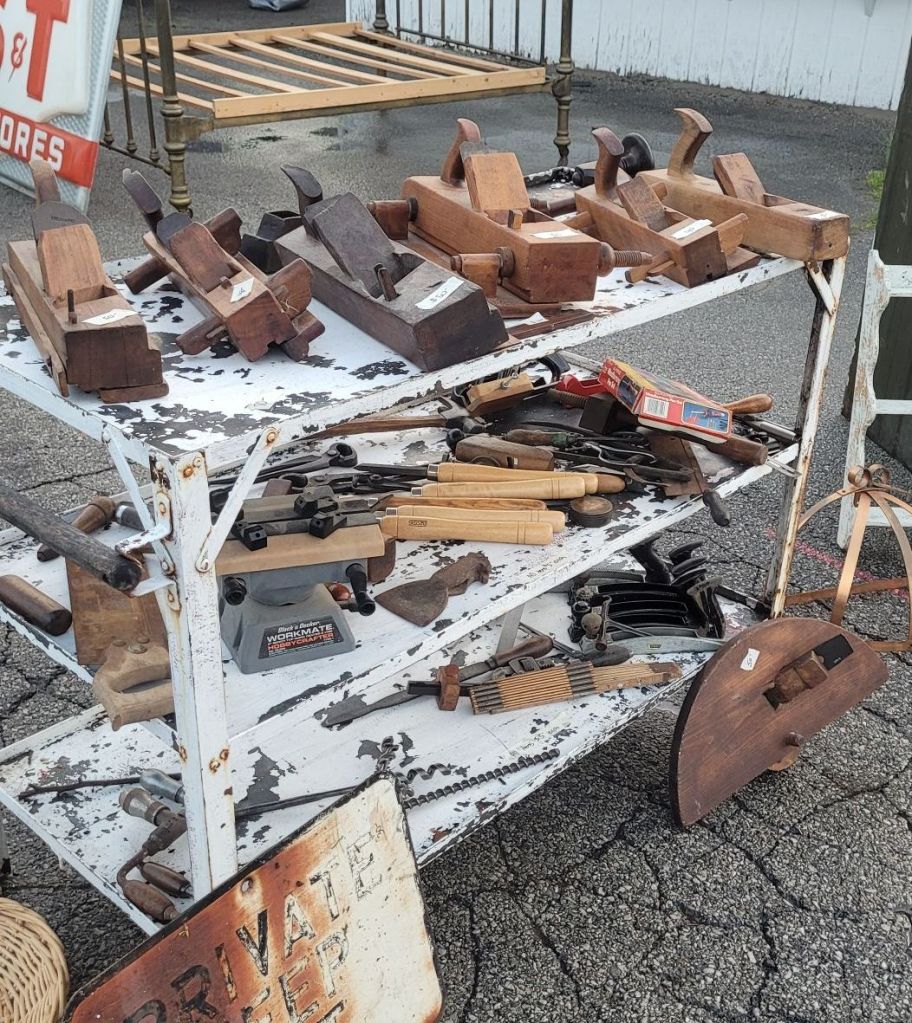
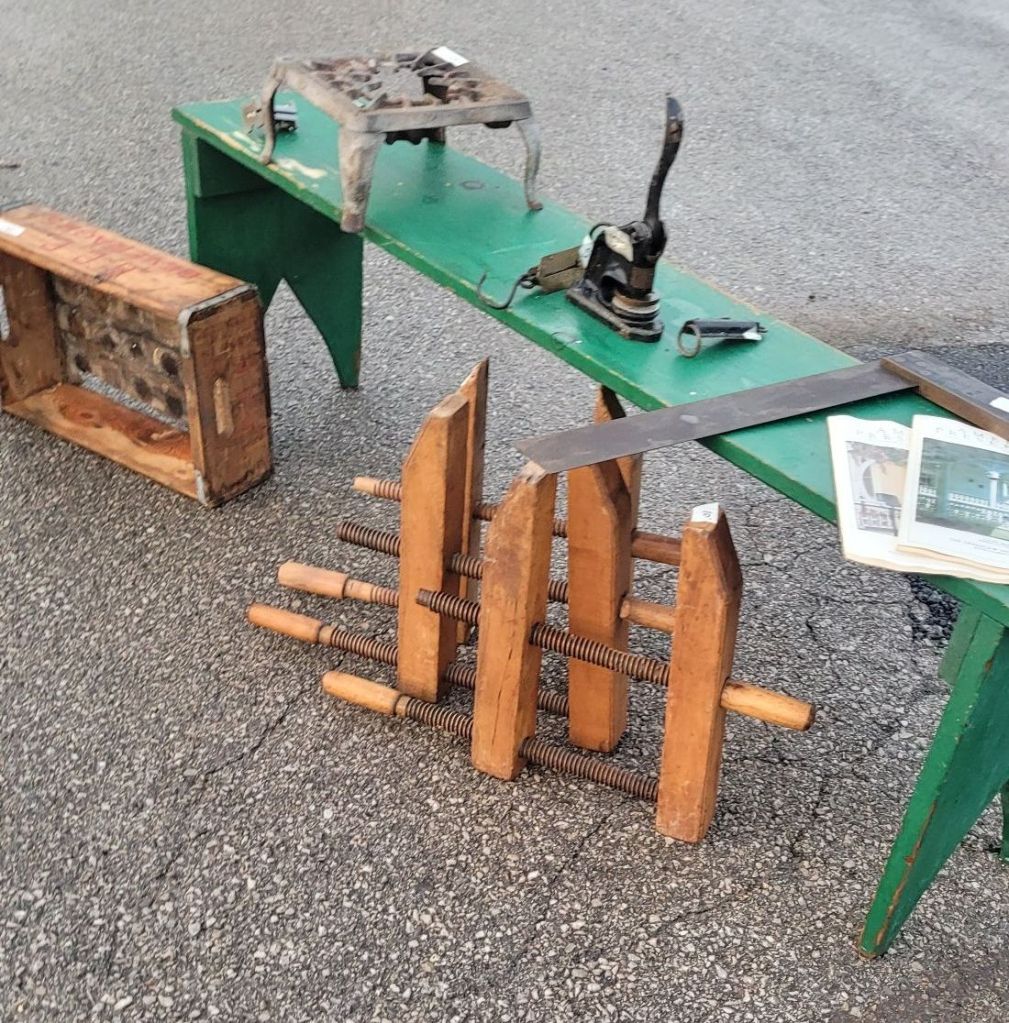
I put most of my tools on a white metal shelf Anita had in her booth. On top were big panel raising planes. On the two shelves were smaller tools that I sold for $5.00 each. I’ve found over the past year that cheap tools don’t sell well on eBay anymore. The buyer will pay $5.00 for the tools but will spend $13.00 in shipping. I mainly ship USPS Priority Mail for the free boxes, but I’ve been rethinking about buying my own boxes and switching to UPS.
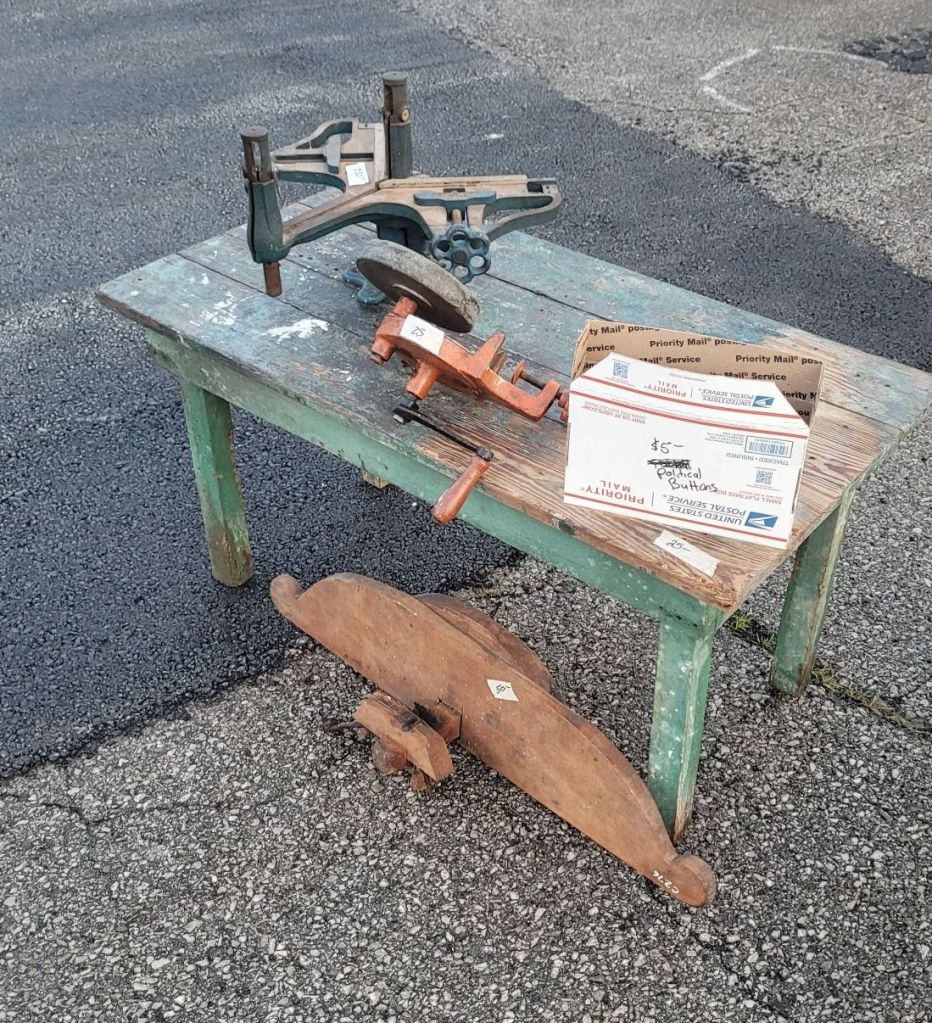
The tool of the day was this Stanley No 100 Picture Framers Miter Box. I had $50.00 on it, which was a steal. Even though I could probably sell it on eBay for more, the shipping would be outrageous. In fact, I checked eBay recent sales, and one sold for $50.00 with $120.00 in shipping. No thanks! I’ll sell it here and let the buyer save the money.
I sat out all day sitting on my trucks tailgate and spoke to numerous customers. Everybody was nice and thankfully had cash. I don’t have Venmo, so cash was the only payment I would take. I negotiated with customers all the time, making sure they felt they were getting a good deal. A lot of time, if I had $20.00 on an item, they would ask if I would take $15.00. I always said yes and never missed out on a sale.
My goal was to sell $400 for the day. By 10:00 am I was close at $280.00. The $5.00 tool shelves were the most popular as customers were looking for deals. People would look at the panel raiser planes, but no one offered me anything for one. Anita’s stuff was more popular with customers than my tools, but I expected that. Most of my customers were women.
By noon, I hit my goal as I surpassed $400. There were plenty of customers left still walking around, so I was happy to still sit on my truck’s tailgate. Nearing the end of the show, a guy came back to look at the Stanley No 100 Miter Box. He asked me what my bottom price was for it. I told him $40.00, and he took it. It was a little less than what I really wanted for it, but I was glad it was going to a good home.
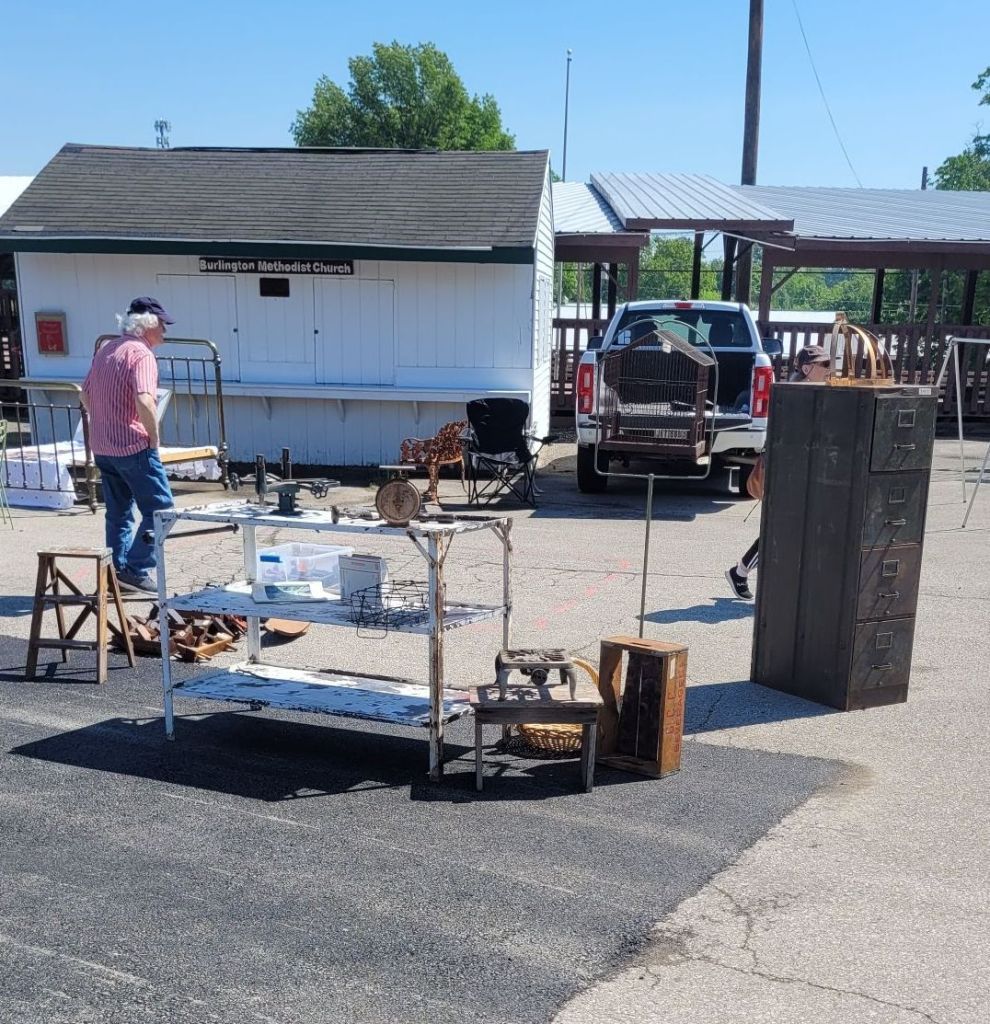
In the end, I sold $641.00 worth of stuff. Out of that, $263.00 were my tools. There was an old file cabinet and that white metal shelf that came home with me. Anita didn’t want either one back in the garage, so I took it to the recycling center this morning and got $18.25 in scrap metal for it.
Doing the show was a lot of fun. It was nice sitting out and relaxing a little bit and talking to people all day and making new friends. I’ll definitely do it again. In fact, I’m considering buying an enclosed trailer so that I can bring more items with me in the future. If I had a lot more inventory, I think I could sell thousands of dollars during the show. I know several people who do the same.