
Hand Tool Headlines
The Woodworking Blogs Aggregator
“Glory to God in the highest heaven, and on earth peace to those on whom his favor rests.” - Luke 2:14
Be sure to visit the Hand Tool Headlines section - scores of my favorite woodworking blogs in one place.
Elia Bizzari - Hand Tool Woodworking

The Firewood Pile

Junior runs the log-yard where I buy my wood. He brokers logs, buying mixed loads from local loggers and tree services, then selling them by species and grade to mills and foreign shippers. It’s a family affair: Junior’s brother runs one of the huge knuckle-boom trucks, his cousin runs the scales, and his son runs a small sawmill back home. Junior’s grandfather was a logger and sawyer, and his great-grandfather was logging trees at the time of the Civil War.
I went to the log yard last week to get a red oak log for a pair of Democratic Side Chairs. Junior knows what I want, often better than I do: he looks at hundreds of logs a day. “We don’t have much red oak. But there’s a red oak butt on the firewood pile the loggers slabbed…” ‘Slabbed’, I discovered, means the loggers split the log in half when they felled it, turning a valuable log into firewood.
The log was a beauty: 30“ in diameter, perfectly straight, fast grown. Junior sawed off a piece small enough that it wouldn’t crush my trailer and loaded it with the knuckle-boom.
‘What do I owe you?’ I always ask, though I know the answer.
‘I’ll catch you next time’ Junior never charges me for logs from the firewood pile. In a world economy where many of his logs go overseas before even being sawn, I think he likes knowing this log will be turned into a chair within 10 miles of his home. And for my part, I like salvaging nice logs that would otherwise end up in someone’s woodstove.

Travels to High Wycombe (and classes by Bill Anderson)
I’ve just returned from a two-week trip to England with my wife Morgan. Bath, London, the Lake District. Almost nothing had to do with my work….except a day in High Wycombe.
I’ve heard about High Wycombe since I started chairmaking. When I was 16, working at Drew Langsner’s shop in Marshall, NC, I first saw the book The History of Chairmaking in High Wycombe, which includes one of the best descriptions of traditional chairmaking I’ve ever read. Then, a year later, I watched Jennie Alexander’s old VHS tape of chair turners at work when I was working with her in Baltimore.
At the turn of the 20th century, chairs were still being made entirely by hand in and around High Wycombe. Pole lathes were still in (spare) use there in mid-century. High Wycombe, in short, is the closest link we have to traditional Windsor chairmaking.
Upon arrival in High Wycombe, we went straight from the train station to the Wycombe Museum:

Where they have an old bodger’s pole lathe:

I’ve been excited to see this lathe for awhile. The two popits (headstocks) look ancient – I wonder if they predate the rest of the lathe. A piece of leather fills the worn screw hole:

The two wedges are the fanciest parts of the lathe:

But the treadle was the most interesting part to me:

The treadle is hinged far behind the bed of the lathe – so far back, in fact, that the turner would have to stand in the gap between the treadle’s two lateral boards as he worked. At 27″ long, the treadle is also far shorter than mine. The tip of barely extends half a foot beyond the lathe bed when the treadle is flat on the floor. My experimenting suggests that this combination would limit the number of revolutions the work makes on each treadle stroke, slowing the work down. But, assuming the treadle was made by a professional (and I think it was, but I’d like to ask someone who knows for sure), it must work well. High Wycombe was a center of chairmaking and anyone using an inefficient late would have gone broke in a hurry. Besides being laughed out of town. I’m itching to try out this treadle arrangement sometime soon.
Next to the lathe was a bodger’s shaving horse:

With the meanest bite I’ve ever seen:

In another room was a chair framer’s bench:

The bench had a post vice mounted on it, with one of what used to be a pair of wooden vice pads in place:
A notch in the pad rests on the vice screw and the pads just kind of sit there. I’ll soon be making some to try them out. I’ve been using pads on my vice that are held in place with magnets, but this is a much simpler solution. Wonderful.
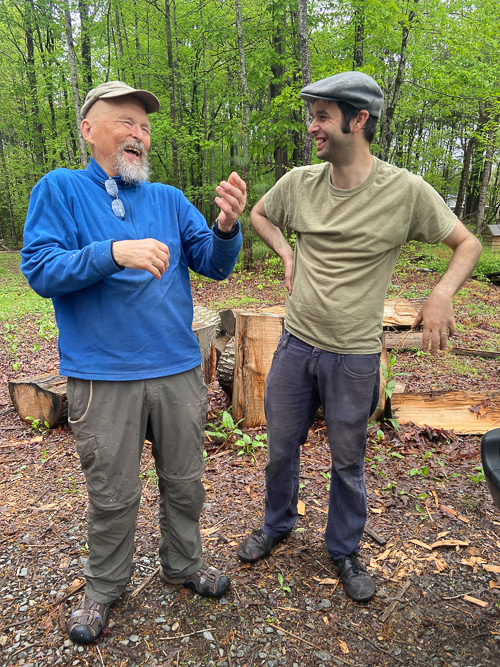 Bill Anderson is one of my longest-held woodworking friends. And one of my closest friends, period. We met dancing squares and contras, and became fast friends. We taught together at the John C. Campbell Folk School for a number of years. We made travishers together. Then, in 2010, Roy Underhill opened his school near us in Pittsboro and Bill became the most prolific teacher there, besides Roy himself.
Now, 15 years later, Roy’s school is closed and Bill has begun teaching one-on-one classes at his shop in Chapel Hill. You’ll never find a teacher who packs more into a class than Bill. Or puts more into helping you learn the material. Hand tool basics, table making, plane-making and restoring, bit-brace making, work-bench fixtures, the list goes on and on. You can find more info here.
The post Travels to High Wycombe (and classes by Bill Anderson) first appeared on Elia Bizzarri - Hand Tool Woodworking.
Old Bodger Videos

I’ve been on the pole lathe turning a pile of parts for upcoming 18th-Century Chairmaking classes. I’ve turned a few hundred parts on the pole lathe before, but this is the first time I’ve turned this many – 75 legs or so – on the pole lathe in one go. I’m really enjoying it.
Batch production like this is one of the best ways to develop skills. My surfaces are getting smoother and my work more efficient. It’s also forced me to make a few changes to my lathe treadle. Body positions that were passable for an hour became unbearable after a day. Now, I’ll benefit from the changes every time I use the lathe.
This time at the lathe has also reinforced what I already knew: turning on the pole lathe can be just as fast as a power lathe. I’ve been turning Samuel Wing’s simple chair legs in less than four minutes, starting with turned cylinders (I used the power lathe for roughing these cylinders, which is much faster for this). Could I turn the legs faster on the power lathe? Maybe, but I doubt it. Would the surfaces be smoother on the power lathe? Probably. But then again I’ve spent the last 25 years turning on the power lathe, so that’s a unfair comparison.
Another good way to develop skills is by watching people who know what they are doing. So I’ve been revisiting videos of the old English chair bodgers, trying to learn their secrets. A few videos I’ve posted here before. But there’s at least two I haven’t, and they’re some of the best:

This first one is from the BBC, ca. 1950. It’s of a pair of brothers, Owen and Alexander Dean, some of the last chair-leg turners in England. Watching this again, I saw something new: the chisel can stay put when the treadle stroke ends. I’ve been backing it up slightly before the next cut, but there’s no need for that – just leave it in place and begin again on the next treadle stroke. Saves a lot of energy.

The second video is from 1941 and is of Albert Carter, chair-leg turner. The narrator says he works 14-hour days and turns out about 10 gross per week, or 1440 legs. If he’s working 6 days per week, and doesn’t break for lunch or tea or anything, that’s 3.5 minutes per leg. Was he splitting and shaving all those legs himself? If so, he’s doing pretty well for a 75-year-old.
The post Old Bodger Videos first appeared on Elia Bizzarri - Hand Tool Woodworking.A Favorite New Technique
“Your book is next.” These welcome words greeted me a few days ago as I opened my email. Megan Fitzpatrick is my editor, Lost Art Press is my publisher, and my book may see the light of day sometime soon. Sure, there’s still lots of editing and formatting for Megan to do, but it’s begun in earnest now.
One of my favorite new techniques that I learned during the book-writing process was boiled joints. I’ve written about them before, but here’s a clip from my talk at the Working Wood in the 18th Century conference at Colonial Williamsburg a few weeks ago, showing how they’re done:
I just this week learned how to edit videos. This is my first, and I’m rather surprised at how simple and fun the process is. Maybe more will come.
The post A Favorite New Technique first appeared on Elia Bizzarri - Hand Tool Woodworking.