
Hand Tool Headlines
The Woodworking Blogs Aggregator
“Glory to God in the highest heaven, and on earth peace to those on whom his favor rests.” - Luke 2:14
Be sure to visit the Hand Tool Headlines section - scores of my favorite woodworking blogs in one place.
General Woodworking
Ladderback chair for sale
I made a few ladderbacks in the past month, one of which was to bring with me to the class I just finished at Pete Galbert’s. These recent chairs are the first of a batch of white oak chairs that will take me a while to get through…
 white oak w hickory bark
The photo’s a bit crooked, not the chair. It’s been fun working this much white oak, I mostly get red around here. Linseed oil finish. Hickory bark seat, woven in a diamond-pattern. The bark was a few strips from the end of a batch, over time their color and texture will blend just fine. Sitting on bark seats creates the best finish they can get.
 diamond weave hickory bark seat
I decided I’m even going to keep one of these chairs. For all the time I’ve spent on them in the past eight or so years, I have none in my house, they all got sold. Time to change that.
 overall view
This chair is for sale – $1,600 includes shipping in the US. I didn’t measure this particular chair, but it’s my standard Jennie Alexander-style chair – they’re about 33 1/2” high, width across the front c. 17” and depth of the seat about12”. Seat height around 17 1/4”.
If you’re interested in this chair, send an email to me at PeterFollansbee7@gmail.com and we can sort out the details. You can send a check or I can send a paypal invoice – including their fee, $1,658. If you come pick it up, we’ll call it $1,450.
new project(s)........
 |
| no more red/orange paint |
Spent some time this AM playing with the adjustable tenon cutter. I got 99.99% of the paint removed except for the ratchet arms. There are few spots hiding out in the nooks and crannies that are being obstinate.
 |
| sigh |
The black paint ain't playing nice nice. The steel wire brush did diddly squat knocking anymore paint off. The paint on this doesn't look that bad but I removed the paint from all the other parts, so I'm bound by law to do the frame. Next batter is stripper.
 |
| hmm........ |
Got the bottom together with no left over parts. All of the screws only fit/go in one place. I was a little apprehensive about remembering that and getting all the screws back where they belong.
 |
| 1st bookcase |
I had to go through all the boards to find two that weren't cupped or bowed. Out of the 12 boards only one (the left one) didn't have a knot in it. I want the carcass of the bookcase to be clear. I'll use the knotted boards for the shelves.
 |
| reference edge |
Used my #8 to straighten and flatten one edge. Next batter was ripping the four to width. I went back and forth on that and settled on 10 3/4". A 1/4' will be lost for the back panel rabbet leaving the shelves to be 10 1/2" deep.
 |
| done |
I was surprised that I didn't have any hiccups flattening the edges. I usually have a few dips and humps to deal with. Surprise, I had none on any of the four I planed.
 |
| dovetails |
Initially I was going to dovetail the top and bottom but I made a left turn. Instead I am dovetailing the bottom and the top I will put in stopped dadoes. I want an overhang on the top and this way I don't waste adding another board to the top.
 |
| had to move it |
The sides of the bookcase are about 42" long. Where I usually put the Moxon wasn't working. The sides were hitting the workbench foot and sticking up too high. I moved it further over to the left. Even there the sides were sitting on the cellar deck but they weren't sticking up too high.
 |
| sawn out |
No problems sawing out the tails, I had clamped the sides together and sawed them as one. I'll chop them out in the AM. I had run out of gas by now. I spent the rest of the PM watching the Welsh chair video reading about it.
accidental woodworker


road trip.......
Made a run out to Gurney's Sawmill this AM. Usually I leave my house around 0700 and I get there about 0745-0750. Today I left closer to 0800 because most of the trip is driving due east right into the rising sun. Most people drive that road at absurdly high speeds which scared me the first I drove out there. Wasn't too bad today and Gurney's didn't have a lot of 1x12 pine to pick and chose.
I left there with six 1x12s by fourteen feet, one 1x12 by twelve feet and one 1x12 by ten feet. The plan is to make a couple of bookcases that I'll use for now stowing shop hardware etc etc. After I'm gone the bookcases can go to Miles and Leo. I'll work on making 2 of them while I study the Welsh chair vid I got from LAP.
 |
| quick drawing |
As a rule I don't like fixed shelf bookcases but this time I'm using fixed shelves. I may add back the extra top shelf, here I nixed it. I have the height where I plan to put them so that is subject to change.
 |
| six 7 foot pine boards |
Getting these out of the truck and into the shop wasn't hard but it also wasn't easy. Of late I've been getting winded and out breath just blinking too fast. Normally I would have carried these down into the shop 3 boards at a time. Today I did one board at a time and slid them down the cellar stairs.
 |
| the rest of the herd |
One ten footer cut in half and one twelve footer cut into 5 and 7 foot lengths. Thinking ahead I can get one top/bottom and side out of one 7 foot board.
 |
| hmm...... |
I remembered what this was for. It is an extension for the 5/8" bit. Craig commented that is what he thought it was too. That is what jarred my memory. Supposed, if my memory is still working, the 5/8" bit doesn't splinter and tear out on the exit like other brad point bits.
 |
| nope |
Still 100% clueless as to what these two doo dads are. I checked the drawer where I kept this to see if there were anymore of them and nada. I don't have more of them that might have lit a light in the brain bucket.
 |
| hmm....... |
Got curious and forgot to snap a before pic. I cleaned the top ratchet arm with the steel wire brush lickety split. The bottom is approximately what it looked like in the before 'pic'. 24 hours soaking in Simple Green will strip paint off of metal (with a little help). A couple of nooks and crannies are still holding paint. Couldn't get the wire brush in there and pick wasn't working neither.
 |
| hmm...... |
The black paint is being stubborn. It wasn't coming off under the wire brush as easily as it did on the ratchet arms. I poured some more Simple Green in the tub and I'll let this soak for another day or two.
 |
| knurled knob |
The paint is 99% gone from the knurling on the rim. I pretty sure it will disappear entirely once I introduce it to the wire wheel on my grinder.
 |
| snagged a pencil |
Not many places give out free pencils or similar small items anymore. You can't beat the free advertising a pencil shows. I should have taken two. Next trip if I remember.
 |
| the new home |
This is where I plan on putting the two bookcases. I mostly want one of them to stow all my nails which probably won't take up more than one shelf. Of course I'll have to find a new hole to stick my off cuts in.
 |
| my first adjustable tenon cutter |
I do remember trying this out and it did work. But as you can see from these two screws, a butcher worked on them. The top one secures the center post that is a depth stop. I can't budge that screw and I don't consider myself a weakling.
 |
| more abuse on the bottom |
The screws securing the iron have had the snot beat out of them too. The iron is made from a file. This tenon maker had a hard life. I bought the 2nd one because of the condition of this. I thought I might be able to use it as a donor?
 |
| WTF? |
How does the business end look like this? This is deliberate work to alter the stem end. Was it done because the jaws in the brace needed help somehow?
I'll start on the bookcases in the AM or monday.
accidental woodworker
welsh stick chair prep.......
 |
| my chair making toys |
I think, but I'm not 100% sure of, that these are all the toys I need to make the stick chair. However, I have a nagging thought banging on the back of my brain bucket that I'm missing something. I remember trying to buy 'it' from Lee Valley and it being out of stock. Tomorrow I am buying the LAP vid on making the stick chair and I'll figure out what, if anything, I need to add to my herd.
 |
| 5/8" tenon cutter |
The iron in this needs some love. The cutting side of it is chipped and the back is not flat. That is where I started flattening the back starting with 100 grit and ending with 400.
 |
| I like shiny |
I had to free hand sharpen this one. I was surprised that the angle is less then 25°. I left it as it was and I'll see how well it holds up.
 |
| hmm....... |
This has an interesting way to secure the iron. The dual screws on the top tilt the iron up/down across the width. The bottom thumb screw secures the iron. I don't have any time on the pond playing with so I don't know the hows and whys for the dual screw setup yet.
 |
| spoke pointer |
I think that this is what this is called. It makes a conical shape on square stock that the tenon cutter can bite on and make the tenon. They come in different sizes and this is one of two I have. The other one needs an iron.
 |
| making a 5/8 tenon |
I hadn't noticed it but there is a depth scale on this. I did it until one inch and then at two inches. Both actual tenon measurements were an 1/8" shy - you have to eyeball and that will take some practice before I get it dead nuts. For now an 1/8" off ain't too bad IMO.
 |
| hmm....... |
Pretty happy with this even though it isn't parallel to the center of the stock. Wasn't expecting the flat end grain at the bottom of the tenon to be so clean. I was expecting a lot more tear out and a ragged out look.
 |
| 5/8" hole |
I have a 5/8" fancy brad point bit but I wanted to use an auger bit to make the hole. This is a practice hole for the tenon I made above.
 |
| inch too long |
I made the tenon 2" long (actual 1 7/8"). Better to have it too long then a frog hair short.
 |
| wedge |
Made a wedge out of cherry which the same as the tenon stock. The tenon stock was straight grained on all four sides which made sawing the kerf a little tricky.
 |
| hmm...... |
The wedge expanded and locked the tenon in the hole. I wasn't sure that I had made the tenon fat enough to do that, but I had. Screwed up on the orientation. I aligned the wedge parallel to the pine grain. There is a slight crack above and below the tenon.
 |
| it is finally time |
I have had this adjustable tenon cutter for a few years and never got around to restoring it. I have two of these and this one is the best. The other has been used, abused, and put away wet. It has the scars of a lot of use that wasn't done kindly. I'm going to restore it now because I might need/want to make a tenon wider/smaller then 5/8".
 |
| stripping the paint |
Back when I was going nutso rehabbing planes and such, someone left a tip about Simple Green. I don't remember who but a big shout out to you. I had left a hand drill soak in Simple Green for a day and all the paint just fell off. I will let this soak until tomorrow and I'll check it then.
 |
| hmm..... |
For the life of me I can not remember exactly this is or what it is used for. All I can recall about it is Chris S from LAP used it so I bought one. Anyone out there know what it is?
 |
| spray shellac |
Got 3 coats on the bottom before lunch. That is all I am laying on there. I couldn't do anything else with my chair making toys so I did this.
 |
| flushed |
Sawed, planed, and sanded the tenon/wedge flush. I have wedged square/rectangular tenons and this is my first round one.
 |
| hmm....... |
The flat on the bottom of the tenon was flush with the pine all the way around. Three sides were gap free and one had a gap. I pulled on this grasping it at the bottom and pulling it with all I had. It held. It didn't groan, squeal, or bend in the least. For whatever reason, a 5/8" tenon seemed to be weak to me.
 |
| two coats on the top |
These will be done today. I think I'll add a couple more coats to the top - 5-6 because the interior will get more wear/tear then the bottom and sides.
I heard back from Lee Valley about getting a spare saw blade for their gents saw. $62 which I declined. A new gents saw is $74 - the cost savings isn't there. I was hoping it would be in the mid $30s. I'll order another saw and send the one I have now out to be sharpened.
accidental woodworker
little shop time......
Left for my VA appointment at 0700 to get my blood work done. The blood draw waiting room was almost full. I guess the hurry up and wait mentality of the military never goes bye bye. I had the blood draw early so it would be done by the time of my oncology appointment at 0830.
That appointment went well. The doc said some people don't experience any side effects and others go over the deep end. I guess I'm lucky that other then some brief nausea I have had no other side effects. My blood work looked good with only my white blood cell count being low. The doc said that was due to chemo and it effects how well I can fight off infections.
I had my Rx for the nausea medication refilled and that took a bazillion hours of waiting before it got filled. It was a little after ten before I got it and headed back to the barn. On the way home I stopped at the eye clinic to get my eyeglasses fixed. That didn't happened and I had to make an appointment which is for this monday.
 |
| after lunch |
I didn't get to the shop until after lunch. I took one box out of the clamps and checked the fit where it will live. The segmented box in the front is one of two boxes that aren't as wide. Wasted space for debris to pack itself in.
 |
| all four |
I sanded the 3 boxes with 80 and 120 grit. No finish on them and I'm leaving them bare for now. I have spray shellac that I could use but I wasn't in the mood for it.
 |
| tenants signed their leases |
This will probably change as I use these. The only hiccup with them is they fill up with all the crappola I generate working at the bench.
 |
| came a week early |
My pic of the bumblebee orchid came today. It surprised me because I thought there were actually 3 bumblebees on this plant. The 'bumblebees' are the flowering part of the orchid.
 |
| checked the fit |
The margin for the mat is what I had planned. The hunt for the color of it isn't going to be easy. I thought I had one picked but seeing the green background of the photo against the off white frame has me second guessing myself.
accidental woodworker
Old Fashioned Milk Paint Tutorial
good shop day......
I am now in the 8th day post my chemo cocktail. Still waiting for even a hint of the side effects the nurse told me about. Other than a twinge of nausea on day 2 and 3, nada. She said I would lose my taste for foods I liked, I would be nauseous, sleep would change, and that I would feel tired. She stated the worse of it usually says hello in 7-10 days. Two more days left for that and I have an appointment with oncology tomorrow at 0830.
In spite of this, I had a great day in the shop. I went to the shop a little after 0800 and worked until lunch around 1130. Filled the pie hole, made a quick trip to the grocery store, and returned to the shop before 1300. Killed the lights at 1435. Been a while since I worked in so many hours in an AM session. I feel good, with nothing shaking hands with me or simmering away in the background. If my blood work is good tomorrow my 2nd chemo cocktail should happen on August 11th.
 |
| hmm...... |
Not exactly something you could shave from. I had already scraped off some debris - mostly glue. Underneath the router is my surface plate which I'll use to clean and smooth the bottom of the router.
 |
| 320 grit |
I didn't go nutso on this. I used 320 and 400 grit and the goal was to get the bottom smooth to the touch.
 |
| sharpening the iron |
It wasn't that bad doing the two irons. My fingers didn't cramp or ache before, during, or after. Which was a lot different from the last time I sharpened either of these. Used the coarse, fine, and extra fine diamond stones.
 |
| worked |
Stropped them both with this. Worked better than I expected.
 |
| hmm...... |
The inside of the frame at all four corners, was dead nuts 90°. Not so for the outside corners. All four were slightly off 90°. That was due to me planing the outside edges - I didn't attempt to check/keep the outside miters at 90°.
 |
| ditto |
The bigger frame was the same but the outside miters were not out as far as the little one.
 |
| hadn't planned on this, but..... |
The well I have behind my workbench had a couple of boxes there. Two of them weren't exactly user friendly - one was too small and the other too big. So I decided to make three boxes all the same size and ones that fill up the well. The bigger boxes will be easier to get the crappola I keep in them in/out.
 |
| sigh |
The width is a wee bit more than the length of the end. Two of the boxes will be the same size and this one will be exactly 3 frog hair shorter in the width.
 |
| ready for glue |
Dry fit had some fits that I had to address. I had to trim each of the bottom panels before the band clamps pulled the miters tight.
 |
| hmm...... |
I had to make one poor man's miter box by hand. This one has only one miter and one 90. The idea is this will be the jig to make a quick miter or a square end cuts.
 |
| hmm...... |
I would give these two cuts a 92 out of a hundred. The 45 is just a frog hair high on the heel. I wonder if the old masters had these problems.
 |
| sigh |
The vertical cut sucks. That is way too nuch light. The vertical saw cuts on the jig looked to be square when checked with my 4" Starrett square. The stock was square all around when I checked that too.
 |
| hmm...... |
Easily squared it with two strokes with a chisel. Squaring the heel also helped with the 45.
 |
| the fault |
I knifed a square line parallel to the heel cut. The tapered saw cut has bit me on the arse again.
 |
| small saw didn't work |
Don't know what I was thinking using the small carcass saw first. Used the big saw and the 90 sawing aid. No problems and the saw cut looked good after I did it.
 |
| nope |
Did two 90 saw cuts and both were the same. It was two frog hairs off.
 |
| how long |
My last poor man's miter box lasted about 3-4 months. I will put the one I just made in the vise for daily shop use and reserve the other two for making mitered frames.
accidental woodworker
Painting "Block" Holder
My wife has recently gotten into watercolor painting, and the paper she uses comes in a thing called a block. There are times when she would like to have the block not flat on the table, but at an angle. So necessity being the mother of invention, I made a block holder with adjustable angle. It turns out that the "adjustable" part was a bit tougher than I thought it might be.
 |
| The completed project |
I had some spare spruce/pine/fir from the potting bench project, so I used that. The block is 9" x 12" and I'm making this thing 12" x 14". I had remembered a book holder project that Matt Estlea did on YouTube and I thought I'd make something similar.
The two frames are half-lapped together. The top one will get a horizontal member that holds the adjustable "kickstand" and the bottom frame gets a third front-to-back stile that has notches cut in it to receive the lower end of the kickstand.
 |
| Front frame partially done |
 |
| Half-lap joints |
The kickstand cross-piece has to swivel to allow different height positions. So I experimented on some scrap with an integral round 3/8" tenon on one piece going into a 1/2" deep, 3/8" diameter hole in another. This seemed about right, so I went with it.
 |
| Prototyping a swiveling part |
 |
| Here's the real thing - parts connected with a bridle joint and round integral tenons shaped with saw, rasp and file |
The piece in my hand in the above photo is actually hollow. I made it by plowing a 1" wide, 5/16" deep groove in a 6" x 1 1/2" x 1/2" piece, then gluing on a cover. This hollowed-out piece houses a 5/16" thick inner piece that slides in and out to adjust the angle of the project. I had experimented with a sliding dovetail mechanism for the kickstand, but wasn't happy with it.
Before gluing up the two frames, I mortised the bottom pieces for hinges. It was much easier doing this when the parts were more manageable.
 |
| Hinges ready |
The lower frame was straightforward - two rails and three stiles half-lapped together. But I did add notches to the center stile to accept the kickstand.
 |
| The lower frame ready for glue-up |
 |
| Gluing up - you can see the notches in the center stile |
Some further touches included gluing on a 1/2" x 1/2" piece as a ledge to support the watercolor "block", drilling some holes in the inner kickstand piece, and making a small pin to keep that inner piece from retracting into the outer piece.
 |
| Here's the ledge that will support the watercolor "block" |
 |
| The pin (made from a bamboo chopstick) and prototype hole |
 |
| The pin in place showing how it prevents the inner piece from retracting |
And here it is all together showing the range of angles it can be set to. With four notches and three holes in the inner member of the kickstand, there's a lot of adjustability.
 |
| Maximum setting is 45 deg |
 |
| Minimum setting (other than sitting flat) is about 15 deg |
 |
| And of course, when not in use, it can fold flat for storage |
I gave this project three coats of shellac, followed by a coat of wax. I also added little vinyl feet on the the bottom frame so that it won't slide on the work table.
The tough thing about this project was trying to figure out where in the top frame to put the pivoting kickstand, and how long to make the kickstand parts. To do this, I hinged together the two frames while they were dry-fit, the top frame with the pivoting arm not yet in place. I clamped a 45 deg triangle between the frames to set the maximum angle and sort of looked where it might be best to place the pivoting arm. I was really just guessing here, but it seems to have worked out.
One last thing. The extending part of the kickstand has a chamfer top and bottom to create a point at its end. Because that point enters the notches in the bottom frame at different angles, I cut those notches at different angles. They're not perfect, and I didn't try to make them so, but they hold the kickstand nicely.
 |
| You can see the point in this photo |
That's it. For a simple little project, it sure had me thinking a lot.
poor man's miter box(es) done.........
 |
| outta the clamps |
Flushed the corners, front and back, with a plane. All the miters are still tight and gap free and I couldn't break it apart with my hands.
 |
| nope |
All four corners held when I whacked it against the lally column. I was impressed because every mitered frame I've made before this was toast (without some reinforcement). I can't think of any that survived me breaking them with my hands. This survived both tests.
 |
| kind of done |
Pleased with how this looks. The finish is smooth with no streaks or 'non shiny' spots. This paint is a semi gloss enamel and it can be tricky painting but the rattle can excelled.
 |
| 2nd miter box |
Came up short using my usual (small) carcass saw (had to try it). I needed another 1/2" or so more saw plate.
 |
| old poor man's miter box |
Broke it up and this will give up two cleats that I'll glue to the miter box bottoms. That is what will hold the miter box in the vise.
 |
90° test cut |
The face cut was dead on but the vertical one wasn't. I thought the cut was toast but it was the stock. It wasn't square which was a relief.
 |
| yesterday's 90° test cut |
The test miter I made with dowels is what I used to saw a couple of 90s. Dead on the face and vertical.
 |
| hmm.... |
I've found with the dozens of these I've made over the years that the fence with the saw cuts in them go south quickly. There isn't any support for them and they slowly move, opening the saw cut making the miters worse. To help delay that I am going to glue a thin piece of pine to the back to span the saw cuts and strengthen it.
 |
| glued and cooking |
The pine I glued on the back was a few frog hairs shy of 3/8" thick.
 |
| done |
It doesn't span the entire saw cut and I didn't see any need for that. I believe most of the help is needed at the bottom between the platform and the fence.
 |
| test cuts |
Wee bit disappointed with the test cuts. The 90 was dead on but the miters were off. Both the right and left miter heels were a frog hair high. If I pushed them into Mr Starrett they looked good. Pushed in loosely, the heel was high. Maybe I'm being too anal about this because the R&L miters went together at 90°.
accidental woodworker
Driving the Work - Lathe Tailstock Centers
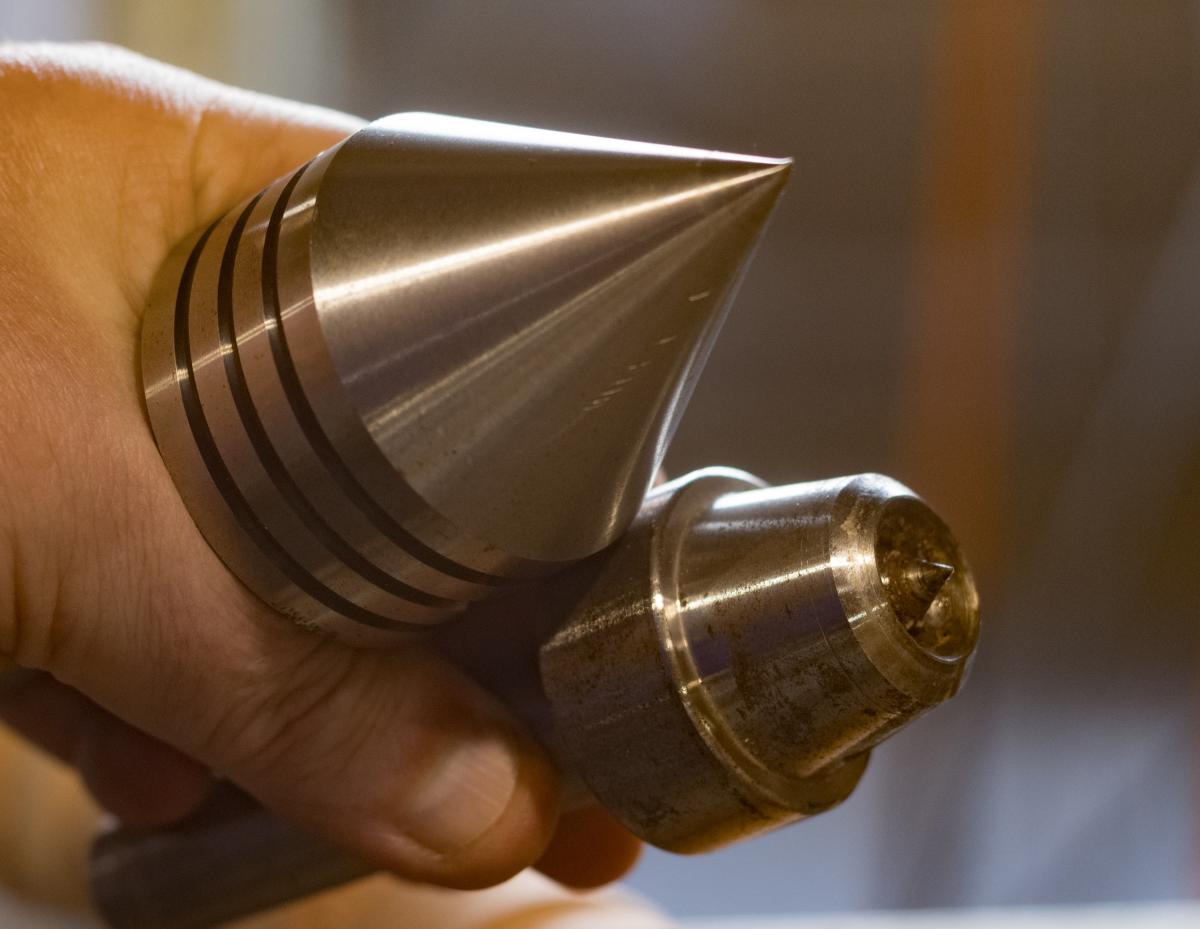 Left: 60 live center. Right: live cup center
I have previously written about the drive centers used on a treadle lathe. Today it's the tailstock's turn. The tailstock support does two things: the first is obvious - it keeps your spindle work from falling out of the lathe. The second, which is important even if you're using a chuck to hold a material, is that it prevents the end of the work from bending away due to tool pressure. In thin stock, this is very obvious that you want to support the material so it doesn't bend away from the tool as it cut. With large work held in a chuck, support from a tailstock center will help prevent the work from spinning out of the chuck if there is a catch.
The most primitive tailstock center is just a pointed bit of metal that the work can rotate around. Such a center is called a dead center, and is typically a steel rod coming to a 60 point. You can just put dead center in your tailstock and it will work. But in general, this isn't done anymore. The problem is that unless you keep the dead center continuously lubricated, the turning work creates a lot of friction and therefore heat, and you lose energy that could otherwise go for keeping the work turning. Before ball bearings became inexpensive, the aptly named dead center was a pretty common way of supporting work. I don't have a dead center for my treadle lathe - there is no point. I do have one for my metal lathe, but I've never used it.
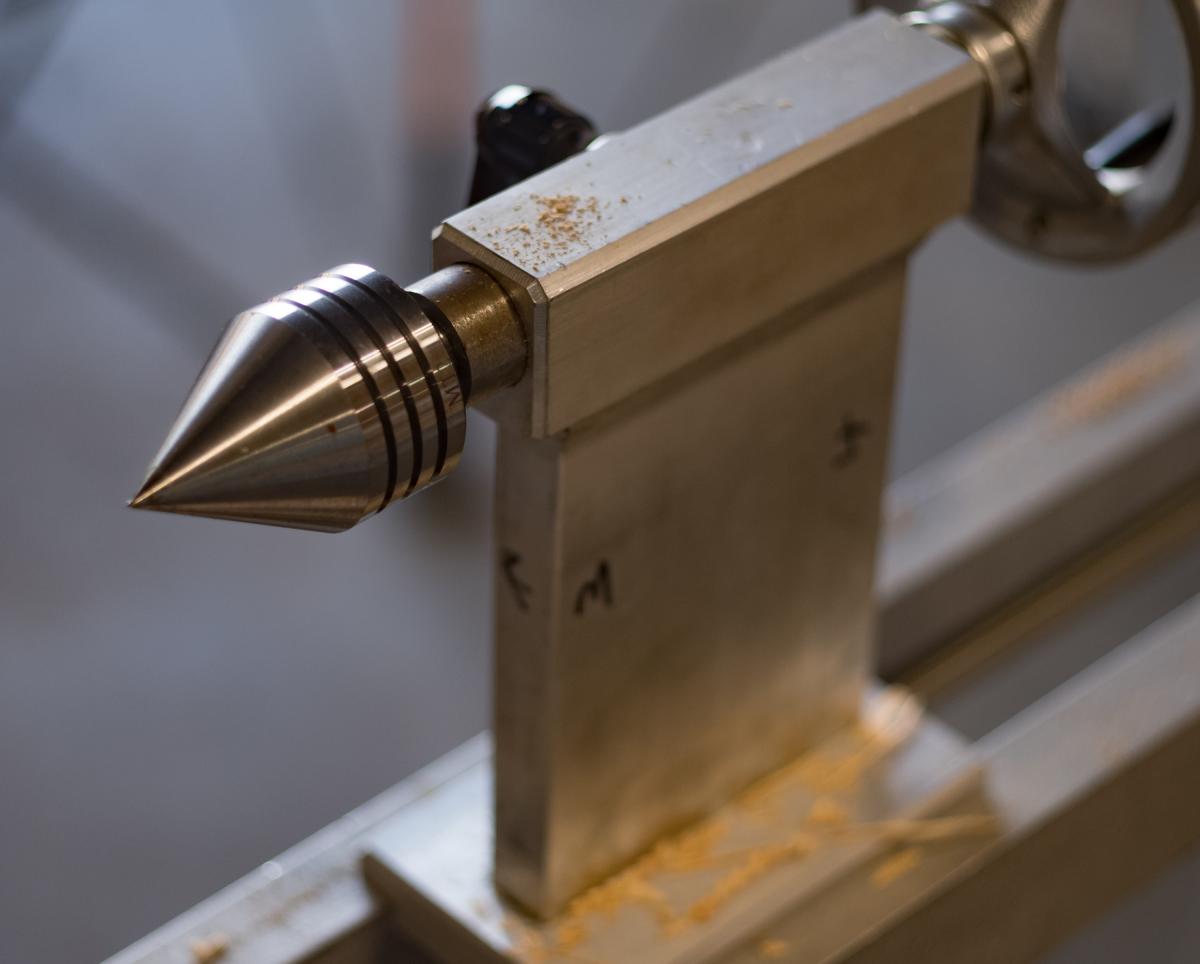
Once the 60 live center with a rotating cone was invented and became affordable, there absolutely was no reason to use a dead center. The typical live center is a 60 cone that spins. All you do is drill a hole at the end of your work, with or without an additional countersink, and the cone supports the work. Works like a charm.
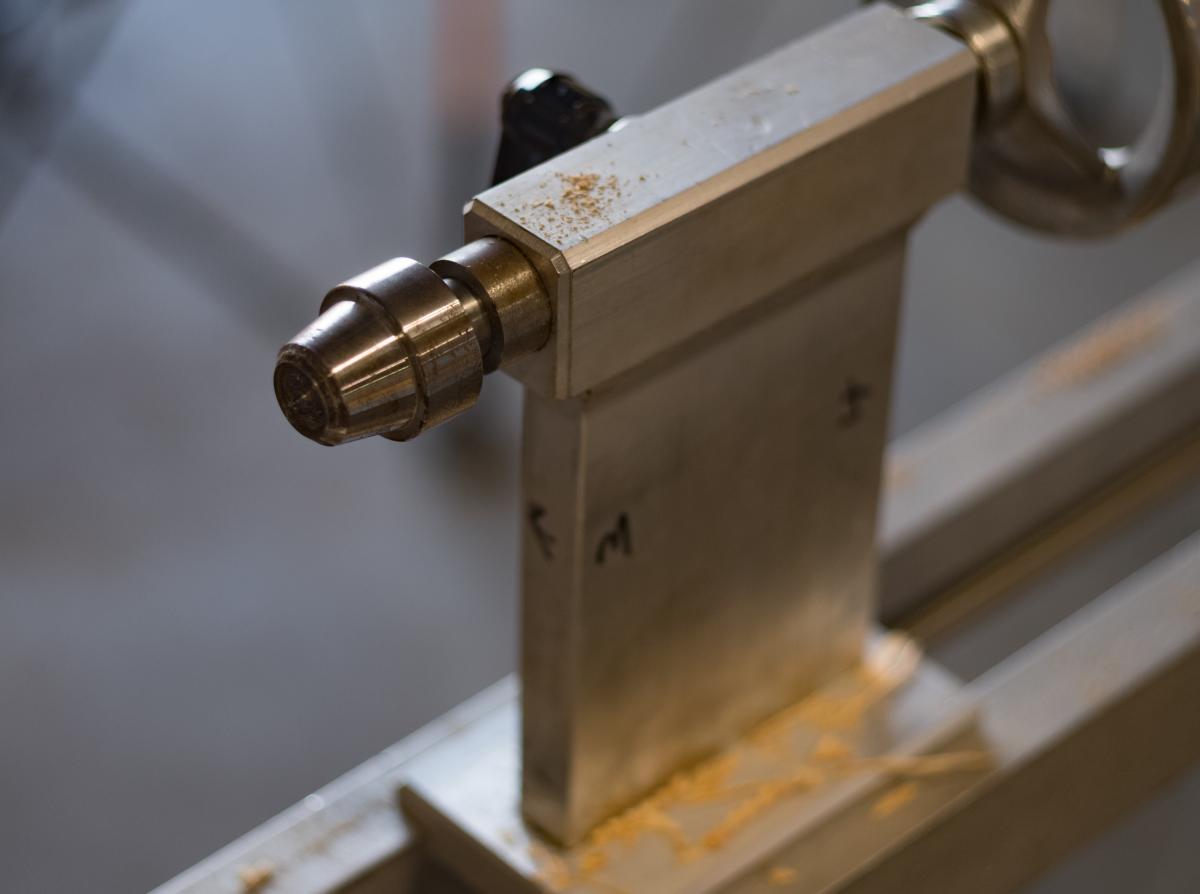
I don't use a 60 live center much either. The reason is that you have to drill a hole. Cup centers are more recent invention. That's what we supply with our treadle lathe. To use it, all you need to do is lay out the center location with a punch mark. The pin in the center of the cup registers on that mark. When you tighten up the tailstock, the sharp ring of the cup grabs the wood and holds it solid. That's it. No drilling. And it rotates along with the work like any live center so there's no friction problem either. I can't think of a reason not to use a cup center - except for two situations. First, if you're turning anything with a hole at the end, you can't locate a cup center. In this case, a regular 60 live center will just center itself on the hole just fine. This is actually pretty important when you're turning handles and other things that get drilled before you actually do the turning. The second case: if you're turning something that has a very small end. Our cup centers are 5/8" in diameter. This means if you want to turn the end of your work smaller than 5/8", you simply don't have the clearance. A typical approach is to leave a little waste at the end. But depending on how deep you put a center hole, a regular live center allows you to turn smaller at the end. The only problem I have with cup centers is that I find over time the ring wears in on the work and gets a little loose. So periodically I find myself having to tighten up the tailstock a little more.
One important advantage of a center - either style - is that it's repeatable. If you take work out of the lathe and put it back, the tailstock center ensures that the work will be aligned that same way as before.
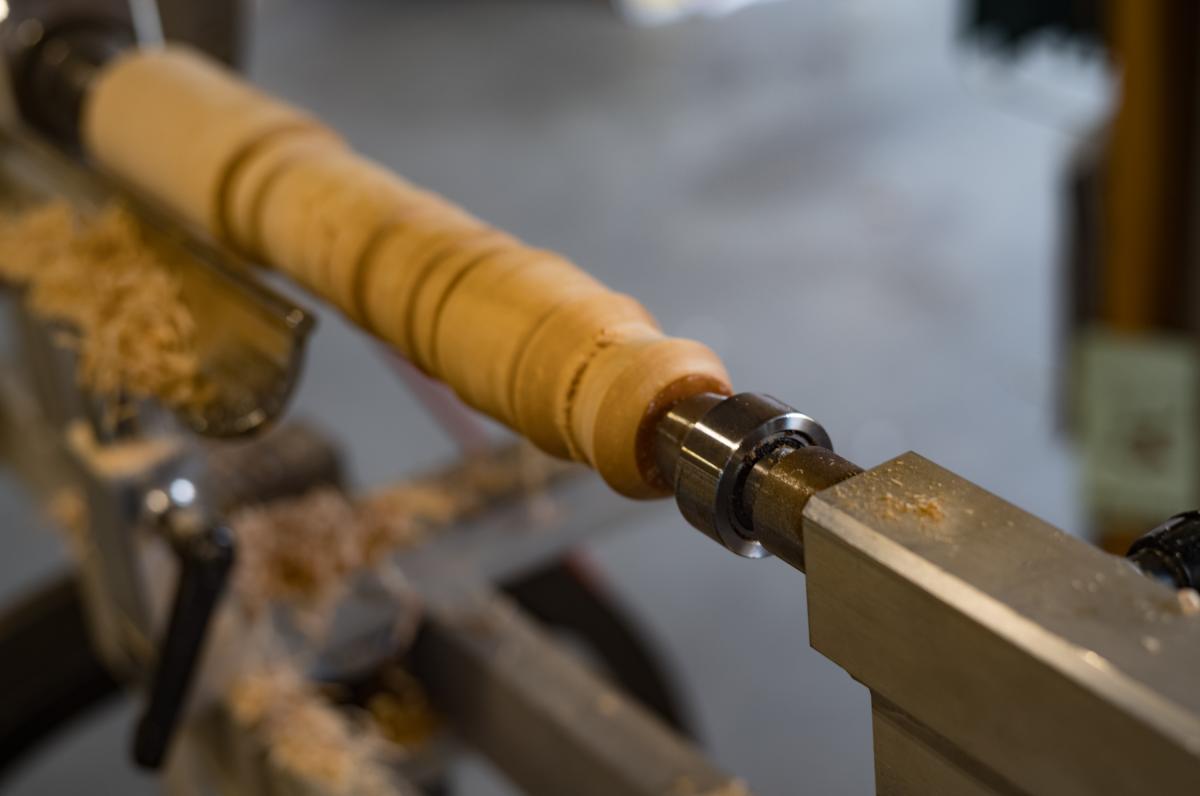 The cup center installed and in use
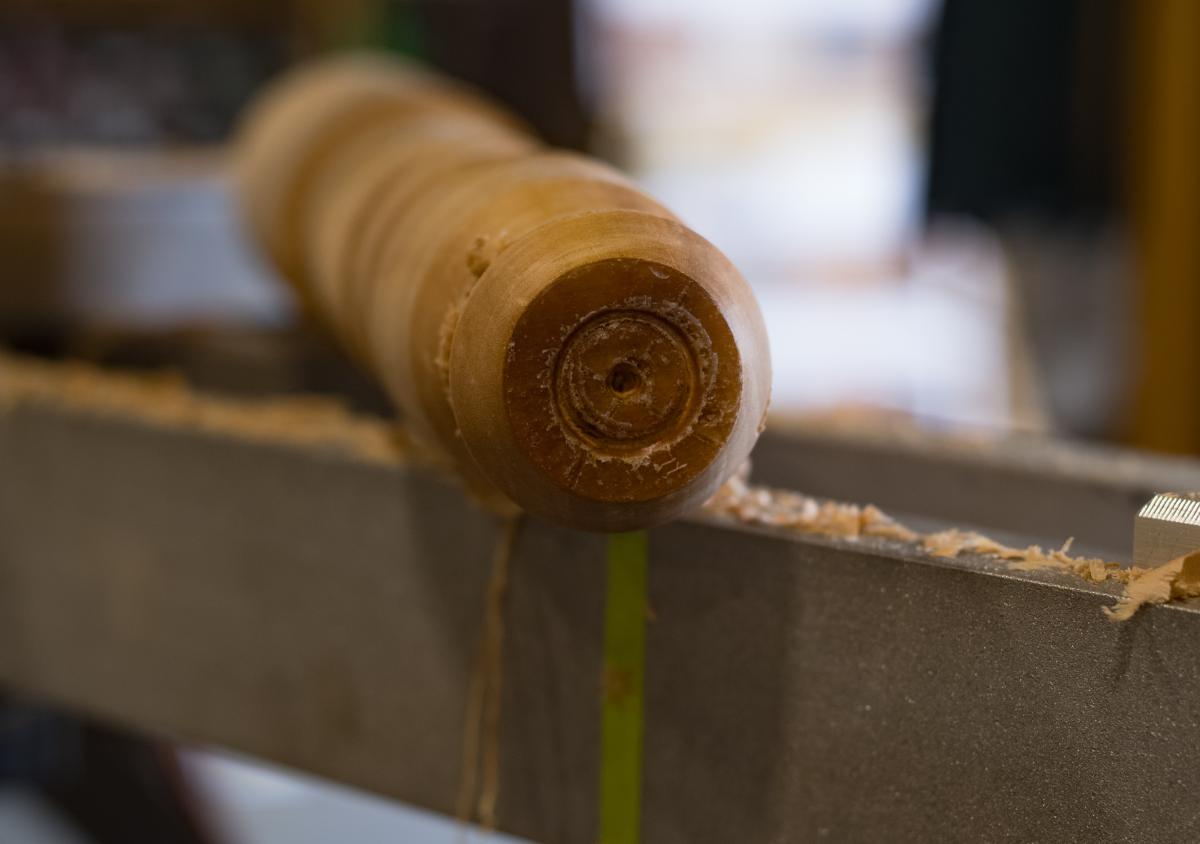 The ring cut in the work by the cup center. This particular stock was coated in wax - which is why the cut is so smeary
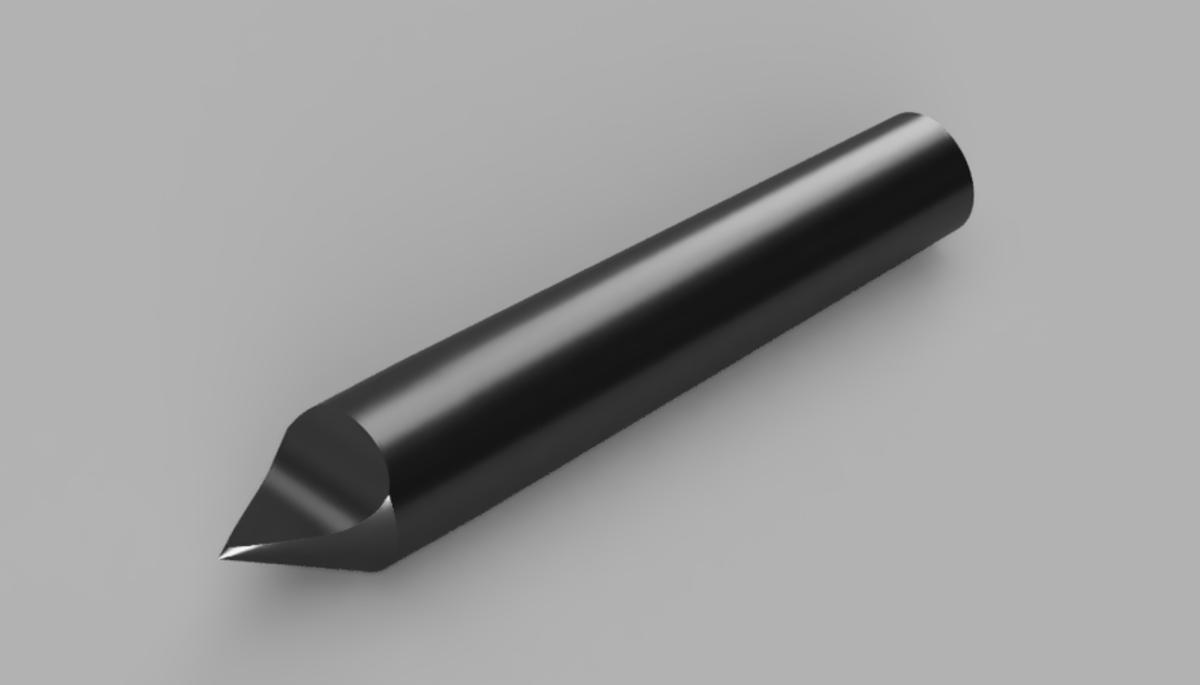 A rendering of a 1/2 center
This leads to a final type of center which I don't own. It's a half center. It's a dead center, so there's always that friction issue. You might want to avoid using it - except when you have to - but it has the top half ground away so you could actually turn right up to the center of the work without hitting your tool on the steel center. This is handy for small work. I would call this a specialty tool, and I haven't seen much commentary about it, but some vendors still stock them.
poor man's miter box(es).........
 |
| hmm....... |
Liking the look of the finish so far on this frame. One spot that isn't cooperating is the flats on the beads. I had to tilt the the frame to get coverage in there. It took 3 coats to barely cover it.
 |
| painting is done |
I'm calling this pic frame done, paint wise. It was still sticking to the blue painters tape so I'll let it hang out on the dryer for a few days. Once it isn't sticky anymore I'll spray on a couple of coats of shellac.
 |
| poor man miter box stock |
Going to try something different this time. I will start with making two boxes with 1/2" oak plywood and a scrap of 5/8" pine. I have a couple of 1x12 pine boards but I'm holding them for later. If these two work, I will make at least one more box with it.
 |
| first box |
Glued the back stop to the platform and clamped it to the tablesaw fence. It is dead nuts 90 between the two. I let it set in for 15 minutes and then screwed the back to the platform. The fence was long enough to clamp both boxes to it.
 |
| another jig |
This is a sawing aid for 90° vertical cuts. Made it out of an off cut of a 2x4 and pine scraps. One of my continuing headaches with making boxes is I (so far) can't saw a 90° vertical cut. This should ensure that I get that saw cut dead nuts.
 |
| change of plans |
Instead of using the newly made 90° jig I used a 1 2 3 block. Clamping the jig to the box and then securing the box in the vise wasn't working. This set up worked. I used my biggest carcass saw to saw it - there is plenty of saw plate under the spine.
 |
| 45 sawing aid jig |
This 2x4 has been hanging out in the shop for at least a year and it should be done with stupid wood tricks. If not I'll whack out another one. Sawed the the 45 on the tablesaw with my Osbourne miter jig. Wasn't expecting this to come out dead nuts on 45. The plan was to saw it out rough and sweeten it on the miter shooting jig.
 |
| hmm....... |
It was looking like I needed two 45 jigs - one for the left and one for the right. I didn't try to over analyze it but I couldn't see an easy way to make one 45 to do both R & L.
 |
| sigh |
I like this miter gauge a lot. I had bought it because Norm had one so I
had to have one too. That aside, since I've had it, whenever I saw an
angle when I set it back to zero it will be off. Will not a saw a 90. It
is relatively easy to adjust and set but it is an annoying PITA. BTW
the miter gauge has preset stops for 90, 22.5 and 45.
 |
| dead on 90 |
When I adjust the miter gauge for 90 I start with narrow piece of scrap around 6-8". Once that is square I confirm with wider scrap.
 |
| upcoming |
Both of my large routers need their irons sharpened, especially the closed throat one on the right. That is the one I use the most too. It wouldn't cut and make a shaving on the dadoes I made in the 90 and 45 sawing jigs. I'll deal with these two in the AM, not that I'm looking forward to that finger cramping, aching feeling.
 |
| my biggest non electric screwdriver |
I put two #12 FH screws in 90 and 45 jigs to secure the clamping board in each jig.
 |
| test time |
Try as I might I couldn't get the 45 jig and the miter box secured in the face vise. Clamped the 45 to the back and then secured the box in the vise at an angle. The 2x4 has a large registration face for the saw to bear against. Sawing at an angle wasn't issue as long as I kept the saw plate up tight and personal against the 2x4.
 |
| test frame |
No problems sawing the 45s R&L. Both looked good with no obvious hiccups. I sawed a test frame out of scraps I dug out of the shitcan. Based on this first frame I don't see this miter box having any longevity - it is just a frog hair above flimsy feeling.
 |
| dry fit |
So happy with this that I could wet myself. All four corners fell into each other naturally. I didn't have tug and pull any of them in close the miters.
 |
| glued and cooking |
I'll find out in the AM how well this behaved. Based on the ease of it clamping up I don't expect any headaches.
 |
| 2nd box |
Forgot to snap a pic of the 90 practice cuts. I checked both boxes for that and both were dead on 90. I'll saw the 45s in this one in the AM. I'll use my current miter box to saw out a couple of strips to glue on the bottoms to have something to clamp them in the vise.
accidental woodworker
bit the bullet.........
Last night after dinner I started a coughing fit that lasted off and on until I hit the rack. When I got up for the toilet trot races, I would cough trying to hack something that never came. The fits suck because there is no warning and the duration can go on for minutes. Still not bad because since the chemo the coughing has decreased to almost nothing. Today so far I coughed a few times but nothing like last night.
 |
| happy with this |
This looked 90% better with no streaks. However there were still light spots so another coat was necessary. I sanded it with 240 and 320 and fingers crossed, that I can call it done after this.
 |
| latex enamel rattle cans |
I couldn't get a semi or gloss oil based enamel in a rattle can so I settled for latex. I had to buy a quart first and then that was used to make up the rattle cans. I got 2 for $13 each plus the cost of the quart - total was $60. And he told me they could get about 12 rattle cans out of one quart.
 |
| hmm...... |
Started on the back because this was my first time applying a rattle can finish to a project. it didn't come out in a fine mist and I got a few blobs here and there. I smoothed them out with a small artist brush. Coverage wasn't full even with two light passes. Based on that I'm thinking 4-6 to cover the back. Might be more on the front because of the beading.
 |
| welsh stick chair |
I am impressed with the quality of this cherry wood. The seat (two pieces) are dead flat and they zero sapwood. This most have came from a big ass cherry tree. I got it in the living room sitting on a ottoman for now. I think it will live here until I'm ready to work it. Jack Nicholson quote -"nice packing...."
 |
| hmm...... |
I think the back is done. I couldn't see any bare pine anywhere. I got 4 coats on it and it looks good. I'll look at it again in the AM before I sign off on it.
Went for a walk today, the weather was decent. It 80F - 27C with a light breeze with no humidity. The walk I went on was less then half of what I was doing pre surgery. It was 4 times as long as the few walks I did post surgery and before the heat waves started. It took me less than hour and I didn't get winded nor did I have any coughing fits. The plan is to keep at this level and slowly build back up to the walk about I was doing pre surgery.
accidental woodworker
rough day......
 |
| hmm....... |
I don't have any clear shellac mixed so I used spray instead. I had 5-6(?) coats already but it didn't look like 3 brushed coats. No hurry for this and it dries super quick so I can get a bazillion coats on before I hit the rack.
 |
| better |
I brushed on a coat with the big brush on the bench and it look streaky. The coverage wasn't that good neither considering it was the 4th coat. I went behind it with this small brush and I liked the results. Streaks were gone, no waterfall drips, and the coverage was pretty good. Wasn't expecting such good results with a small piss ant brush.
 |
| bumblebee orchid frame |
I'm not making the same me-steak with this frame that I made with the green one above. I sanded this one with 120, 150, 180, finishing with 240. Baby butt smooth no matter where I checked on the frame. Still don't have a warm and fuzzy about painting this. I would like it to be an enamel - latex enamel IMO sucks pond scum for brushing.
Tomorrow I'll go to the local paint store and see if I can get a rattle can of oil based enamel (or latex enamel). I have seen rattle cans ordered there before but I've never asked for one. Will there be joy in Disneyland in the AM?
 |
| happy with this |
Laid down the paint with the big brush and then went over it with the small one. No problems with that even though it is only a 1/2" wide. And it didn't take much longer to do the frame with it vice the bigger one. Coverage is better than I expected too. There was a lot of light spots that are gone now. I will probably have to put on one more coat in the AM.
Spent a lot of today molding my butt cheeks into my desk chair. I was a lot more tired today then the previous couple of days. Got lethargic before lunch and I had trouble keeping the peepers open. The oncology nurse had told me that I would feel like this around 7-10 days out.
The nausea I felt yesterday is gone. It turns out that I was supposed to take a nausea pill twice a day - I was only taking it once in the morning. Feeling nauseous is an uncomfortable feeling that I can't work through. I can't work around the tiredness so I made several 10 minute work sessions in the shop today. Killed the lights for the day before 1400.
 |
| stick books |
These two books are from LAP and they are intense. They are everything
you wanted and didn't want to know about stick chairs. I've been
slogging through them for a couple of days now and it ain't easy. I
don't do well with printed learning, especially so with woodworking.
I'll be biting the bullet and getting Chris's vid on making a stick
chair. I do much better learning through visual anyways.
accidental woodworker
Kitchen Remodel – 2
Continuing on with the kitchen remodel on our 120 year old Japanese home. The site looks pretty messy in these pictures, but that’s what you get when you’re trying to live in a space while renovating. Every morning and evening I would open and close the blue tarp which became the only barrier to the… Read More »Kitchen Remodel – 2
The post Kitchen Remodel – 2 appeared first on Big Sand Woodworking.
an oops?..........
 |
| the bumblebee orchid frame |
This is ready for finish. What the finish will be I haven't decided on yet. I'm leaning in the direction of a rattle can finish. The thoughts on that is it will lay flat and look better then a brushed on finish. I was going to buy a few cans at Wally World but they keep everything locked up now. Besides the color palette sucked and the paint available was mostly metallic and for metal or plastic.
Made a 2nd run to the neighborhood paint store and that had infinitely more options but I didn't buy anything. I will wait until I get the orchid photo before I pick a color for the frame.
 |
| oops or a brain fart |
I don't remember if I had sanded or planed the frame before I made it. I think that is why it looks like a dirt country road after a rain storm. I spent most of the morning session sanding the frame, front and back, starting with 120 and ending with 320. Definitely looked better and felt smooth when I dragged my finger tips over it.
 |
| hmm...... |
Miters and the banding are sawn to rough dimensions. I worked on them one at a time started with the first long side and working CW to the last short side.
 |
| done |
Used yellow and super glue to secure the bandings. I rounded over the outside edges with a plane and sandpaper. The inside edges just got the arris knocked down.
 |
| one more |
I don't intend to go nutso on the back of this. There is some light spots still showing through but I am only putting on two coats and calling this side done.
 |
| cherry welsh stick chair |
This box is heavy. Even if I didn't have a weight lifting restriction, this is still heavy. I'm going to drag it into the living room and let it acclimate before hauling it to the shop.
It will probably be a while before I get around to this. The chemo cocktail is slowly saying hello to me. For the past two days I have had a faint twinge of nausea off and on with heartburn after I fill the pie hole.. Also feel just a wee bit out of sorts - not sick but not feeling tip top neither. I have run out of gas two days in a row now around lunch time. I don't feel dog tired fatigue, but I do feel like taking a nap. I'll spend this time reading the stick book and watching the video.
accidental woodworker
beaded frame pt II..........
 |
| confirmation |
Typing this blog last night I thought the back frame was too small and this AM it shook hands with me. Before I could make a replacement I had to make a road trip to Lowes.
 |
| not the first time |
I made the back frame to fit between the toes - wrong way. I should have aligned the heels of the miters with the layout lines. Like the caption said, this wasn't the first time I had brain farted doing it.
 |
| back to the shooting board |
The little gizmo I was using to square the miters wasn't working. I had kind of figured out a way hold the stock in the gadget but the results weren't that good. The 45 was ok but the face wasn't square. I still sawed the miters by hand but shot them true on the shooting board.
 |
| hmm....... |
This is the first back frame and it is still square within a 16th on the diagonals. Unfortunately I don't see any use for this for so I'll hang on to it until it gets in my way and I'll shitcan it. I had whacked this frame against the lally column and surprise, it held. I whacked it on all four miters twice and it held. I hadn't expected it to survive even the first one.
 |
| replacement back frame |
Glued and cooking. After this had set up for an hour I glued and nailed on the new pic frame.
 |
| not happy with this |
The paint is streaky and IMO, it looks like crap. I want the paint to be smooth and flat. Sanding it did diddly squat making it smooth. I'm going to have think about what to do with this because I can't put anything in this frame as is.
 |
| my desk glasses box |
This is the box I keep my desk glasses in. Lots of wiggle room and easy in/out with no headaches. Happy with the box but not how it fits here. There is another post at the back edge and the box barely touches/spans between them. It annoys me to no end when the box moves in falls in between them. Time to address and fix this.
 |
| new eyeglasses box |
Made this box long enough to span the top of it (what would you call it). I'm going fancy with it banding the top edges of the box with cherry.
Ran out of gas just before lunch and I nodded out. Not sure if it was because of the chemo cocktail but I went with the flow. One good thing I noticed is my coughing has gone down to almost nothing. Still getting winded with mild exertion but some things are changing for the good.
My desk kit came today and my wife struggled getting it onto the porch. I started to lift if and my body twinged immediately. I'll have to unpack it on the porch and bring the wood to the shop a few pieces at a time.
accidental woodworker
one more pic frame......(but something new this time)
I bought a photo print of a bumblebee orchid for my SIL's birthday which is the same day as my wife's. I doubt I'll get it finished and to him by that day but it'll be close. That is what I got whacked out today post one day from my chemo cocktail. It hasn't hit me yet and I'm taking it one day at a time.
 |
| done |
True to my word I got four coats total on the inside and top edge of both boxes. Still can't recall what I wanted to put in the smaller box but it won't go to waste with me.
 |
| yikes |
There was a puddle in this corner. I scraped it and it went back down to bare wood. Three coats on and it'll need another one just for this.
 |
| the frame for the SIL |
I'm going to try something new with this frame. I'm going to mold a profile on the outside and inside edges. I don't want a chamfer but a bead. First step is straightening and squaring two edges to rip out the sides.
 |
| hmm...... |
I molded a 3/8" bead on the outside edge. I didn't want the same size on the inside edge because the width isn't wide enough. I molded a 1/8", 1/4", and 5/16" bead on scraps and decided the 1/4" bead looked the best.
 |
| getting confused |
The print size is 12x16 and I want a one inch mat border so the length (outside) of each side needs to be roughly 4" longer. Started laying out the length and ran head long into La La Land babbling to myself.
 |
| hmm...... |
The length of the miter is 1 5/8" which is well within the 4" I allowed. But laying it out initially I was doing something wrong because the sides were coming up short. It almost got to the point of me making two new pieces - the longest sides would have been used to make the short sides.
 |
| new layout strategy |
Thought about it for a few and pulled my head out of my arse. I was confusing myself with the inside and outside measurements. The new layout strategy was to start on the inside edge and layout 1" from the heel of the left miter, measure 12" from that mark and add 1" to that for the mat border at the right miter. That is the inside length to the heel of the opposite miter. More then enough room. Don't understand how I missed it on the first go around but I finally solved it. Wash, rinse, and repeat for the 16" sides.
 |
| insurance |
Ripped a 12x16 inch piece of plywood to match the print size. The 12" side is spot on including the 2" allowance for the mat border. FYI - this is the crappiest plywood I have ever bought. Super light with paper thin ply veneers with only a wee bit of stiffness. Not even good enough for drawer bottoms and totally useless for a quick mitered box. Cheap and IMO useless but good enough for this purpose.
 |
| double, triple checking |
Used it to make sure the other side matched the results of the first one.
 |
| first dry fit |
The miters look good and the frame came together without any hiccups. The beaded corners aligned better than I hoped they would. I didn't have any chipped beads or blowout. When I sawed them I did them painfully slow and it paid off.
 |
| the proof |
The test piece says it all. The border is about a16th over one inch on all four sides. I had purposely sawed the lengths of the sides a few frog hairs longer for just in case.
 |
| test drilling |
Before I committed to the real frame, I drilled a couple of test holes. One was to check the depth and the other was the spacing/clearance.
 |
| first check is okay |
The spacing is good. I have clearance too - the dowel is well clear of the beaded profile. The depth was off. It was too deep and blew through to the other side. I had to drop the depth a 1/4" more to avoid blowing through again.
 |
| yikes |
Not quite a blowout but a frog hair away from it. I soaked it with super glue twice and fingers crossed it will hold.
 |
| 2nd dry fit |
Toes and heels aligned with no hiccups. Tightening the clamps can easily pull the heels and toes pass each other. The key for me to tighten one corner slowly, continually checking, and go to the next one. Don't do the final squeezing until all the corners are set and aligned.
 |
| glued and cooking |
After ten minutes in the clamps I took them off to wipe out the glue in the beads at the corners. Flipped the frame over and wiped off the squeeze out on the face of the miters. Clamped back up again paying attention and making sure the toes and heels were still aligned.
 |
| back frame |
I don't have any stock to make a poor mans' miter box so I decided to try and free hand saw the miters.
 |
| hmm...... |
I had to trim the heels on two miters to get it to close up gap free. I don't use this gadget that often because I find it awkward to hold/clamp the miter in it and still be able to trim the miter. For whatever reason, no headaches this time. I could see that I had sawn the miters a frog hair off plumb.
 |
| three times was the charm |
This corner needed extra love and attention. Finally got the miter to close up.
 |
| glued and cooking |
Happy with this considering I did it free hand. All the miters from the top are gap free. Can't see the bottoms because of the clamps.
 |
| less than a 16th off |
I think that is pretty darn good for my first free hand sawn miter frame. Just realized that this frame is toast. Happy with how it came it out but I screwed up and the frame is too small. I should have measures for the heels R/L and Top/Bottom but instead I measured ffrom the toes. Sigh. I'll be making a new one in the AM.
 |
| spoiler alert |
I was doing one final check on the miters before I set it aside to cook. Looking down on the face of the miters they were all tight and gap free. However, this corner when viewed from the edge had a gap. No problem closing it up with an assist from the bar clamp. The two frames will cook until the AM.
My cherry welsh stick chair kit has shipped but no arrival date as of today. Lee Valley got back to me and they are looking into the pricing for a replacement blade for my crosscut gents saw. Once I get that I'll send the current dull one out to be sharpened - I hope that is something that is possible. hmm.... maybe I should email customer service again.
accidental woodworker
The Art of Noise
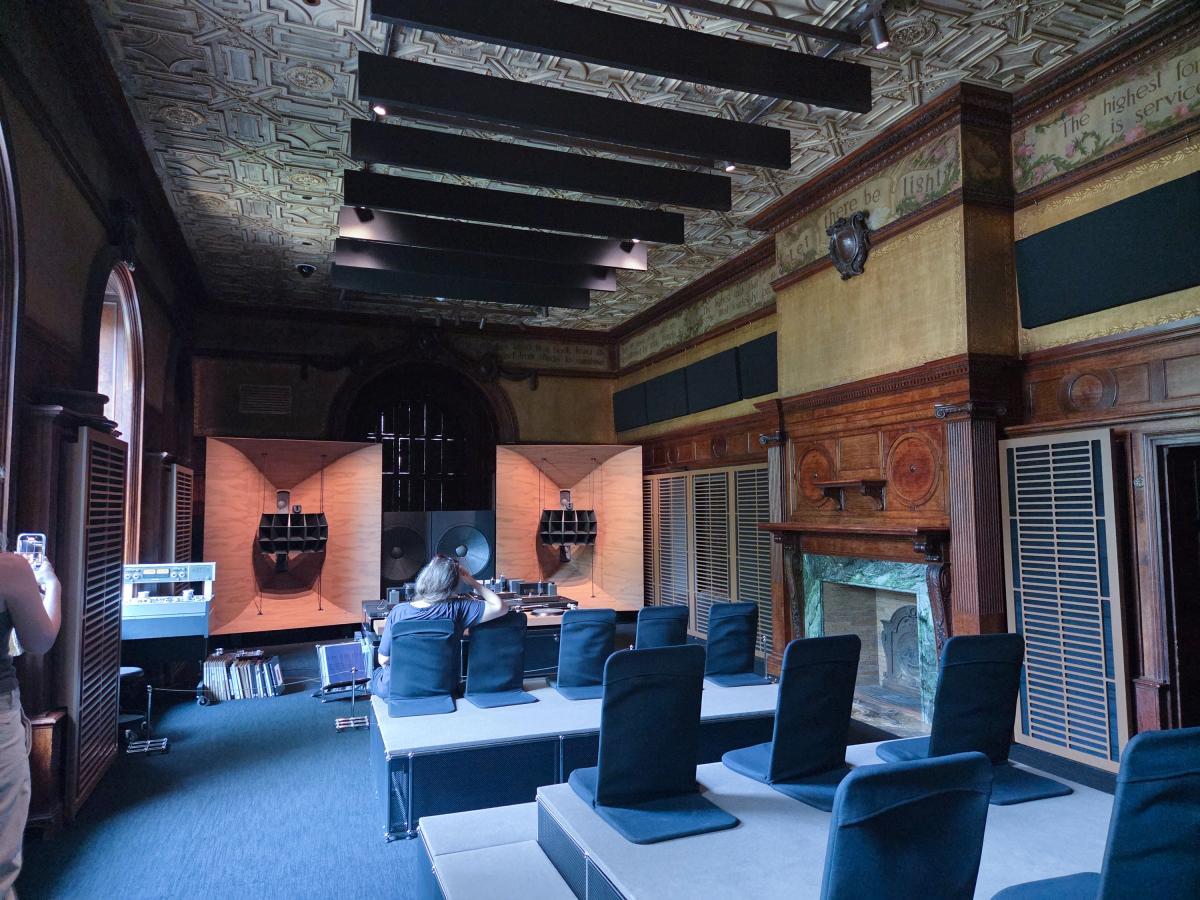 "HiFi Pursuit Listening Room Dream No. 3"
I just heard a spectacular sound system that was set up as part of an exhibit, The Art of Noise, at the Cooper Hewitt Museum a Smithsonian museum that focuses on design (above). The exhibit "HiFi Pursuit Listening Room Dream No. 3" by Devon Turnbull is a state-of-the-art listening system set up in one room of the spectacular Andrew Carnegie mansion in which the museum is based. The sound is powerful, crisp, with an articulated bass that I have never heard before. It was awesome listening to it. The room was totally subjugated to the requirements of the sound. Baffles were hung from the ceiling; sound absorption cushions were hung covering the awesome carved paneling that I could have spent hours looking at. The seating was nondescript although comfortable enough. The front of the room had two giant woofers; I'm not sure how the rest of the stuff in the middle works. This is a system costing many of hundreds of thousands of dollars. And yet - in a typical failure of design that we see in so many audio systems - the beauty of the room was hidden and the records, the heart of the system, were on the floor leaning against a soundboard.
The first floor of the museum included furniture pieces as exemplars of great artifacts of design. But "The Art of Noise" drew the bulk of attendees because furniture is increasingly something most people don't care about. Furniture has become a disposable purchase. It's something most people don't pay attention to (with rare exceptions, perhaps including you). This is why Ikea is so successful. Their furniture is intensely practical at the cost of elegance and longevity.
What we do care about is gizmos. The television was a very important one, with whole rooms designed around a giant screen. But as The Art of Noise documents, beginning in the early in the 20th century, and reaching a height in the 1970's and '80's, sound systems became important elements of the home. People set up phonographs, radios, and speakers in their living rooms and dens.
The exhibit has some of the more interesting stereo systems of that era.
When you design something, it's usually pretty important to figure out before you start what features are important. In the system by Turnbull, it's pretty obvious that the system was designed purely for the best sound, nothing else. Sound quality in the systems shown below took a back seat to convenience, modern elegance, and looking high-tech and expensive. (At least this was my perspective. The museum described the exhibit as "designed to envelop the listener in sound that is as rich in texture as it is in emotion, [so] visitors will experience realistic, natural sound from Turnbulls sculptures and a chance to slow down and engage deeply in listening.")
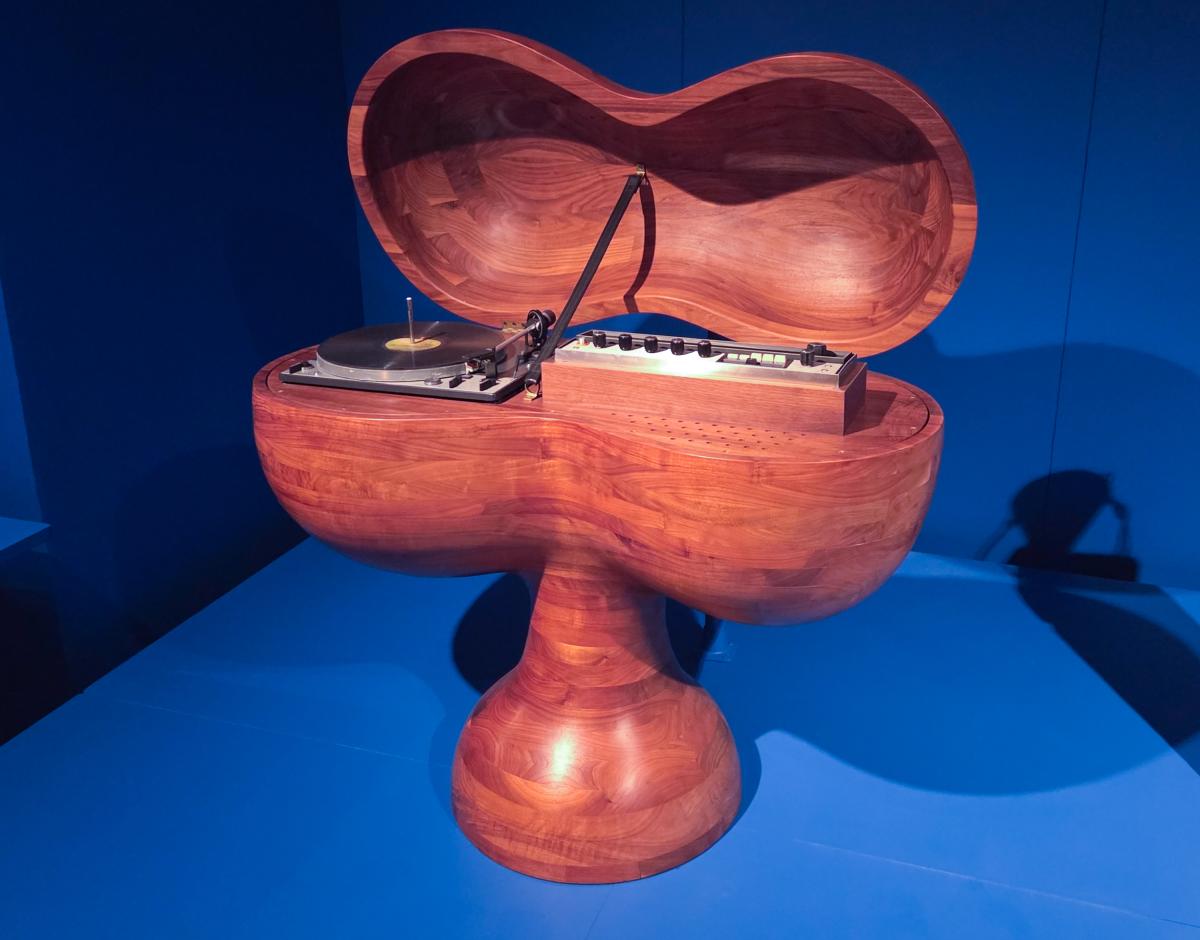 "Stereo Chest"
Most of the equipment shown below were by international manufacturers of audio equipment, but two boutique systems stand out. The walnut "Stereo Chest" (1973) by Wendell Castle fits right in with the rest of his work at the time, but it's not really about "sound" per se. When closed, the chest even conceals its purpose. To me it looks like a drinks cabinet that someone converted for audio.
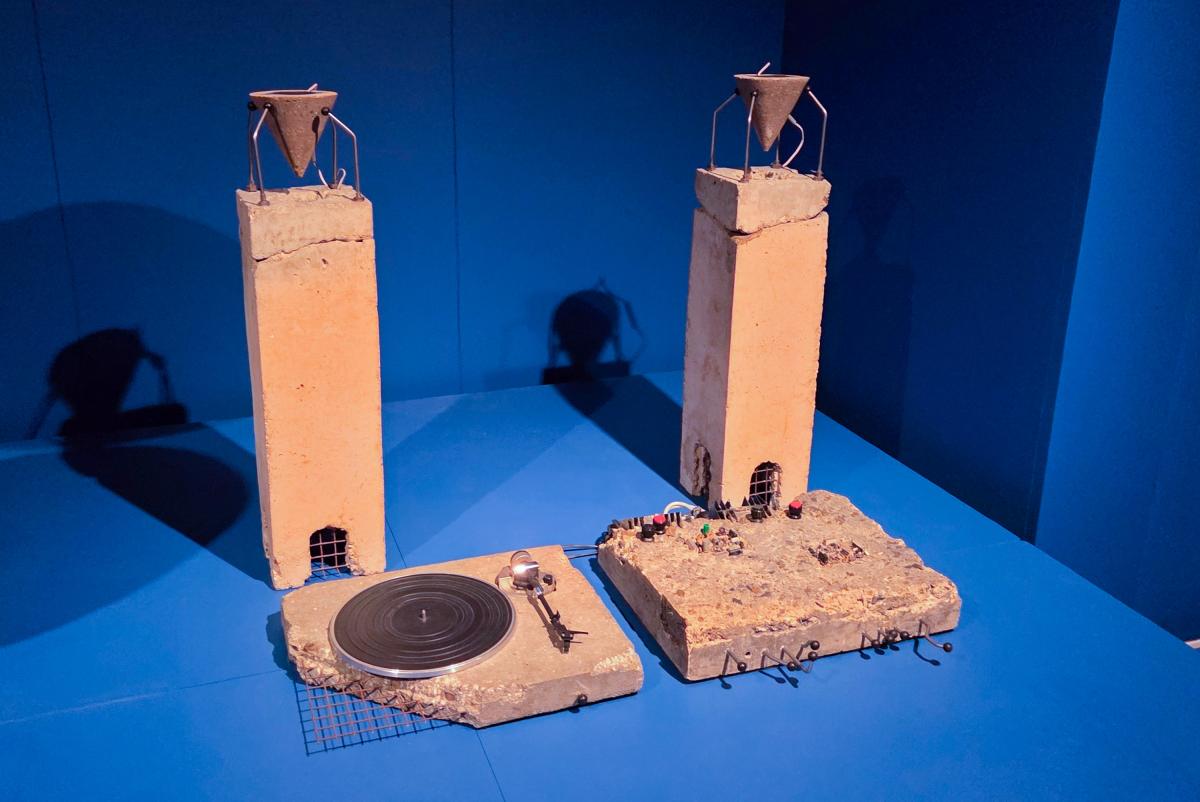 "Concrete Stereo"
Next door to the Castle chest is "Concrete Stereo" (1983) by Ron Arad. The setup includes a turntable, amp, and speakers. Again the artwork seems less about sound than visual interest. While it's not to my taste I think it's pretty cool.
The other images of these sound systems are more futuristic than what most people had, but I find them compelling. In general these packages do not sound as good as audiophile systems of the time, where the emphasis was on sound, rather than looks or convenience.
 "SoundSticks"
The SoundSticks from 2000 are a fun stopgap between then and now. Designed by the Apple Industrial Design Group for Harmon Kardon, it was one of the cooler attempts at smaller "bookshelf" systems for people without the floor space for a full-sized system.
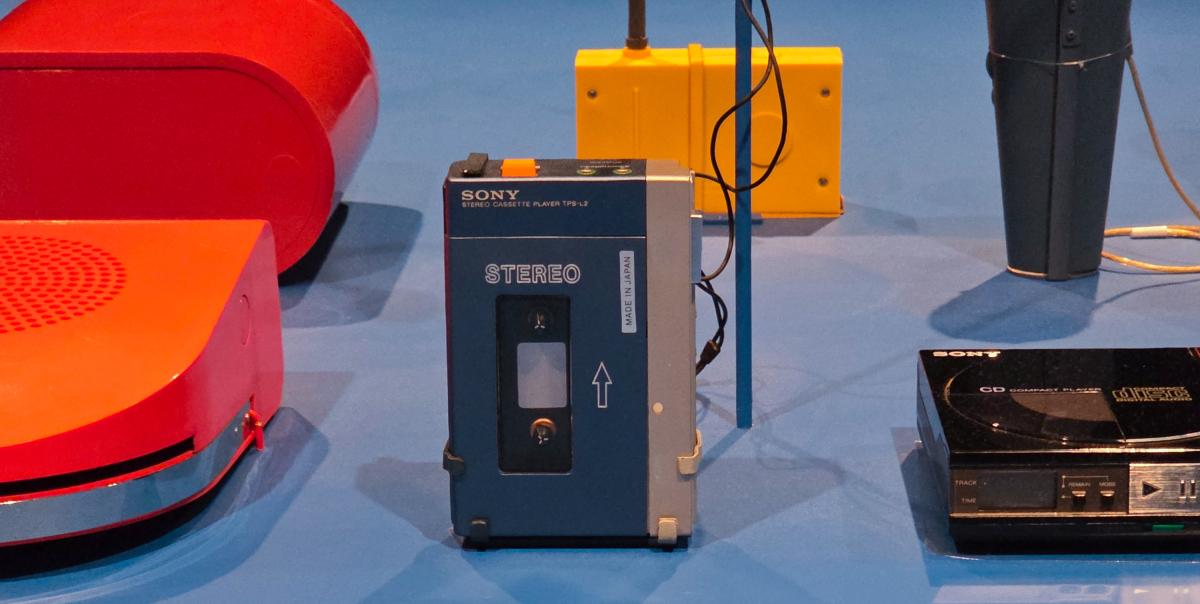 TPS-L2-Walkman
The death knell for common sound systems first rang in 1979. Inventors had tried to make music portable since the 1930's, but the introduction of TPS-L2-Walkman and headphones made portability a reality. Sound became personal, and that changed everything. Music didn't need to tie you down to a specific room or location: you could bring it with you. And because the format was a cassette, you could mix and match your own music. What you listened to became yours and yours alone. This phenomenon was the tip of the iceberg. Later came the Ipod and of course phones. While I still prefer listening over speakers, and the Turnbull installation shows how involving that can be, most people listen to music as a portable, personal experience.
The exhibit included a vast range of portable music devices in addition to the Walkman. The exhibit also had a room with some wonderful concert posters reminding us that live music is still awesome. This collection included some very memorable posters - I know I won't soon forget the poster for a James Brown at the Apollo that featured the astonishing assertion that the show was suitable for all families.
I mostly rate art by whether or not I want it - how willing I am to wallow in covetous feelings. I own a decent stereo system, and I have a lot of records I don't play anymore now that I stream. I didn't really covet anything in the show except I wish I'd gone to those concerts listed on the posters. Even the awesome system on the first floor: I can't imagine turning a room into something like that. The equipment's just too big. But everything was fun to listen too, and see.
The show was supposed to close over the weekend, but has been extended through August 16, 2026
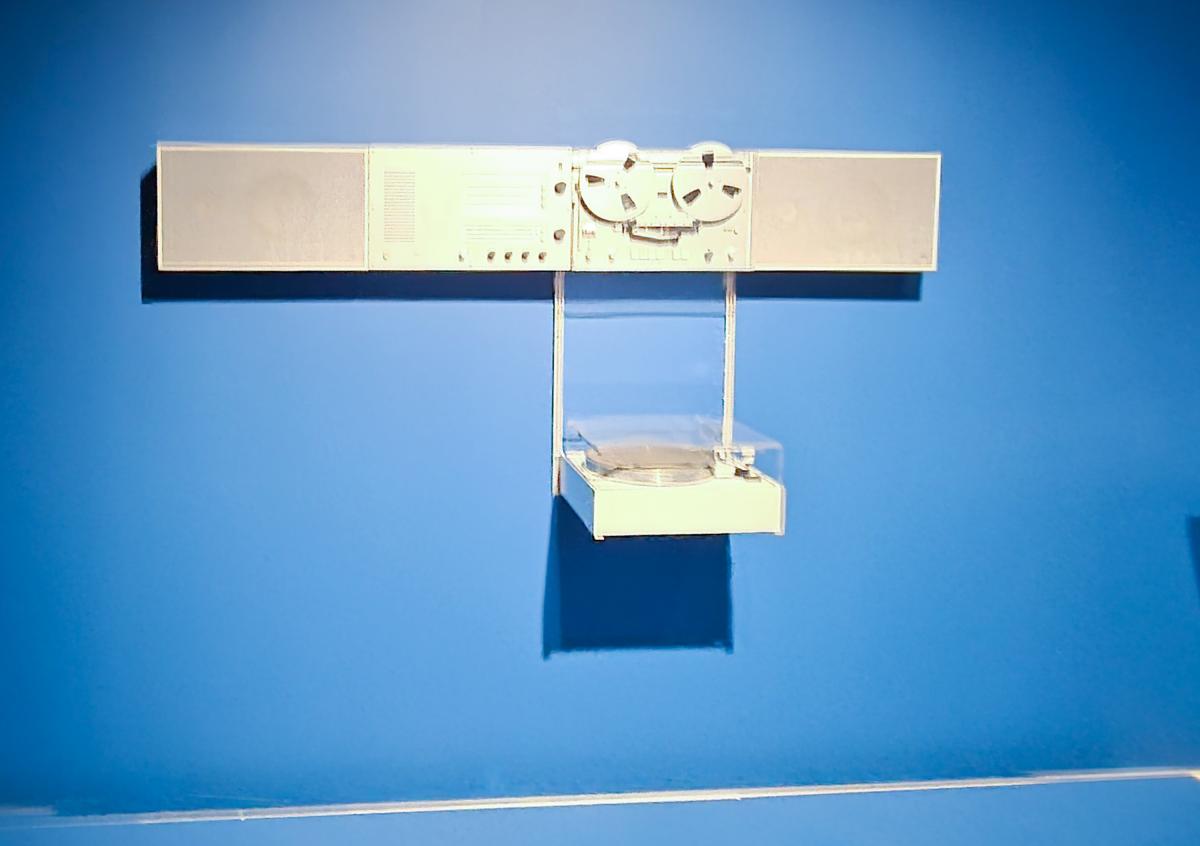 Designed by Dieter Rams, 1962-1965, and manufactured by Braun AG
 Center: RR-126 Radio - Phonograph 1965, by Achille Castiglioni and Pier Giacomo Castiglioni. Manufactured by Brionvega S.p.A. Right: Vision 2000 Cassette Player and Radio - 1971 - Thilo Oerke Manufactured by Rosita Tonmobel - Audiorama 4000 Speakers 1972 designed and manufactured by Grundi
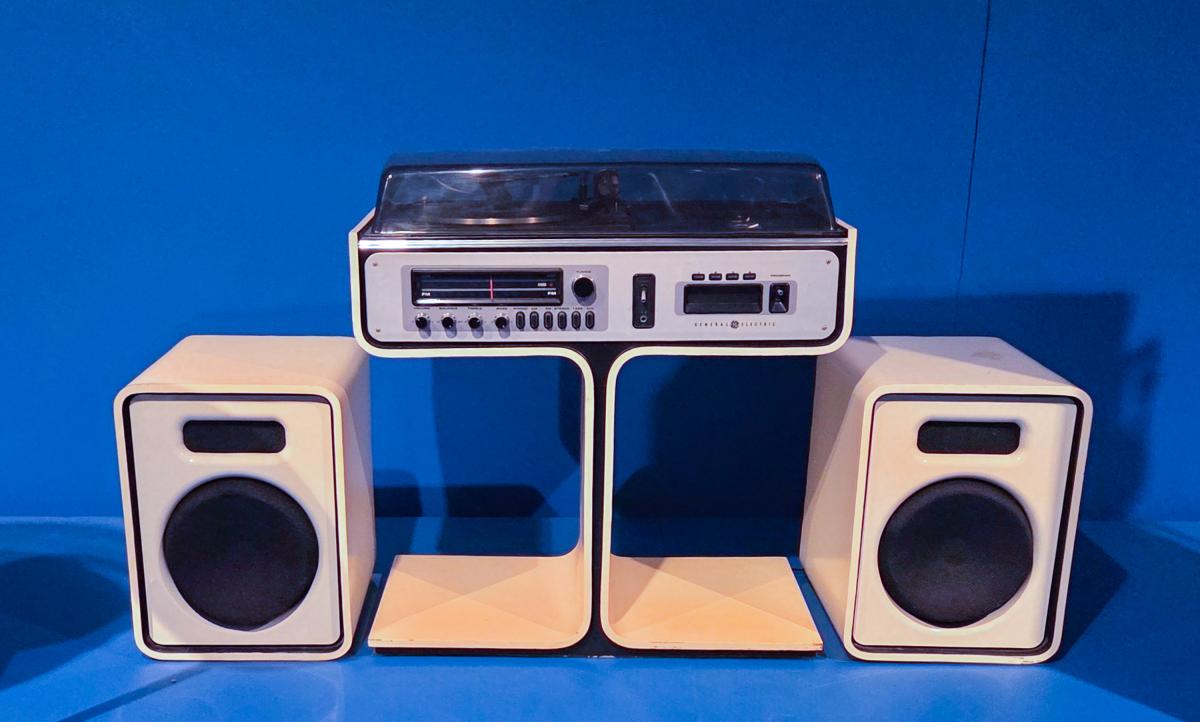 SC7300 Stereo System 1973 designed and manufactured General Electric Company
 The wonderful main hallway of the Cooper Hewitt Museum, formerly the Andrew Carnegie Mansion
 needs a 3rd coat.......
 |
| nope |
The hole in the arm doesn't line up with the hole on the frame. The screw had come out at an angle when I unscrewed but I didn't give it a second thought. Still don't know if the screws are imperial or metric, but the one I picked out screwed down in the right hand arm with zero headaches.
 |
| an hour later |
I couldn't get the screw started in the left hand arm at all. I tried filing it but it was slow, careful going. There wasn't much metal that I could file off and it was a bit awkward maneuvering the file to remove what metal I could. Gave up after an hour - I couldn't get more the 1/2 of the two holes aligned. How did the person who assembled this get the screw installed?
 |
| hmm....... |
After dinner last night trotted down to the shop and steel wooled both of the boxes. No headaches with that. Both boxes came out smooth to the touch and the amount of steel wool dust was about what I expected to see. Slapped on a third coat and trotted back up the stairs to my desk.
 |
| the green frame |
This had the slightest bit of tackiness in a few spots - all where the paint looked to the heaviest. I scraped the inside/outside bandings and the tops of them with the card scraper first. I was careful painting this but there were still spots with waterfall drips. Scraping is quicker and gives better results over using sandpaper or steel wool. I also used the scraper on the flat part of the frame before using 320 sandpaper to smooth it all out.
 |
| much better |
Yesterday when I used 320 on the back it didn't look like this. There was so much green it was hard to see the brown underneath it.
 |
| needs a 3rd coat |
I can still see the grain under the 2nd coat of paint. I'm not going for a wash look, I want this to be a solid green. I'll let to set until tomorrow. There are thunder boomers rolling through this PM along with high humidity - that effects how this will set without being tacky.
 |
| done today? |
Got 4-5 coats on the bottom and the sides. 3 coats on the inside and one on the top edges. The plan is to get 2-3 more coats on it today and call it done by the AM.
Had my first chemo cocktail today. It took over three hours and consisted of two infusions. The first one took 10 minutes and the other took 40. The total time expended was due to ordering and waiting for it to get to me.
I have about 7-10 days before the chemo kicks in and really introduces itself to my body. Nausea and fatigue are the two side effects (of a potential boatload) I'm most concerned about. The nurse said the fatigue will come in about 7-10 days and that I should stay out of the shop and rest. She said to listen and obey what my body is telling me.
I have blood work on July 30th to baseline my blood for the first chemo treatment and the 2nd chemo cocktail party is scheduled for the August 11th. That is dependent on what my blood work is on that day. Before the chemo the doc reviews the blood work and that drives whether or not I get the cocktail.
The brain MRI came back normal and I forgot to ask the doc about why it was ordered. Maybe on the next appointment. The shortness of breath is still saying hello and I had way fewer coughing fits yesterday and so far none today. My heart rate continues to stay in the normal range with excursions in the low 90s (with exertions) for about two weeks now. The 'blister' on my chest is slowly getting smaller and it is sure taking its time going bye bye.
accidental woodworker
Pages
