
Hand Tool Headlines
The Woodworking Blogs Aggregator
“Glory to God in the highest heaven, and on earth peace to those on whom his favor rests.” - Luke 2:14
Be sure to visit the Hand Tool Headlines section - scores of my favorite woodworking blogs in one place.
Hand Tools
Three Shrinkpots and a Bowl Available
Miles's desk pt XIX........
 |
| underside |
Three coats and I'm calling this part done. Three coats is sufficient for the underside IMO.
 |
| topside |
No evidence of the indentation but the chamfer and the end grain needs a touch up. Sanded them with my sticks from 100 up to 220 grit. After that I was read to apply the shellac. Spent the rest of the AM session applying said shellac on the top and the drawers.
 |
| new pic frame |
My wife bought a reproduction of a 1689 map of the Plymouth Colony. I was asked to make a frame for it and this is it. 1/2" poplar frame that I use bridle joints to join the corners.
 |
| glued and cooking |
I'll let this cook until tomorrow. I'll bring it to Maria after I get it painted.
 |
| 4 coats |
This batch of shellac is super blonde and I can see a difference in this compared to my last batch which was blonde. This is a lot clearer without a hint of a yellow/orange tint.
 |
| my OCD was in overdrive |
I had to replace the left drawer tilt rail. Super glad that I didn't use glue on this.
 |
| hmm...... |
The pine drawer tilt rails are strong enough for this purpose but I am concerned about the poplar wearing against the pine. There is over an 1/8" of clearance between the tilt rail and the top of the drawer. I'm going to glue a 16th inch thick cherry strip to the underside of the tilt rail. Cherry should wear better than the pine would.
 |
| done (almost) |
Wear strips glued and cooking. I had tested the wear strip clearance and the drawer slid in/out smoothly still. It knocked down the slight tilt the drawer I had to almost nothing.
 |
| much better |
Better fit with no gap this time. Installed it the same way as the original, no glue and one screw.
 |
| hmm....... |
I'll let this cook until the AM to ensure a good bond. It is only a glue connection, no nails or screws to help out.
Got the spray shellac from Amazon so I can't put it off anymore. I will be done with the applying shellac to the top by tomorrow. The next batter is sanding the base which I ain't looking forward to.
accidental woodworker
Miles's desk pt XVIII........
 |
| couldn't wait |
Went back to the shop after dinner to check on the dent. It had been a couple of hours since I steamed it and it looked good. It was flush - I couldn't feel it at all with my finger tips. Happy with that but I could still see the outline of it.
 |
| twenty minutes later |
Scraped and sanded the indentation outline until it disappeared. I wiped down the area with alcohol and 99.9% of it was gone. One small spot could be seen in raking light but I stopped here. Made a command decision that this was good enough.
 |
| surprise |
UPS delivered the drawer pulls at 2034 on saturday. I can't recall ever getting a saturday deliver from Lee Valley. The pulls are smaller than what I thought they would be. The under grabbie space is adequate - my fat fingers fit - so it will definitely work for Miles/Leo.
 |
| checking the indentation in the AM |
The work I did on it after dinner last night still looked good in the AM. Even the small spot I saw in raking light was hard to find this AM. The final check mark will be what will happen once shellac goes on.
 |
| hmm..... |
Wiped the area where the indentation was first with alcohol. Nothing popped out with the alcohol. I then wiped down the entire top with alcohol to see if there were any other holidays.
 |
| fingertip test |
Ran my fingertips all over the top to feel for any rough spots. I had sanded the top after wetting it with water and I found a couple of raised rough areas. The indentation was no where to be seen. I think I'm finally done with the top.
 |
| template |
The screw holes on the pulls are on 3 1/4" centers. Which means the holes are 1 11/16" on either side of the center line. Used this to transfer the screw holes to the drawer front with a center punch.
Editing update. While proofing the blog I saw that I had lost a 1/3 of the blog post. It was going nutso trying to save it and it went south into the black hole. Stercus acidit. This is the second time in the past couple of weeks that this has happened. Another annoying quirk to deal with?
Recap of what blogger shitcanned on me - got 3 coats of shellac on the drawers except for the fronts. Three coats of shellac are on the bottom of the top. Mixed a fresh batch of clear shellac that I'll use for the rest of the desk.
To help with applying shellac on the slats I bought 3 cans of spray shellac from Amazon and I'll have them today. From past experience, applying any type of finish on slats is difficult and time consuming. It is maddening trying to keep drips and runs from happening. I'll brush shellac on all the drawer fronts, rails, and legs.
accidental woodworker
Two Wooden Planes in Detail

There can be no doubt, wooden planes might just feel heavy in the hand when you first pick up say one of the longer jack planes or longer 22" version on up, but on wood the weight suddenly disappears; it happens to such a point that their near weightlessness can barely be felt as you push it forward. Take a small step further, add a zigzag of candle wax from an old stem candle or a dab or two of furniture polish to the sole, and it's the gentlest parachute drop as in a canopy-type (ram-air/square) that creates a soft and controlled descent to a supremely gentle landing. Did you know that parachutes don't fall, but fly? So too a wooden plane merely floats and glides with free-friction ease. No muscling to task or "bearing down" overhand. No matter what you do with steel or bronze, cast metal type planes of any maker you care to name, they can never come close to a wooden plane, no matter how you slice it.
Two of my half a dozen wooden bench planes. They look very, similar, but the tell-tale is in the skewed wedge in one and square across one in the other. The square across one on the right is simply a longish bench plane used for straightening and levelling boards on the face and adjacent edges. The left one is called a badger plane, and we use this plane for planing inside or creating rebates. More below.I own more than enough wooden planes, currently around 200. Most of them are not bench planes but a variety that will come under the general heading moulding planes, but a quarter of which would never make a mould in their life. I'm mentioning these two planes because they are mine, they are always at the end of my bench, and when I am tired of working with other planes, metal ones, I reach for one or the other of these to help me out. Why do I not just use them in my videos and advocate using them for all? Availability, problem-solving, knowing what to buy, excessive wear and more. But it is worth knowing that, contrary to popular belief that metal versions last longer, have better adjustability, are less expensive and just work better, there is no evidence that metal planes outlast wooden ones whereas there is plenty of evidence that wooden ones have and do often last in excess of 200 hundred years. Also, for good reason and not trying to halt progress, woodworkers in every category from barrel making and carriage building, furniture making and every other woodworking craft, refused to use all metal planes for half a century. It was to do with the ugly heaviness and the fact that they stuck to wood like molasses, compared to the wood-on-wood experience of wooden soles on planes.
Looking back in investigative way of researching the history and the development of hand planes is very interesting. Here we find the reason that most all-metal planes were well over 95% obsolete after a short 50-year lifespan of woodworking at least. Wooden ones had a much longer lifespan of centuries but even holding their own for so long a period, ultimately resulted in decline in the same period of the first half of the 1900s that the metal ones died out. The wonders of industrialised woodworking progressed from hand work to machine work. The outcome of decline on the one hand and incline on the other, influenced domestic home workshops, where we now see the most prevalent way of creating things from wood is machining it; this is generally seen as highly innovative, progressive and cost-effective in time, skill level and financial investment even though for the main part it is quite deceptively presented. For experienced men like myself, it is generally true that my skills enable me to work more efficiently to produce the quality work I need. Did you know that furniture makers rarely laid out 90% of their dovetails, but freely cut them solely by eye and a few pencil lines? My trained and capable abilities make my work as fast and faster in many areas of woodworking. But people give up far too soon and fail to really establish the substantive skills and knowledge and speed needed and believe machines are the better way forward, and, well, who am I to contradict the beliefs of others? Actually, there is no doubt that this is true in many areas of stock prep and more, but please factor in the elements that most machine advocates ten to always leave out. We dive deeply into the benefits of physical and mental high demand, but I will park that here.
 L. COOK kept things simple. Short name no frilly edges, and he never passed the plane on to others yet used the plane for half a century of daily use going off patination.
My 22" wooden plane made from 3" by 3" beech is a fine example of an English plane made by W. GREENSLADE of BRISTOL, ENGLAND in the mid-1800s. It's one that was worked with and worked well for its former owner, L. COOK. The name stamp tells me that there was likely just one owner before me. This plane seems always to pull itself to task and when people advocate low benches to power-down on their planes to make them cut, I understand all the more that they simply do not know what they are talking about or worse still, how to sharpen and use their planes. I push forward with a firm but not excessive push, my fingers around the tote and my forehand wrapped in an overhand hold, and up comes the shaving, rising effortlessly like wispy camp-fire smoke from oak, cherry, walnut ash and even knotty elm. The shavings, one after another, after another, spiral up from the throat as if each one pulls the other. Setting the depth of cut comes from slight hammer- and bench-taps in a split second, and so too aligning the cutting iron's cutting edge to the sole of the plane. A bump here and a tap there governs the plane's passage, and all of this rubbish about bearing down does not bear thinking about. Of course, you might just not know what you are doing, so I am careful here. Unless some laziness has set in, and then not finely adjusting your plane accordingly, or worse still, refusing to sharpen the dull one you are forcing to submit, your experience will be less positive altogether.
 Some people will consider this a crude way of setting any plane, and we in our ignorance might consider ourselves to be superior, but it was superbly effective and fast in the hands of a master. In many cases, it was a side tap on the edge of the bench for alignment, a nudge on the nose or heel for a deeper or withdrawn depth of cut.
 We once called it "hammer ash". The end grain of beech takes shock well, hence few other woods in the UK were ever used for plane making for three hundred years.
Don't be shocked by the hammer marks on the fore end, top of the plane or its heel. For that is exactly what they represent, shock marks. The blade and wedge are shocked out by quite swift and severe hammer blows with a steel hammer. Nothing prissy about this. A swift whack dislodges the wedge and cutting iron assembly altogether or, with light taps, the iron is retarded to lighten the depth of cuts.
 I could take a hundred shaving to spill from the plane without any jamming and without stopping or adjusting. What a remarkably designed and made plane this is. No plane made today compares to these once commonly made and used planes and that is not nostalgia but pure truth.
 Badger Plane
Badger planes are a different breed of plane altogether, though at first glance they might look the same to the uninitiated. This plane offered above and top is commonly called by the English name Badger plane. It's a rebate plane that's often worked adaptively against a strip of wood clamped to the workpiece for rebating or to refine existing rebates by taking of a shaving or two to take out plane and shaper marks left by machines, but mainly it was used for creating raised panels for panelled doors, solid wood panels installed into grooves and rebates.
 Looking at the plane over the mouth and from above, the complexity of a skew-mouthed plane becomes far more complex in every way. There are no square angles to it anywhere. The bed is skewed, and the wedge recesses are all angled, necessitating angled recesses throughout.
Often, gurus describe the reason any plane that was made with a skewed cutting iron was to make the plane cut better; more efficiently. That was merely a byproduct of the real reason, and far from the main reason at all. Think this differently and the answer makes tremendous sense. The point of the skewed iron tucks tight into the internal corner. The push engages this point and the skewed iron keeps the plane pulled-in tight to the inside side of the rebate as the plane deepens the rebate and so prevents the plane from slewing off course. The plane then needs no steering to keep it 'on point' and tracked. A squared across cutting iron always drifts from its path. In regular planing, this is easier to control. In rebating, you want accuracy to keep the internal corners sharp and crisp.
And here is another unspoken reality. Every bench plane we use is automatically skewed and that's because when we need to hold bench planes, our two-handed hand holds on the plane fore and aft forms a triangular pattern from the wide part of our shoulders which are 18-20" apart down to our two hands centralised on the plane to power through. This triangulation skews the smoothing planes and the longer bench planes in action; it is not so much an intentional skewing, but a practical application to present the plane according to a more comfortable angle for our body moves. The badger plane needs the pull of the advanced point at the cutting edge to pull the plane into the corner as the rebate is formed. All the more do we need this because of the bias presented by our body stance in upper shoulder wideness to our hands on the plane forming the triangulation. Physiology in every aspect of hand tool woodworking must be considered, and it's this, mostly, that makes hand tool woodworking ultra-different to machining wood where only minimal physical work involving our dynamism is necessary and used. Dynamism is the theory that phenomena of matter or mind are due to the action of forces rather than to motion or matter.
 The two inside faces are chased out at an angle and so are not parallel to the outside faces. This corner tapers from zero to 1/4" and the opposite groove on the far side runs exactly parallel to the bottom of this groove. These grooves receive the cutting iron assembly and the wooden securement wedge
This mouth looks square across in the image, but it is drastically skewed, with the point being the most forward point. The cutting iron protrudes slightly past the side of the plane when set correctly.
 See how the blade is not parallel to the mouth; it's more important that the blade lies perfectly parallel to the face of the sole so that an even thickness of shaving is removed. Notice, though it might be less obvious, that the corner of the blade protrudes past the side face of the pane by a paper thickness. Without this, the plane will move away from the side of the rebate with each stroke, leaving the wall sloping. Not what we want at all.
 Many people theorise about hand tools in the same way they have about low bench heights, but rarely present from experiencing tools and benches through decades of use. Well, too low, low bench heights and the modern advocacy for them revolves around poor teaching saying you need to bear down on and over the plane and the wood to effect a cut. Totally erroneous. Sharp planes always, always pull themselves to the surface, whereas dull planes push themselves off and away. Dead simple, really.
 It's the upside-down name and logo in the centre that is the name of the actual maker, the other names are owner names, stamped to identify planes that might otherwise get mixed up with others. Varvill and Sons were prolific plane makers from York, England, and made excellent planes.
This plane had three known users and possibly others who did not own a name stamp. Ed Campbell and E. Campbell were likely related, but not one and the same. Possibly father and son, Ed Campbell being the senior. C. Laseby and J. Goodwin were earlier owners, going off the patina in the name stamps. Rhykenology, the study of hand planes and their history, evolution, etc is an interesting study though I only researched and studied as part of my using and use for planes.
 The skewed cutting iron facilitates a particular action in rebate planes. It is not to make the planing action easier. Not at all. It is purely to keep the plane tight into the corner of the rebate. Sharpness right up to the more fragile corner is critical.
These planes are very much a joy to use when sharp and set up correctly, tuned to the particular wood and such. They remove material rapidly with zero friction-rebellion or stubbornness, even facing the intermittent rise of opposing and awkward grain that every other all-metal version of planes generally balk at. Set quite deeply for initial rebating and then lightly for the final refining strokes. By running a saw kerf across the grain, they can raise a raised field and panel very succinctly by simply tilting the plane against a clamped on fence until enough depth establishes a wall to work to. And this is where the skewed iron works really well too.
 This slot receives the head of the set screw so that the cutting iron rests fully supported on the bed incline. Though now old, the crispness of the final cuts are pristinely made. Then see the two channels either side of the slope. Both tapered, they receive the cutting iron assembly and the wedge. The whole escapement is pristinely cut by hand and eye. There are hardly any square edges to this Badger plane. It's a remarkable and outstanding piece of woodwork that never gets noticed and is never mention in these terms.
Another note worth mentioning because of erroneous comments is that the bed angle is five or more degrees steeper, or so it might appear to the uninitiated. Skewed badger planes have a steeper bed because of the skewed presentation of the cutting iron. Presented as it is, the skew directly affects the angle and because of the skew, the angle parallels that of the common bed angle used in square-across plane irons. The skew lowers the angle; the more the skew in relation to the long axis of the plane, the lower the level of resistance; if you were to turn the angle to say 90º, I know, ridiculous, the apparent and now compound angle of cut or bed angle would be the equivalent of zero.
 This brass dome, attached to the cap iron, extended the thread area for the set screw to better fasten to in a metal that tapped well and was less brittle. And notice the neat chamfer around the top of the cap iron, too. The small details of a content creator creatively taking his work seriously.
This plane is 150 years old; it comes from the bygone, never to return, age when every component was hand hammer forged, hand trued by hand planing, hand chiselled, mostly but not necessarily hand sawn, metal hand tapping threads in steel and brass, hand shaped when no power routers working according to CNC programming, in fact, and I mean, in fact, utterly hand made. The cutting iron and components are shaped and consolidated using hammers on an anvil by eye and also forging using a hand made trip hammer. Under intense heat, 2,300º, the two pieces of metal, lie in wait in the full heat of the forge, heated by coke or gas, and using no more than household cleaner, borax (to prevent oxidation), a naturally occurring high-alkaline white mineral powder, intense, repeated hammer blows in quick succession, welds the soft (mild steel) and hard (high-carbon tool steel) steels together so that you have the resilience of a shock-resistant body metal combined with a durable (hardened steel)cutting edge. I have a Stanley plane iron that was made using these two soft and hard metals, and it is vastly superior to any plane iron I have come across bar none. Alas, the blades made this way were discontinued after a short-lived production run.
 When the set screw is loosened, the gap opens and there is no tension between the cutting iron and the cap iron . . .
 . . . when it's cinched tight, the gap closes and creates tension between the two. It's a dynamic, physical phenomena in the diametrical opposition of two metal parts.
From the outside of a fully assembled and set wooden plane, it's easy to miss the incredible fine work of the wedge itself. How remarkable is this hand made component. The fineness of wedge ensures that there is no vibration and no snagging to the shavings rising in the throat of the plane.
 The wedge finds its perfect mating to the grooves in the inner faces of the plane.
 What Paul Sellers Gets Right and What Gets Missed
I came across a clip from Paul Sellers where he says it’s not about applying downward pressure and that sharp tools make the work easier. That’s absolutely true. Sharp tools should always be the starting point, and relying on force to compensate for dull edges is poor practice.
But there is another side to this that often gets overlooked.
Low workbenches allow you to use your legs and core to help drive the plane through the wood, rather than relying only on your arms. This makes longer strokes more efficient and helps reduce fatigue over time, especially during heavier stock removal.
Historically, this makes sense. Earlier wooden planes were generally taller and suited a different grip and stance. When metal planes, such as those from Stanley, became common, they sat lower in the hand and required less effort to push. At the same time, work began to shift toward more controlled, finer bench work, which led to higher bench heights becoming more common.
So a low bench is not a mistake or bad habit. It is simply a different approach, built around full body mechanics and efficiency for certain types of work.
This is not about saying one method is right or wrong. It is about understanding that different tools, bench heights, and techniques evolved together, and each has its place depending on the task.
What type of files and to correctly use them
This is a very old video and one of the most in depth I have seen to date. As always, there is a lot of misinformation online, along with sloppy use of tools, especially hand tools. Much of this comes from people who present themselves as teachers but simply make things up as they go.
This is why it is always best to source information from books or other credible sources, preferably older books and older videos like this one. There is a prophetic saying that one of the signs of end times will be fewer scholars and many speakers. Clearly, we are living in such times, where many people speak online about various subjects, while those with real knowledge are drowned out by the noise of loud voices and their followers.
Miles's desk pt XVII & Leo's dresser.......
 |
| flushed |
The epoxy planes easy and clean but it is kind like planing cherry. I'm not going nutso on cleaning the bottom at all. It is flat and straight in all directions and that is all that really matters.
 |
| hmm..... |
I'm going to install a couple of anti drawer tippy things. I have them on my desk and I'll put them on Miles. The drawer tips downward a little and it is a wee bit floppy so this will cure that. However, I can't put them centered on the drawer because I have table top clips in the way. Instead I'll position about 1/3 of the way in from the drawer edge.
 |
| reinforcing the top rail |
Found a bunch of #12 two inch screws for the rail screw job. I had ordered some #8 by 2 1/2" screws but now I think they would have been too small for this.
 |
| Yankee screw driver |
I was surprised by how well this screwdriver handled the #12 screws. I had no hiccups driving them 99.9% of the way and no headaches locking it and driving them flush. I like using these Yankee drivers - I have 4 of them - for driving screws. Unlike using a cordless drill, it is almost impossible to over drive or strip the head of a screw with them.
 |
| underside of the top rail |
I only put one screw in the center divider along with one each at each end. Feel a lot better about the table top clips not failing due to the rail going south.
 |
| checking |
Since I had the base on the top, I checked that my overhang was consistent all the way around. I checked each and every position for the table top clips. One to make sure that they fit and two, that I would be able to screw them down. The drawer guide assembly wasn't interfering with any of them.
 |
| boring work |
Routed a 45° chamfer all the way around and now I'm sanding the end grain smooth with the sanding sticks starting with 100 grit.
 |
| cherry ain't easy |
The 100 and later 120 grit sanding sticks were making poor progress on smoothing the end grain. Decided to try a card scraper and it worked. I was not expecting it to work as well as it did on end grain. In spite of it working much better than the sanding stick, it still took a lot of time and calories to smooth the end grain.
 |
| sigh |
Sanded the top starting with 100 and ending with 200. This spot has a couple of indentations that came from ?????? I tried to scrape them away but nada. I thought I was done with the top but it ain't so boys and girls.
 |
| test piece |
I am using 3/4 pine for the drawer tilt thing (drawer tilt rail?). I cut a slot centered on each end for a #0 biscuit. Did a test piece to make sure I figured out how far down from the top of the rail the mating biscuit slot had to be. Got it on the first try.
 |
| done |
The biscuit is just to hold the rail in place. I drove one screw in at each end to secure it. No glue, just an one inch #6 screw and a #0 biscuit.
 |
| hmm...... |
 |
| underside of the top |
Sanded the underside with 100 grit and stopped there. Branded and initialed it. This has a check mark in the done column.
 |
| better pic |
I didn't notice this after I was done sanding so it happened between then and when it shook hands with me. Tried sanding it with 220 and nada. Plan #2 is try steaming it out with my shop iron.
 |
| done |
Continue to be impressed with the paint job with the smooth finish roller. I think I'm done, I didn't see any holidays .
 |
| drawers |
No streaks from a paint brush and it looks pebbled now but after it dries it will be as smooth as a state zero sea.
Steamed the hiccup on the top and it didn't go smoothly. I accidentally spilled water on the top so I had to flood and wet the entire top. I'll be sanding it again in the AM but I think I managed to get the indentation raised. I'll find out in the AM how well that went.
Didn't get any pics of the initial fiasco but I was optimistic about how the iron did steaming the indentation.
accidental woodworker
Empty! (v. #1993)
“What is truth?” asked Pilate.

Jesus of Nazareth died, proving he was truly a man.
Jesus the Christ walked out of the tomb like a boss, proving he was truly God.
There you go, Pilate.
Truth.
New Model Mandolin: 3
Here’s Part 3 of my New Model Mandolin build series. In this one, I look at joining the Adirondack soundboard and making and fitting the rosette. There’s also a bit more on the neck and last but certainly not least, the back gets braced and fitted and you’ll see how the radius dish (seen in part 1) continues to help the process.
Cheers Gary
Leaves of Grass Shrink Book Box
Miles's desk pt XVI........
 |
| fitting the drawers.... |
The left side drawer in/out guides are square to the front. However, the right side ain't so boys and girls. On the flip side of the coin, the guides are parallel front to back. I pried off the right guide and used the drawer to set it again. Sure glad I only nailed them.
 |
| almost |
This was the fit of the left drawer after planing the top and bottom edges flush all the way around.
 |
| done |
Fitting the left drawer was painless. I had to go back and trim the sides twice before the drawer slid in/out effortlessly. No binding or hesitation pushing it in or pulling it out.
 |
| done |
Both drawers work the same. I didn't go nutso trying to get a piston fit - I care more about how smoothly the drawers work in/out.
 |
| right hand drawer |
Dry clamped the drawer guide and then I fitted the drawer. I got the left drawer in/out guides screwed down. No glue, just screws, so anyone coming behind me can effect any necessary repairs/replacements.
 |
| super glue |
Decided not to nail the drawer guides first before screwing them. Instead I put a couple of dabs of super glue at each end. Clamped them lightly to help the super glue cook and set quicker.
 |
| drawer stops |
I glued the stops in place and let them set for an hour. After that I added two screws to each of them.
 |
| hmm...... |
Both the drawer fronts are slightly proud of the front rail. I marked them with a pencil and planed them within a frog hair of being flush.
 |
| done |
The right hand drawer guide is screwed off and nothing shifted. The drawer still slid in/out easily and without any hiccups.
 |
| hmm..... |
There isn't much left to do on the desk. I put stops at the front so the drawer can't inadvertently be pulled out and play the bounce test with Mr Floor. All that is left to do is finish the top, attach it, sand endlessly, and slap on 5-7 coats of shellac.
 |
| speaking of the top |
I like the overall look of this desk. It is clean and simple. Glad that I didn't go for a bank of vertical drawers on the right side. The tedious part of applying the finish is just around the corner.
 |
| one more hump |
I doubt that this would be noticed but I expended the calories and flattened it. It took me less than an hour to do that. Used 3 hand planes, the Stanley #80 & #112, and finally my random orbit sander with grits from 100 to 220 to finish the top.
 |
| passed with flying colors |
Wiped down the top with alcohol and nothing popped out. No plane tracks, chatter marks, rough squirrely grain showed up.
 |
| choices |
A 45 chamfer or a table top thumbnail, which one wins the Kewpie doll? I really liked the thumbnail profile a lot but in the end I'll be using the 45 bit. The round over of the thumbnail bit doesn't fit in with the overall look of the desk. The overall look of the desk is rectilinear with squared off edges galore.
 |
| hmm...... |
The divider gave up the ship. Four of the corner blocks let loose. Glued it back together and let cook in situ.
 |
| pull out stop |
No need to go nutso on this. Unless someone goes Cro magnon, it should last as long as the desk does.
 |
| hmm....... |
The top of the front rail flexes a lot. Too much to ignore. The top of the rail will be under the strain of holding the top down to it and it needs some help. I am thinking of putting a couple of 2 1/2" screws into the center divider and the two ends to stiffen it up.
 |
| hmm..... |
This is the underside of the top and I thought I had filled this in already. All I had done was to stuff the knot hole with cherry shavings.
 |
| done |
Filled it in with epoxy. I didn't bother to dye it black because it is the underside. This will keep bits of the knot from loosening and falling out down the line.
accidental woodworker
Plane Wellness 2026
I’ll be one of the presenters at next month’s 2026 edition of Plane Wellness. If you are in the region of Butler PA May 16-17 and have the inclination, we would love to have you join us. I learned about the organization from a class student a couple years ago and wholeheartedly agree with their mission statement, Improving Mental Wellness Through Woodworking. And who could not use a little extra dose of mental wellness these days?
My presentation will include (of course) the finishing process and the beauties of polissoiring.
The list of presenters is impressive and include a lot of voices I do not know, so I am especially looking forward to being challenged, informed, and encouraged.
I hope to see you there.
Miles's desk pt XV & Leo's dresser.......
 |
| first one |
The fit looks good - it is snug and gap free even though it is seated less than a 1/3 of the way in.
 |
| 2nd one |
Fit was just as good and it continued on with the 3rd and 4th ones.
 |
| hmm..... |
I didn't think the drawer would fit at all. Disappointed in the half blinds at the front. After they were fully seated gaps stood up and shook hands with me. Sigh.
 |
| plowing grooves |
On the dry fit of the drawers I checked that the bottom edges lined up flush. This way the groove would align all around.
 |
| left hand drawer |
I used prefinished plywood (one face only) for the drawer bottoms. It was left over from the bookcase I made a few months back. I could only get one corner of the left drawer to fit in the opening.
 |
| glued and cooking |
Needed some help with the back dovetails - this drawer had loose fitting back dovetails. I didn't want the back clamps to pull the drawer out of square so I clamped the front ones. They were snug and didn't need any clamp pressure.
 |
| 1st coat |
I'm impressed with this first coat. It covered every sin with nothing showing. I'm optimistic that one coat will do it but it will be getting at least two. One of the rails didn't cooperate and the paint didn't cover well and will need a second coat.
 |
| from Wally World |
The only spot on the dresser I used a paint brush was the legs. Everything else I used this roller. I have always been a brush man but that changed today. The paint job from the roller was heads above the brush work. The roller work is dead smooth and the brush work on the legs is no where as smooth. I was skeptical about this 'smooth' finish but I'm impressed the results.
 |
| filling the groove ends |
In order to bury this groove in a pin socket I would have had to sacrifice drawer depth and I didn't do that. I'm able to contain my OCD and fill in the holes.
 |
| gap filling stock |
Took some heavy shavings with the 5 1/2 until I made some thick enough to fill the gaps in the tails/pins.
 |
| it worked |
I wasn't sure that the shaving would survive being pushed into the gap but it did. I used this on all the gaps I filled.
 |
| one done, one more |
Found a thin piece of cherry to fill in the half pin gaps at the top and bottom. I used a hammer to thin the cherry until it fit the gap.
 |
| still cooking |
I am going to wait until the AM before fitting the drawers. I didn't want to risk planing them now and blowing out the joinery.
 |
| came 3 days early |
Jefferson is my 2nd favorite president. I have a book about Monticello and the gadgets he has I find fascinating. This desk was the 18th century equivalent of a tablet. Looking forward to reading it - it also has plans to make one.
I ordered 4 drawer pulls - oil rubbed bronze - because I like how they look against the cherry. Ordered them two days ago and they shipped today. I doubt that I'll get them before monday of next week at the earliest.
accidental woodworker
Holding wood by the edge of the bench top, part 2
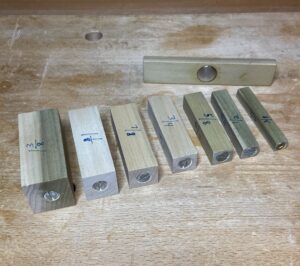
Miles's desk pt XIV.........
 |
| hmm..... |
The glue up healed well and was just slightly proud. A few strokes with 120 grit and it was flush and smooth.
 |
| one down and one to go |
Tails done on the first drawer. The plan is to do one drawer, one step each, before moving on to the next one.
 |
| lost the previous one |
Searched for it but nada. This is needed to set the height of the stock in the vise correctly.
 |
| hmm...... |
The spacer top is flush with the top of the outboard thing a ma bob behind it. Makes transferring the tails onto the pin boards level and easy.
 |
| should swell with glue |
Back of the first drawer dry fitted. Went together off the saw.
 |
| hmm..... |
The back left corner is loose as in it ain't snug. I initially put it together the wrong way. That way it was snug but when I put the corner together in the right orientation, it was loose. There is no way glue will swell this one. I'll be filling in the tails/pins with veneer.
 |
| 2nd drawer |
Found the problem mismatch on the first drawer. I had labeled the bottom of the sides wrong. They were correct for the long sides but not for the back. Caught that before I did the dry fit on the 2nd drawer.
 |
| prepped |
There are two more steps before the drawers get a check mark in the done column. I have to chop the pin sockets in the drawer front and plow the groove for the drawer bottom. There isn't much more that needs to be done to complete the desk.
 |
| pin sockets |
This was the last thing I got done today on the drawers. I don't over saw my half blinds, I think that is sloppy workmanship. A wee bit harder hammering the card scraper in cherry vice pine.
Had to go the VA in the AM and I'm glad I did. My wife is coming to West Roxbury with me for the CT biopsy on the 22nd. The procedure takes ~30 minutes but I have to spend 5-7 hours in recovery to ensure I don't get a collapsed lung. Anyways, I made a reservation for the shuttle and that is what I'm glad for. There wasn't one for me, unexpected, but the coordinator saved a seat for me and my wife.
accidental woodworker
Planes for Rebating No1

In the USA, a rebate is what you get back in taxes from the government or other organisation whereas in English, it can mean a step-down forming an internal corner. The Irish penman, George Bernard Shaw, supposedly said: "England and America are two countries divided by a common language." Others say Oscar Wilde expanded on it, along with a few others. The phrase highlights how our sharing a common language, American and British, may use terms differently to describe something even though our two distinct cultures may well say it the same way. We sometimes experience misunderstandings due to our cultural differences in vocabulary, spelling, and idiomatic expression. We are, of course, programmed through education to think and speak according to our culture. The language may not express who we are so much as the what of what we do. In the UK, you can leave a tip in a place you ate or drank or not.
These rebate planes are on my work shelf and I pull them into work now and then. The Stanley #78, their #90 and the plough plane top left are the ones I will use in videos. The three or four others are more luxury planes I can live and work without. I will discuss these in later blogsWhatever term you decide on is fine with me. A rabbet and a rebate are one and the same. Another term is the duplex filletster (same as fillister USA) plane. I dismiss this term because, well, it's too long a title and I think a non-relative term so it's more of a misfit that adds confusion to the mix. The double meaning of 'rebate' works for me because it relates to and through context, so is not confusing at all. All of that said, in Stanley UK's pamphlet user guide, it entitles the pamphlet and the plane as a Stanley No 78 DUPLEX RABBET PLANE

Here is the link to a previous blog and video you might find helpful.
The Stanley #78 Rebate Plane
 My personal best version seems to be quite unique in that it has an ultra-smooth handle instead of the textured version that adds to the ugliness of the plane.
The singular most important plane to any hand tool woodworker after the bench planes is the plane that's generally capable and dedicated to creating a whole rebate. Only one of the planes shown at top has that capability completely within its design framework. The Stanley #78 has both fence guide and depth stop (once referred to as a depth gauge), controlling alignment of the plane to the wood and then finalised depth. All of the other planes are quite uniquely designed to 'clean up' and are well adapted and adopted to task in one way or another, and so are secondary-use planes that follow on from the #78 or machine work. Because the #78 plane is so important, let's start with the #78.
 It's a remarkable utilitarian plane, typifying the mass production tool making work of Stanley. They made what sold at as low a cost as possible, and intentionally worked to put other toolmakers out of business and competition wherever they could. In its early history, Stanley bought out toolmakers wherever it was practicable.
The Stanley #78 can never be described as an attractive or pretty plane. The wooden ones can be very attractive, but not for my discussion here. I have relied on the seventy-eight I own now for over sixty years and after the opening awkwardness of starting out, it soon became second nature for me to use it. Two key elements must always be maintained–sharpness and blade width. Keeping the plane blade nice and sharp takes only a minute to do yet sadly this the aspect of the plane that is most neglected.
 The ruler shows the narrow gap needed between the plane side and the side of the blade to enable it to take shavings. You would think that would lead to too much wiggle room and inaccurate rebating, but, no, it works just fine.
The second key to a well functioning #78 is the plane blade width. The plane blade comes with the plane slightly wider than the plane body, and new owners might think that this is down to sloppy manufacture. It's not. Ideally, the blade should protrude slightly past the sides of the plane. This is the case with any kind of rebate plane. This slight oversizing extension, a paper thickness each side, gives relief in the cut from the plane body riding the existing or emerging rebate to allow a shaving to be taken. Too tightly in and without this relief, the plane will gradually move stroke on stroke away from that internal corner, creating annoying steps with each ensuing stroke.
 Set deeply for faster reduction, the ribbons rise to take out the bulk of the waste and then reset for a finer cut and with two more shavings the two adjacent surfaces are smooth as silk.
Thankfully, this plane is one of the cheapest and most readily available of all planes via eBay. Currently, there are 300 available on that platform this morning with the majority priced at between £15 to £50 and at various levels of having all the parts, so some without fences and depth stops and others altogether there. A fully restored, sharpened and complete, still-in-the-box version might go for £100 and though restoration is no biggie to do yourself, it is still worth that higher price for a dedicated and unique hand plane as a tool that would last a lifetime of full-time use. Considering its dedicated but perhaps limited purpose, it's not too surprising that most woodworkers do not own such a plane.
 Here the blade has been reinstalled at its forward or bull-nose position for the inside of existing rebates. It's often less than ideal but for the fitting of components it might be the only way when a project part has moved for whatever reason.
The term duplex refers to the dual position the cutting iron can be installed in the plane at. Though you lose the internal lever adjustment, installing the blade at the front enables shaving to be taken within an internal corner. The remaining quarter inch of uncut wood is chiselled level after each level of rebate planing.
Adaptation: The #78 Scrub Plane
 Scrubbing down with a converted Stanley #78 takes out crowning and other warpage very quickly and even if you are a general machinist, this will prep wood for passing into a machine.
Installing a slightly radiused cutting iron in the same standard #78 plane converts it to a highly efficient and inexpensive scrub plane that removes the high places in warped wood rapidly. Scrub planes and the term comes from the way we tend to scrub the surface using the plane in just about any direction that works. Vintage short soled wooden planes, now worn out and well-worn through long-term use had gaping mouths that allowed heavy shavings to fit into, through and out of the plane. These old planes were not discarded, but repurposed as 'scrub' planes, adding another decade of use to the owner. All metal versions were created by Stanley Rule & Level Company back in the first half of the last century. These planes are useful additions to our accumulation of planes in that we use them prior to say the jack plane or the smoothing plane. You can read me further on this and watch my video here.
 Showing the radiused cutting iron installed. Looking on from the end view, the cutting iron only uses about half to three-quarters of the cutting iron, depending on the depth of cut you set.
In some woods, like pine, the undulated surface after using the scrub plane to thin down over thickness stock can be really dramatic. I have seen furniture with this left in as a surface treatment on tabletops and such.
 Pine reduction is very rapid with a converted Stanley #78 to a scrub plane.
Normal Function
The plane is intended for both with and across the grain use. You can create rebates across the grain for various reasons, such as creating panels to be installed into grooves and rebates in frames. You can also use it to make tenons on wider rails as well, though this is not practical for narrow rails as there is not enough registration surface to support the sole or for the fence to ride against.
 Across the grain for tenoning works really well with the spur side cutter down to sever the fibres ahead of the main cutting iron.
Cross-grain planing cuts really well with the spur in place, a clean shoulder line is cut before the cutting iron just behind the spur cutter lifts out the waste wood.
The built-in spur is stowed in the side of the plane. Loosen the set screw and turn the spur 90º so that one of the spur cutting edges protrudes past the sole. This spur cuts an inch ahead of the main cutting iron to sever the cross-grain fibres. Without this turned to its active position, cross-grain rebating will result in very rough, unusable work.
Two Tip Solutions
If you do not have the spur, use a knifewall to cut through the surface fibres and keep cutting with subsequent strokes, or saw down the knifewall first and then follow on with the plane.

Because there is no long grain cutting, the shavings gather easily and quickly, as shown. The experience is really quite unique and pleasant. Very different.

The stowed spur cutter has three spurs and that is because these cutters, if used a lot, will have a short work life. Rotating to a new spur extends the life of the plane for cross-grain cutting.

The actioned spur cutter protrudes past the sole of the plane by a millimetre and from a fixed, non-adjustable centre point anchored by a set screw. Subsequent sharpening shortens the useable length, so I sharpen minimally and only when essential.

These planes, when new, arrive with only one of the cutters bevelled and ready for use.

I want you to notice a barely discernible dishing of the triple-pointed cutter here. This 'dishing' more dimples the steel to then send the tips slightly out so that when the set screw is cinched tight, the points will sit slightly proud of the plane body and at the same time, intentionally, aligns the tip in action with the main cutting iron protruding beyond the plane's side as it should. Instead of this part being simply drilled and countersunk, the centre is dimpled by force, hence the dark graduating shadow surrounding the screw head that evidences intent.
Do you have to sharpen dead square? No. I freehand most of the time and correct myself as I go, as this establishes a good habit and works faster than using a honing guide. But most important is the self-discipline of muscle-memory establishment and its maintenance long term. Some planes are really quite forgiving when it comes to sharpening. The narrower the blades, the easier the passage into the wood. Plough plane cutters are a good example but, even so, I never neglect sharpening any edge. The width of the #78 makes it easy to work in the wood, no matter the species.
Feeds and Speeds on a Treadle Lathe
 Tearout that shouldn't be there
When you work on a CNC mill, it's all about feeds and speeds. For a particular material, the questions are: how fast do you spin a given milling cutter, how fast can you move the tool across the work, and how deep a cut can you take? Do it right, you get a nice smooth finish and fast cutting. Do it wrong and you waste time, break the tool or damage the work.
With a wood lathe, when it's just you holding the tool in your hand against a toolrest, the same actual criteria apply - but we don't actually calculate them. Instead, you go by feel. When making a cut, how much pressure do you put on the tool so it feeds into the wood and how fast you move the tool across the work? A treadle lathe has totally different feeds and speeds than a regular powered wood lathe has.
For example, I've been playing around turning a piece of cherry wood. Cherry is dead easy. The wood turns easily, but because everything is coming out well, I have noticed my tendency to do what I do with powered equipment: lean into it. That is, subconsciously my brain is thinking that everything is cutting nicely, and the lathe seems to have plenty of power, so why not push a little deeper?
If I am lucky, when I stop the lathe I just see more tearout than I would want; if I am unlucky, this tendency is rewarded with a rough cut - chatter. Chatter in spindle turning occurs when the interplay between the sharpness of the tool, the speed of the lathe, and the depth of cut exceeds the force of the tool needed to shave the wood easily. So you have the tool unable to cut cleanly, and one of three things will happen.
1 - You get a shaving - but probably not since the force on the wood isn't enough to remove a thick shaving.
2 - The tool is so jammed into the cut that everything comes to a screaming, dangerous stop. The tool could break or get jerked out of your hands; the work could shatter; or the lathe could stall.
3 - The most likely outcome on a treadle lathe is that the wood just pushes the blade out of the cut and keeps turning. That doesn't sound too bad, but the wood is rotating while you are still trying to take that heavy cut, and as the wood revolves the tool is sneaking back for another try, going for a heavier and heavier shaving until the tool gets pushed out of the cut again. This is how you get chatter.
Treadle lathes run slower than powered lathes - under 1000 RPM vs 2,500 to 4,000 RPM on a 2" spindle. With the same pressure on a tool, the tool will advance into the wood 2-3 times the feed rate per revolution. Less power and a potentially higher feed is why a treadle lathe is more prone to chatter than a powered lathe.
What I just described really applies to spindle turning where the grain of the wood is perpendicular to the cutting action. In bowl turning where the grain of the wood is parallel to the tool, the problems are worse. You get tearout (above) or chunks of wood flying out from the work. Half the time when turning a bowl you are cutting against the grain of the wood. Bowl turners have strategies for combating the grain problem with tool selection and cutting approach, but unless you are controlling your feed, you will have this problem to various degrees.
The picture shows the tearout in my cherry bowl that occurred when I went against the grain - my tool wasn't very sharp and I was holding it wrong. (Since I took that picture, the bowl has progressed and the problems were fixed.). On the other side of the bowl blank (below), I am cutting with the grain, and in spite of my dull tool I am getting a clean surface.
The other problem is when starting a project, the wood isn't round yet, you are cutting air a percentage of the time, and there is nothing for the bevel to ride on. When that happens, the tool wants to lurch forward into the cut, and suddenly you are taking way too thick a cut (and bad things will happen - see above).
The first step towards a solution is sharp tools. While sharp tools are critical on any lathe, it's even more important when turning with a treadle lathe. A sharp tool lessens the force needed for a clean cut so you can take heavier cuts before the lathe rebels. With a sharp tool, the shaving is cut away cleanly, and not just ripped off the wood. I have all HSS tools and I keep an extra fine diamond stone next to the lathe and routinely touch up the edge. A strop with green honing compound helps too.
The second step is to understand how to keep the tool steady so that you can control the depth of cut no matter if you are cutting wood or air. I have learned enough to now know that have been doing it all wrong. I am used to resting the tool on the toolrest and the bevel on the wood and then raising the handle so the tool cuts. I maintain pressure, relying on that pressure on the wood to keep my cut consistent. This doesn't work at all when cutting air on an interrupted cut. Resting the bevel on the wood and raising the handle is how you set the depth of cut, and riding the bevel against the wood keeps the tool from shifting about. But keeping the handle in a consistent position is what keeps the feed rate constant. You do that by holding the the tool at the end of the handle. (The other hand is at the rest moving the tool back and forth.) Any hand movement is reduced proportionally by the ratio of distance toolrest to work versus toolrest to where you hold the handle. You can also brace the tool against your side. Long- handled tools allow for a steadier cut. But long handles do get in the way on a treadle lathe. Increasingly I find myself automatically changing my position and alternating feet as I turn to get out of the way - and the long handle is becoming less and less of an issue. On a bowl I do a lot of turning standing facing the headstock, treadling with either foot from the side. This is a big learning curve for new treadle turners, myself definitely included.
Some turners will say that this idea is obvious - but obviously for me it wasn't. Short handled tools are easier to use on a treadle lathe because they get in the way less, but they need more gentle, steadier holding at the handle end. Long handled tools make for a steadier turning session, once you learn to get out of their way. We know that the lathe has attracted attention from folks who are new to turning and - as someone myself learning new tricks - I want to acknowledge the learning curve (and also say developing the skill has been a lot of fun).

"/> No tearout when the grain direction cooperates on the opposite side of the bowl
Miles's desk pt XIII & Leo's dresser.......
 |
| clamps off |
There weren't any stresses in the desk - as the clamps came off nothing groaned or shifted. Sawed off the dowels and flushed them with a chisel.
 |
| hmm....... |
The back drawer rail is 5/16" off the front drawer rail. I hadn't thought about this when I made the front rail wider to accommodate a bigger drawer - depth wise. It took a few to wrap my head around how to deal with difference. Sometimes my spatial visualization ain't too good.
 |
| test piece |
I think I resolved what had to be done at the rear drawer rail to make it level with the front drawer rail. A 5/16" tongue on the back of the drawer in/out guide was the trick. The test piece lap was too deep but it put me on the right road.
 |
| depth setting jig |
My 18" combo square worked just as well as this would have had I not broke it.
 |
| drawer in/out guides |
Glued the guides and set them aside to cook. After lunch I added 3 screws to them because I didn't want to rely solely on glue.
 |
| front drawer rail |
No glue for this, just 5 screws. If need be any repairs/replacement will be easy.
 |
| didn't want to break this out |
The back drawer rail install didn't go smoothly. Initially I had screwed one end and the rail had shifted downward. Unscrewed the rail and filled in the errant screw hole. I then nailed the rail flush with the back top rail. Part of the problem was there wasn't any where to apply a clamp. The nails were sufficient to hold the rail flush so I could screw it off.
 |
| in/out guides |
Since I had the nail gut out, I nailed the guides with one nail at the front and back. After I make the drawers and fit them, I'll add a screw at the front and back to each one.
 |
| drawers |
The plan was to start the drawers in the AM. I stopped working on the desk here and turned my attention to Leo's dresser.
 |
| no paint today |
Got the dresser and all the drawers sanded and ready for paint. However, I blew off a big chip on the front of the dresser. I glued that back on and once it has set I'll have to do some putty work. One part of the blow off went MIA.
 |
| hmm...... |
Made a test groove for the plywood I plan to use for the bottom of the drawers. This fit is not snug but it isn't sloppy loose either.
 |
| done |
Got the depth and inset from edge dialed in. I was going to use drawer slips but I am now plowing grooves for the plywood in the front and sides.
Laid out the tails on both drawers and set up my Moxon vise. I'll start on the half blind dovetailing in the AM.
accidental woodworker
Some More Tool Finds
My name is Matt and I've got a problem. I just can't seem to help myself. About 4-5 weeks ago I visited a couple of estate / garage sales and found a few cool things. I just can't stand the thought of these things going to the dump if nobody takes them. Or the thought of someone else finding these things and not knowing what they are and mistreating them. Well, I guess the first step to recovery is admitting I have a problem. I'd rather think of it as charity for the old tools.
First, at one garage sale I found a nice partial set of auger bits. These were #4, 5, 6, 7, 9 and 10 bits. A shame the set didn't go all the way up to 16, but beggars can't be choosers. I can't recall, but I probably paid no more than $10 for them all. They cleaned up easily with wire wheels in a drill. And they were easily sharpened, too. Full length cutting spurs.
 |
| The Irwin bits in size order |

Logo upper: IRWIN

Logo lower: U S OF A
 |
| The file is pointing to a ruined spur |
Then a week or two later, I found this group of tools at another sale. This group cost a measly $20. And I got to the sale late! Who knows what I might have found if I had gone early!
 |
| Spring clamps, more auger bits, a 6" brace, saw set and "parts" plane |
This group of auger bits had an 8/16" size, so after cleaning it up, I added it to the earlier set to fill in that missing size. The bits' sizes and logos were as follows (a slash indicates a divider between lines in the logo; a ~~~ symbol means unintelligible markings).
- 1 1/2" (#24) TEMPER / TESTED
- 1" (#16) U.S.A. HSB & CO. CHICAGO (Hibbert, Spencer and Bartlett)
- 1" (#16) THE IRWIN BIT / MADE IN U.S.A. / MAINBOR
- 5/8" (#10) Jennings / Pattern
- 1/2" (#8) ~~~ Bit / ~~~ S. Pat. Off.
- 3/8" (#6) ROCKFORK ILLINOIS GREENLEE / MADE IN U ~~~
- 3/8" (#6) IRWIN / U S OF A
I gave this group of bits a bath in rust remover and then wire wheeled them with a drill. They look really great now. One of the 1" bits went into another set I've got that was missing that size.
 |
| Lookin' good! |
The is a 6" sweep brace made by John S. Fray. I didn't have a 6" brace, so this was a nice pickup. There were some interesting things about this brace, so I think I'll write about it separately.
 |
| 6" sweep brace |
 |
| THE JOHN S. FRAY CO. (other side says BRIDGEPORT, CONN U.S.A.) |
The plane is what's left of a type 9 (1902-1907) Stanley #3. I wish I could have found the missing parts, but even if I had, the frog had been broken (or cut) above the depth adjusting yoke, and a piece of brass had been riveted to the inside of the left cheek. I wish I knew what the prior owner was trying to do with this - maybe making some sort of nicker, judging by a corner of it placed at the plane's mouth.
 |
| Stanley #3 with frog broken or cut |
 |
| This brass was "riveted" to the cheek using a peened nail |
I got the plane to use for parts. For a couple of bucks, how could I go wrong. But I would really have loved a useable type 9 #3.
Last on the list was this saw set. The only marking on it was J. M. KELLAR and I'm thinking that was an owner rather than a maker - I found nothing about Kellar with a quick internet search.
 |
| The saw set |
 |
| The only marking |
 |
| Front end with anvil dial settings |
It looks like a fully functioning saw set, but I've yet to try it out. The first pic of the set shows the lower screw that "squeezes" a saw plate to the anvil, similar to some other sets I've seen. I might have to see if I can take it apart and clean it up. More on that later if I do.
Holding wood by the edge of the bench top, part 1
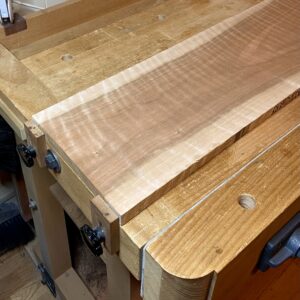
Pages
